Categories
Solar

Why Solar Panel Serial Number Traceability Is Critical for Warranty and Claims?

Somewhere on the aluminum frame of every solar panel shipped to a rooftop in Chennai, a utility-scale farm in Texas, or a community array in rural Germany, there is a small string of characters that carries an outsized responsibility: the module serial number. This alphanumeric code is not merely administrative for housekeeping. It is the single thread that connects a solar panel to its manufacturer, its production batch, its material origin, its performance guarantee, and, critically, its warranty rights. 

As global solar installations accelerate at a pace few anticipated, the serial number has never mattered more. In the first half of 2025 alone, the world added 380 GW of new solar capacity, a staggering 64% higher than the same period in 2024. The global solar panel market, valued at approximately USD 202.8 billion in 2025, is on course to exceed USD 700 billion by 2036. Behind every gigawatt of that installed capacity is a mountain of panels, each with a warranty stretching 10 to 25 years into the future. 

Managing warranty obligations and processing claims across billions of deployed panels without reliable serial-number traceability is not just operationally inefficient; it is also a significant business risk. It is financially catastrophic and, in an industry built on long-term trust, commercially devastating. This blog explores exactly why solar panel serial number traceability is critical for warranty and claims management, what the consequences of getting it wrong look like, and how forward-thinking manufacturers are building the systems to get it right. 

The Solar Warranty Landscape: What Is Actually at Stake 

Solar panel warranties are unlike most consumer product warranties. They are extraordinarily long-term commitments, tying manufacturers to obligations that can span three decades. The industry operates with two primary warranty types: 

Product Warranties (Equipment Warranties) 

These cover defects in materials and craft. The industry standard has shifted significantly upward, from 10–12-year product warranties once the baseline to premium manufacturers now routinely offering 25-year warranties. Covered failures include delamination, cracking, cell discoloration, junction box failures, and frame corrosion. When a covered defect occurs, the manufacturer must repair, replace, or financially compensate the owner. 

Performance (Power Output) Warranties 

These guarantee that a panel will maintain a minimum percentage of its original power output over its service life, typically with no more than 0.5% annual degradation, and most manufacturers promise at least 80–90% of rated output after 25 years. Some leading manufacturers, such as Maxeon, now offer 40-year performance warranties with degradation rates as low as 0.25% per year. When a panel falls short of the guaranteed threshold, the manufacturer is liable. 

$  MARKET EXPOSURE 

USD 202.8 billion solar panel market in 2025 

Projected to reach USD 700+ billion by 2036 at 13.2% CAGR — warranty liabilities scale proportionally (Research Nester, 2025) 

Every warranty claim begins with identifying the specific panel, making a reliable serial number essential for industry professionals to trust the warranty process and avoid operational risks. 

When claiming on your solar panel product warranty, you’ll always need to provide the serial number of each defective module, as well as photo evidence.” Sunsave Energy, Solar Panel Warranty Expert Guide 2026 

What a Solar Panel Serial Number Actually Contains 

A solar panel serial number is not arbitrary. Manufacturers encode a structured set of information into the alphanumeric sequence, typically including: 

  • Plant Code: Manufacturing plant or factory code 
  • Line ID: Production line identifier 
  • Date Code: Year and week of manufacture 
  • Product Code: Panel model and wattage class 
  • Batch Sequence: Sequential unit number within the batch 

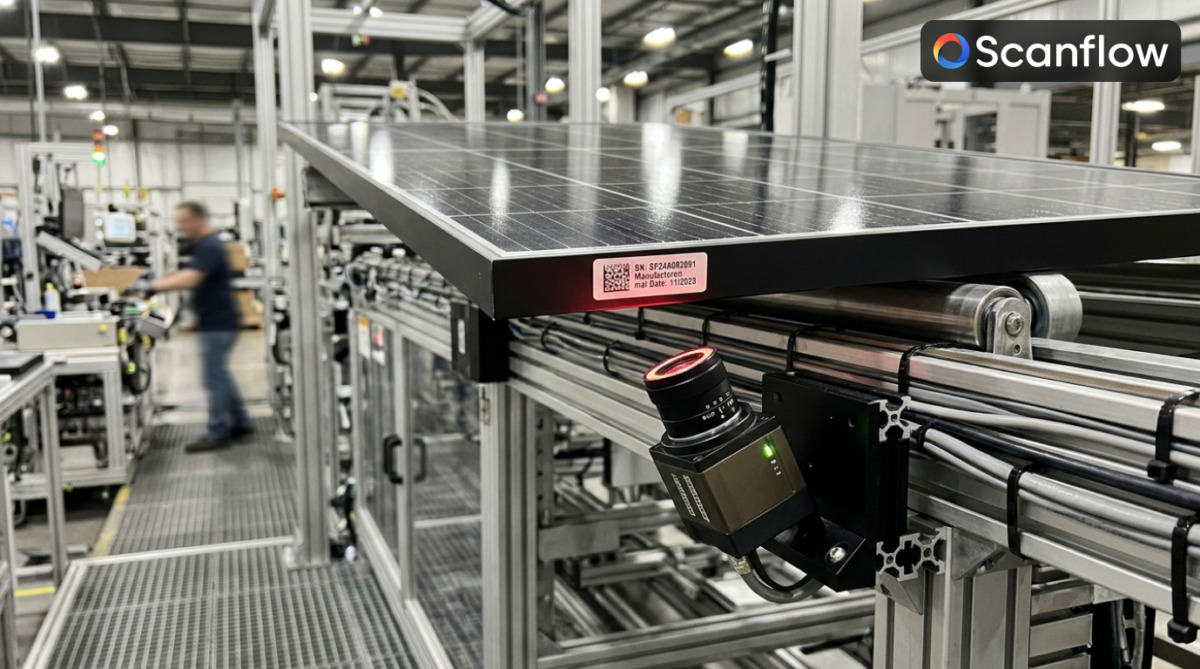
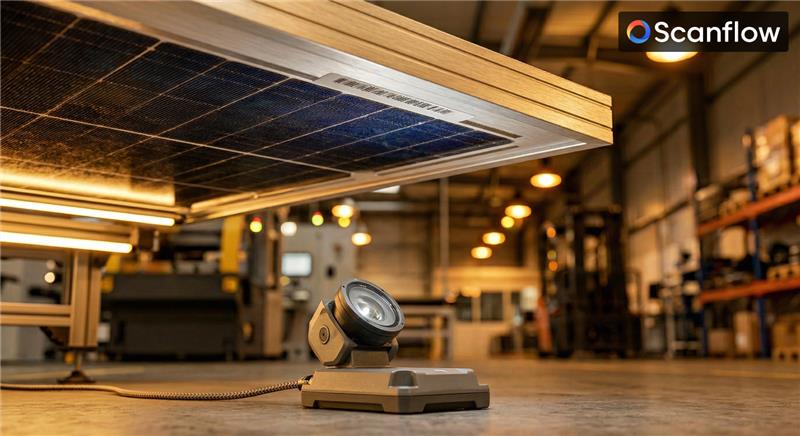
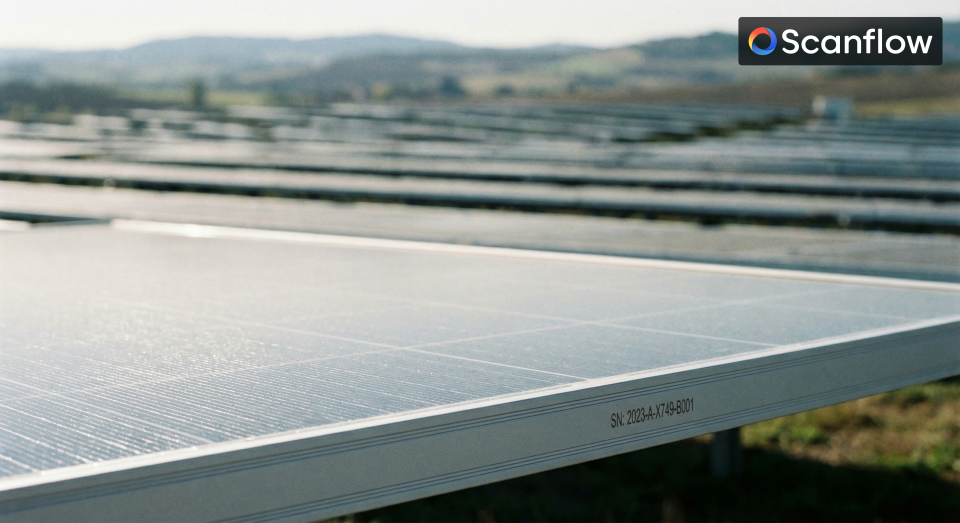
This encoded data makes the serial number the primary key for every record associated with that panel, from its raw silicon wafer through quality control test results, shipping manifests, installation records, monitoring data, and ultimately warranty claims. You can find the serial number printed on the panel’s rating plate label, which is on the back frame. Manufacturers increasingly encode it in a 2D QR code or Data Matrix barcode for easier machine-readable scanning. 

In a well-designed traceability system, scanning serial numbers at any stage reassures industry peers that panels’ histories are secure, encouraging confidence in digital solutions over unreliable manual records. 

📋  WARRANTY DOCUMENTATION FACT 

Serial numbers are mandatory for all warranty claims 

Successful warranty claims require serial numbers, performance data, installation records, and photos — typical processing takes 4–8 weeks (Solar Tech Online, 2025) 


Why Traceability Breaks Down and the Consequences When It Does 

The Manual Recording Problem 

Across large-scale solar deployments, utility farms running tens of thousands of panels, commercial rooftops with hundreds of modules, serial number capture is still often performed manually. Installers write numbers by hand onto paper commissioning forms or type them into spreadsheets from photographs. The error rate in manual transcription is significant: transposed characters, incomplete entries, and panels installed without any serial number record are common. A study of solar operations practices found that manually kept records frequently fail to hold up under audit, creating solar compliance exposure beyond just warranty implications. 

The Supply Chain Handoff Gap 

Solar panels change hands multiple times before installation: manufacturer to distributor, distributor to project developer, developer to EPC contractor, contractor to O&M operator. Each handoff introduces the risk that teams fail to transfer serial number records cleanly or use incompatible formats. As a result, the panel reaches the site with a serial number on its frame but without any connected digital history. 

The Bankruptcy Scenario 

The solar industry has learned painful lessons about what happens when warranty obligations outlive the companies that issued them. SunPower Corporation’s Chapter 11 bankruptcy filing in August 2024 was a stark reminder. The company had issued 25-year product warranties on panels it had installed across North America. When the business failed, the manufacturers of those components became directly liable for warranty fulfillment, provided they could identify, from serial numbers, exactly which panels were covered and whether they had been installed legitimately under SunPower programs. 

  INDUSTRY WARNING CASE 

SunPower filed for Chapter 11 bankruptcy on August 5, 2024 

Issued 25-year product warranties that will now outlast the company — component manufacturers are on the hook for decades of claims, relying entirely on serial number traceability (Warranty Week, 2024) 

 We’re watching a feared scenario play out in real time with SunPower Corp. The manufacturers that supplied the specific components are all on the hook for fulfilling those warranty claims, potentially for decades to come.” Warranty Week, Solar Power Warranty Expenses Report, October 2024 

The Counterfeit and Substitution Risk 

In a global market where panels are commoditized and price pressure is intense, counterfeit modules and the substitution of lower-spec panels for premium models are real risks. Without end-to-end serial number traceability tied to verified manufacturing data, it becomes extremely difficult for manufacturers to defend against fraudulent warranty claims on panels they never actually produced, or to identify genuine claims on panels that have been tampered with.  

How Does A Serial Number Traceability Directly Protect Warranty Rights 

  1. Proof of Manufacture and Authenticity

A serial number linked to a manufacturer’s production database is definitive proof of origin. It establishes that a specific panel was produced on a specific line, on a specific date, using specific materials and process parameters. This traceability is the foundation of every valid warranty claim and the first thing a manufacturer checks when a claim is submitted. Without it, neither party can verify authenticity. 

  1. Precise Batch Identification for Targeted Remediation

Not all defects affect all panels equally. A contamination event in a specific raw material batch, a process parameter excursion on a particular production line, or a quality issue tied to a specific shipment of encapsulant film may affect only panels within a narrow production window. Without serial number traceability mapped to production batches, a manufacturer facing defect reports cannot surgically identify and proactively remediate the at-risk population. Instead, they face the choice of ignoring the risk or issuing a blanket remediation, which is both financially and reputationally costly. 

🔬  NREL FINDING 

Just 5 in 10,000 modern solar panels fail a 0.05% rate 

Low individual failure rates mask significant batch-level clustering traceability enables targeted response rather than blanket remediation (NREL, via Solar.com) 


  1. Performance Degradation Verification

Performance warranty claims require establishing a panel’s baseline output at commissioning and comparing it to the current output after years of field operation. This entire process depends on continuous, serial-number-linked monitoring data. A panel without a clean serial number record cannot be baseline-validated, and a performance warranty claim without monitoring data tied to a specific serial number will almost certainly be denied or heavily disputed. 

  1. Insurance and Financing Compliance

Large solar portfolios are routinely used as collateral for project finance and are subject to specialist insurance coverage. Insurers and lenders are increasingly scrutinizing the quality of asset-traceability records as part of their underwriting and due diligence processes. Poor serial number traceability increases insurance claim costs and can affect credit terms on project debt, a material financial impact that extends well beyond the warranty department. 

As Scanflow’s operational research (2025) notes, insurers of large solar energy portfolios are beginning to factor asset-tracking quality into their risk models, evaluating the traceability of investments and whether issues have been identified and managed. This process means that good traceability directly translates into lower insurance premiums and a quantifiable commercial return. 

  1. Regulatory Compliance: UFLPA and Supply Chain Laws

Solar panel traceability is not only a warranty issue. The US Uyghur Forced Labor Prevention Act (UFLPA), the EU Forced Labor Regulation, and the Solar Stewardship Initiative’s Supply Chain Traceability Standard (published December 2024) all require manufacturers and importers to demonstrate verifiable supply chain traceability from raw materials to finished product. Serial numbers are the anchor point of this traceability—they connect a specific panel to its specific supply chain records. US Customs and Border Protection has begun issuing supply chain questionnaires to solar companies requesting extensive disclosures, marking an expansion of enforcement scrutiny. 

🌐  REGULATORY MILESTONE 

SSI Supply Chain Traceability Standard launched in December 2024 

Certification now mandatory for Solar Stewardship Initiative manufacturing members serial number traceability is the chain-of-custody anchor (Solar Stewardship Initiative, 2024) 

 The Real-World Cost of Poor Traceability: By the Numbers 

The financial consequences of inadequate serial number traceability are not hypothetical. They surface in every layer of the solar business: 

  • Claims Cost: Warranty accrual inflation: SolarEdge reported a claims rate of 17.0% in Q1 2024 among the highest in the industry. Difficulty in identifying and remediating issues at the batch level directly drives elevated claims rates. When you cannot surgically identify defective populations, your warranty reserve must cover the entire deployed base. 
  • Dispute Cost: Dispute resolution costs: A warranty claim without proper serial number documentation triggers manual investigation, site visits, and engineering reviews. Industry estimates put the average cost to process a disputed solar warranty claim significantly higher than a clean, documented claim, adding weeks to resolution timelines and substantial labor costs. 
  • Insurance Impact: Insurance premium uplift: Portfolios with poor asset traceability attract higher insurance premiums, with underwriters applying risk loadings for unverifiable asset condition. 
  • Compliance Cost: Regulatory fines and border detentions: Panels without verifiable supply chain traceability face detention at US and EU customs. The opportunity cost of detained inventory storage fees, financing costs, and project delays can far exceed the cost of implementing traceability in the first place. 

“Increased insurance claim costs, increased compliance risk, and reduced operational efficiency are the three compounding penalties of poor solar serial number traceability. The technology to avoid all three exists today.” Scanflow AI, Automate Solar Panel Serial Number Scanning, 2025  

Best Practices: Building a Robust Solar Panel Serial Number Traceability System 

Automated Scanning at Every Production Stage 

Manual serial number capture is the single largest source of traceability failure in solar manufacturing. Leading manufacturers are deploying automated AI-powered scanning systems at each production checkpoint, end of line, packaging, and warehouse dispatch to ensure that every panel’s serial number is machine-captured and immediately written to a central database. AI-based solar barcode and QR code readers achieve read rates above 99% and integrate directly with MES and ERP systems, eliminating the transcription errors endemic to manual processes. 

Digital Handoff Documentation 

Every transfer of custody, manufacturer to distributor, distributor to project developer, developer to installer, should be accompanied by a structured digital manifest that includes serial numbers for every panel in the shipment. Cloud-based solar asset management platforms enable instantaneous serial number verification at each handoff point, creating an auditable chain of custody that survives company changes, personnel turnover, and even manufacturer insolvency. 

Field Scanning Tools for Installers 

Mobile SDK-based scanning tools that enable field technicians to scan serial numbers directly from panel labels with a smartphone camera, with results automatically synced to a cloud asset register, have dramatically reduced the friction of installation-time serial number capture. Zeitview’s Solar Insights platform, for example, specifically enables field technicians to scan and capture serial numbers from PV modules affected by anomalies, directly accelerating warranty claim initiation. 

Linked Performance Monitoring 

The most valuable serial-number traceability systems link each module’s identifier to its real-time performance-monitoring data. When a panel’s output drops below warranted thresholds, the monitoring system can automatically flag the anomaly, cross-reference the serial number to identify the production batch and installation date, and pre-populate a draft warranty claim, reducing claim initiation time from weeks to hours. 

End-of-Life and Recycling Traceability 

Regulatory obligations increasingly extend to solar panel end-of-life. The EU, US, and Australian jurisdictions all have, or are developing, regulations requiring traceable records of solar panels for recycling and disposal. Serial number traceability maintained from manufacture through operation ensures compliance at disposal. It supports the recovery of valuable materials (silver, silicon, glass) with verified provenance that can command premium pricing in recycled materials markets. 

The Future of Solar Panel Traceability: What’s Coming 

Blockchain-Anchored Serial Number Records 

Several manufacturers and industry consortia are using blockchain to build serial-number registries that track each panel’s production records, ownership transfers, and performance data on a distributed ledger. This practice makes traceability records tamper-proof and survivable, even if any individual company in the chain ceases to exist, directly addressing the bankruptcy scenario that has plagued solar warranty management. 

Digital Product Passports 

The EU’s forthcoming Digital Product Passport regulation, which will apply to batteries and also expand to solar modules, will mandate that every product carry a machine-readable digital record accessible throughout its lifecycle. Serial numbers will be the keys to these passports, making traceability infrastructure not a competitive advantage but a regulatory baseline. 

AI-Predictive Warranty Modeling 

The convergence of serial-number-linked performance data with AI predictive analytics is enabling manufacturers to model warranty risk at the individual panel level, identifying units likely to fail before they do, enabling proactive replacement under warranty rather than reactive claims handling. This process transforms serial number traceability from a record-keeping function into a proactive risk management capability. 

🚀  MARKET TRAJECTORY 

380 GW of solar capacity added globally in H1 2025 alone 

64% higher than H1 2024 the traceability challenge scales with every gigawatt installed (Ember Energy, September 2025) 

Conclusion: Traceability Is Not Overhead, It Is the Warranty 

The solar industry is in a period of extraordinary growth, and with that growth comes an expanding universe of warranty obligations. A solar panel manufactured in 2025 may carry a 25-year performance warranty that stretches to 2050. The manufacturer that issued that warranty and the serial-number system they use to manage it will undergo testing over decades of field operation, multiple ownership changes, regulatory shifts, and technological evolution. 

Serial number traceability is not a back-office administrative function. It is the operational backbone of every warranty commitment a solar manufacturer makes. It is the mechanism that enables targeted recall and remediation rather than costly blanket action. It is the evidence trail that validates legitimate claims and defends against fraudulent ones. It is the compliance infrastructure that keeps panels moving through international supply chains. And increasingly, it is a metric that insurers, lenders, and regulators use to assess the professionalism and trustworthiness of a solar business. 

The manufacturers who invest in robust, automated, end-to-end serial number traceability today are not spending money on overhead. They are laying the foundation for every warranty promise they make and protecting the long-term commercial relationships those promises represent. 

Key Takeaways 

  • Solar panel warranties span 10–25+ years. Serial number traceability is the only mechanism that enables those commitments to be manageable at scale. 
  • You must include a serial number with every warranty claim. Without clean traceability records, the team will delay legitimate claims and struggle to resolve disputes efficiently. 
  • The SunPower bankruptcy (2024) demonstrated the catastrophic consequences of warranty obligations outliving the warranty issuer and the critical role serial numbers play in identifying liability. 
  • Regulators in the US, EU, and Australia are tightening supply chain traceability requirements; serial numbers are the audit anchor. 
  • Automated scanning, digital handoff documentation, and linked performance monitoring are the building blocks of a world-class solar traceability system. 
  • The 380 GW installed in H1 2025 alone represents a generation of panels that will be filing warranty claims through the 2040s. The time to build a robust traceability infrastructure is now. 
Categories
Solar

How AI Scanning Helps Solar Companies Pass Audits Faster?

Solar is no longer a niche source of power. By 2025, global solar PV installations reached around 647 GW in a single year, taking cumulative capacity well beyond 2 TW and making solar the backbone of new power generation worldwide. As portfolios scale into hundreds of megawatts and gigawatts across multiple sites, the volume of operational data explodes: panel serial numbers, installation records, warranty details, inspection logs, maintenance reports, incident tickets, and more.  

When an audit arrives whether from investors, regulators, insurers, or certification bodies operations teams face the same bottleneck: quickly collecting and verifying asset data at scale. For large solar farms with hundreds of thousands or even millions of panels, manually locating and validating asset records can take days or even weeks, tying up field teams and back-office staff.  

AI-powered scanning technology is changing that equation. By automatically identifying and recording solar panel information in the field using computer vision and OCR, AI scanning builds confidence in data accuracy and asset traceability, so teams can feel assured about audit readiness and long-term asset integrity.  

Why solar audits are on the rise? 

As solar becomes a core part of national energy systems and institutional portfolios, scrutiny around how these assets is documented, operated, and valued is increasing. Several types of audits are now common across utility-scale and C&I solar portfolios.  

  • Compliance audits: Government agencies and regulators require proof that solar assets meet installation, electrical, and safety standards, often aligned to grid codes and local regulations.  
  • Warranty validation: Manufacturers and OEMs demand accurate serial numbers and installation records before honoring warranty claims, especially as modules become larger, thinner, and more exposed to extreme weather events.  
  • Investor and lender audits: Financial stakeholders routinely audit solar assets to verify that the physical inventory matches financed assets and that performance aligns with expected yield models.  
  • Insurance inspections: Insurers increasingly request detailed asset documentation and evidence of risk controls (for hail, fire, and storm events) before writing or renewing policies.  

Across all these scenarios, accurate, auditable asset identification is nonnegotiable. As capacity additions are expected to average hundreds of gigawatts per year through 2035, solar players that still rely on clipboards and spreadsheets risk falling behind.  

The Problem: Manual Asset Verification 

In many projects, panel data is still captured manually during installation or commissioning and then spread across spreadsheets, PDFs, and siloed systems. Over time, this data becomes hard to verify and even harder to defend in an audit.   

Common pain points include:  

  • Missing, faded, or unreadable serial numbers 
  • Mismatched or outdated panel inventory records 
  • Timeconsuming manual walkdowns and inspections 
  • Incomplete or inconsistent installation documentation across sites 
  • Limited sitelevel traceability between procurement, installation, and operations 

When auditors ask for proof, teams often must physically inspect panels, photograph nameplates, and crosscheck them against multiple databases a process that can take weeks on large sites and often requires repeated truck rolls. As portfolios grow, this manual approach simply does not scale.  

How AI Scanning Works in Solar Operations? 

AI scanning uses computer vision and machine learning to detect and scan solar panel information automatically from images or video feeds. Instead of manually entering serial numbers, technicians or drone pilots scan modules using a mobile device, drone camera, or fixed imaging system integrated with AI software.  

A typical workflow looks like this:  

  1. Detect the PV module in the image or video frame. 
  2. Locate the serial number or nameplate region. 
  3. Extract the serial number and key metadata using OCR and AI-based text enhancement. 
  4. Validate the extracted data, flagging lowconfidence reads for human review. 
  5. Automatically match the module to the site’s digital twin or asset management system. 

The result is fast, repeatable, and accurate asset identification at module level, with standardized workflows and short turnaround times even on multihundredMW sites. When combined with thermography and performance analytics, serial number scans become a powerful foundation for modulelevel traceability and proactive maintenance.  

Key Ways AI Scanning Accelerates Solar Audits 

  1. Instant Panel Identification at Scale 

AI scanning lets technicians or drones capture panel information in seconds instead of manually locating and typing serial numbers into spreadsheets. Dronebased serial number scanning has already proven it can cover large solar fields quickly by capturing highresolution images across entire arrays and automatically extracting module IDs in bulk.  

For audit teams, this means what used to take days of groundbased checks can be compressed into hours, with structured, exportable datasets ready for auditors.  

  1. AlwaysCurrent Digital Asset Records

Every scan automatically updates the asset database, creating a continuously updated digital record of each module, including:  

  • Serial number and manufacturer details 
  • Physical location within the string, block, and site 
  • Installation and commissioning dates 
  • Maintenance and anomaly history 

This turns your plant into a living digital twin where asset changes repowering, replacements, relocations are captured in near real time. When auditors ask for modulelevel documentation, teams can generate reports instantly instead of digging through legacy files.  

  1. EndToEnd Chain of Custody 

Auditors, OEMs, and buyers want proof that the panels installed in the field are exactly the ones that were procured, shipped, and financed. AI scanning creates a traceable digital chain of custody from factory to field and through each stage of operations.  

Some manufacturers and consortia are even piloting blockchainbased provenance records, where serial numbers are linked to immutable histories accessible to all stakeholders in the value chain. When those chainofcustody records are backed by AIverified serial number scans, audit discussions become faster and far less contentious.  

Robust data security and access controls are essential, ensuring that sensitive asset information remains protected while still being easily auditable for authorized parties.  

  1. Faster, Safer Field Inspections

Manual inspections across widearea solar farms are laborintensive, costly, and often unsafe in harsh environments. AIenabled robots and drones allow teams to capture panel and serial data rapidly while walking rows, driving autonomous platforms, or flying programmed drone missions.  

Large installations that once required days of verification now typically take only hours, with standardized flight plans, automated image processing, and readytouse audit exports. This frees field teams to focus on highervalue tasks such as diagnosing issues instead of reading nameplates in the sun.  

  1. Less Human Error, More Confidence

Manual serial number recording is prone to errors especially when numbers are long, small, or partially obscured. AI scanning reduces these risks by extracting data directly from images, using ML models to enhance lowcontrast text, and applying validation rules to flag anomalies.  

For compliance and financial audits, fewer errors translate directly into fewer disputes, fewer repeat site visits, and higher confidence among regulators, investors, and insurers.  

Beyond Audits: Impact On Solar Asset Management 

While audits are often the trigger for change, AI scanning delivers ongoing value across the entire asset lifecycle.  

Solar companies gain: 

  • Better visibility and traceability of installed assets at module level 
  • Faster troubleshooting, as performance anomalies can be linked to specific panel IDs and manufacturers 
  • Simplified warranty and insurance claims using precise serialtagged incident reports 
  • Improved inventory accuracy and repowering planning, especially when sites are upgraded or reconfigured 

As AIbased O&M becomes a central pillar of asset management, operators are shifting from reactive walkdowns to datadriven decisionmaking, using fleetwide dashboards and predictive models rather than manual reports. AI serial number scanning is a foundational building block in digital evolution.  

RealWorld Scenarios Where AI Scanning Shines 

AI scanning is particularly valuable in highcomplexity, highstakes solar environments.  

  • Utilityscale solar farms
    With hundreds of thousands or millions of modules, verifying serial numbers manually is nearly impossible at audit speed. AIdriven drone scanning enables endtoend documentation without interrupting plant operations.  
  • Solar repowering and retrofits
    When modules are replaced or upgraded, AI scanning documents exactly which panels were swapped, where they were installed, and how performance changes over time.  
  • Warranty and insurance claim investigations
    After hail or storm damage, AI scanning helps technicians quickly identify affected modules, capture their serial numbers, and export structured claim reports that align with OEM and insurer requirements.  
  • Asset transfers and portfolio acquisitions
    During M&A or refinancing, buyers and lenders demand accurate, verifiable asset registers. AIbased serial number scanning provides a fast way to confirm that what is on the ground matches what is on the balance sheet.  

In each of these cases, AI scanning reduces friction between field teams, finance, and external stakeholders, making the asset base easier to trust and transact. 

Preparing Solar Operations for Faster, Cleaner Audits 

To get ready for the next wave of audits and to unlock the broader benefits of digital O&M solar companies should focus on strengthening asset visibility and data integrity.  

Priority actions include: 

  • Digitize all solar asset records: Consolidate panel inventories, drawings, warranty documents, and inspection logs into a centralized, searchable system or digital twin.  
  • Implement AIbased serial number capture: Deploy AI scanning tools (fieldbased, dronebased, or both) to standardize module identification across new builds and existing sites.  
  • Standardize documentation and workflows: Define consistent data models, naming conventions, and QA checks for how serial data and inspection findings are captured and stored.  
  • Integrate scanning with asset management platforms: Connect AI scanning outputs directly into CMMS, SCADA, monitoring, and asset management systems so data flows automatically into the tools your teams already use.  

Companies that invest in these capabilities now will find audits far less disruptive to operations, and they will also be better positioned to scale portfolios, secure financing, and maximize longterm asset value.  

Final Thoughts 

As global solar capacity races toward multiple terawatts and annual additions stay in the hundreds of gigawatts, traditional manual asset verification is no longer sustainable. AIpowered scanning offers a faster, more reliable way to capture solar panel data, maintain accurate asset records, and prove asset integrity to demanding stakeholders.  

By automating module identification, strengthening the digital chain of custody, and integrating with modern asset management platforms, solar companies can dramatically cut the time and effort required to prepare for audits while laying the foundation for AIdriven O&M and smarter, more profitable solar portfolios.  

Categories
Solar

Best Practices for Solar Panel Barcode Labeling & Scanning

A barcode label might seem like a small detail, but emphasizing its durability is crsucial because it underpins warranty claims, maintenance records, and performance analysis over the panel’s 25–30-year lifespan. When labels fail, the consequences are costly: denied warranty claims, lost asset records, and O&M teams working in the dark.  

This guide covers what actually works for solar panel barcode labeling based on field experience from manufacturers, installers, and asset managers. 

WHY BARCODE QUALITY MATTERS 

Poor barcode labeling creates five major problems in solar panel identification.

  • Warranty denials. No readable serial number = no warranty coverage. A $400 panel replacement becomes your cost. 
  • Compliance gaps. EU and California regulations increasingly require panel-level traceability for recycling. 
  • O&M inefficiency. Technicians can’t retrieve service history without serial numbers, resulting in wasted site visits. 
  • Bad analytics. Panel-level monitoring breaks when you can’t map solar serial numbers to performance data. 
  • Lower resale value. Used panels without verifiable history sell for 15-25% less, if they sell at all. 

WHAT LABEL MATERIALS ACTUALLY LAST OUTDOORS 

Most barcode failures come from choosing the wrong label material. Here’s what works and what doesn’t: 

DON’T USE: Paper Adhesive Labels 

Standard paper labels with acrylic adhesive fail within 3-7 years outdoors. UV exposure makes them brittle, moisture kills the adhesive, and thermal cycling accelerates both. These are fine for indoor logistics but completely unsuited to solar installations. 

 FIELD REALITY: In a 2017 ground-mount installation audited in 2024, 60% of paper labels were unreadable or missing. The operator spent $150,000 re-labeling 25,000 panels. 

 MINIMUM STANDARD: Polyester + UV Laminate 

Polyester labels with UV-resistant overlaminate are the minimum for outdoor use. They last 10-15 years in most climates. Specify silicone-based adhesive rated for -40°C to +150°C.  

Cost: $0.50-$1.00 per label (5-10x more than paper, but worth it) 

  • BEST: Anodized Aluminum or Laser-Etched  

For 25–30-year durability, use anodized aluminium labels (riveted or high-temp adhesive) or laser-etched codes directly on the frame or glass. These survive the full lifespan of the panel without degradation. 

Cost: $3-$8 per panel (higher upfront, but eliminates re-labeling costs later) 

  • PREMIUM: RFID Tags 

Embedded RFID tags in junction boxes are readable through dirt and soiling, don’t require line-of-sight, and store additional data beyond serial numbers. They cost $5-$12 per panel but enable automated drone scanning and batch reads. 

 QUICK COMPARISON: LABEL OPTIONS 

Label Type Outdoor LifespanCost Per Panel
Paper adhesive3–7 years$0.10–$0.25
Polyester + UV10–15 years$0.50–$1.00
Anodised aluminum25–30 years$3.00–$6.00
Laser-etched30+ years$4.00–$8.00
RFID embedded20–25 years$5.00–$12.00

WHAT BARCODE TYPE TO USE 

 Use QR codes (2D barcodes) instead of traditional linear barcodes. Here’s why: 

 By choosing QR codes with built-in error correction, technicians can feel assured that even when labels are dirtied or scratched, the codes remain readable, supporting their confidence in efficient scanning during installation and maintenance. 

Traditional linear barcodes (such as Code 128) lack error correction. Any damage makes them completely unreadable. 

BEST PRACTICE: Print both a QR code and a traditional barcode on the same label for redundancy. The QR code handles long-term durability, while the linear barcode works with older warehouse scanners during shipping. 

WHERE TO PLACE LABELS ON PANELS 

Label placement affects both scanning efficiency and durability. 

  • RECOMMENDED: Frame-Mounted (Rear Short Edge) 
  • Place on the rear-facing short edge near the junction box 
  • Avoid upward-facing surfaces that collect water and debris 
  • Keep clear of cable routing and junction box covers 
  • Orient the barcode to read correctly on installation of the panel 

 CONSIDER: Redundant Labeling 

For critical installations, place labels in two locations: one on the frame and one laser-etched on the back sheet. This approach provides backup if reading the primary label fails. The extra cost is minimal compared to losing traceability on a 25-year asset. 

SCANNER TECHNOLOGY: WHAT WORKS IN THE FIELD 

  • BEST FOR FIELD WORK: Handheld Imager Scanners 

 Camera-based imager scanners read QR codes, handle damaged labels, and work reliably in bright sunlight. Look for ruggedised models with Bluetooth, IP67 sealing, and long battery life. Pair with tablets running your asset management app. 

 Cost: $300-$800 per scanner  

  • BUDGET OPTION: Smartphone Camera Scanning 

Modern smartphones can scan QR codes with their cameras. Works for small installations or occasional scanning, but dedicated scanners are faster and more reliable for high-volume commissioning work. 

  • LARGE SITES: Drone-Based Scanning 

 Drone-mounted cameras with computer vision can scan panel labels from the air, achieving 85-95% read rates on well-maintained labels. This technology is rapidly maturing and in use by large asset managers for annual audits. 

CONNECTING SCANNED DATA TO YOUR SYSTEMS 

 Scanning is only valuable if the data flows into your asset management system automatically, with no spreadsheets or manual re-entry. 

  • REAL-TIME API INTEGRATION  

Your scanning app should push data directly to your CMMS or asset management platform via API. This process enables immediate validation: the app can check whether a serial number exists in the manufacturer’s database, whether it has already commissioned elsewhere, or whether it matches the expected panel model. 

Platforms with APIs: Salesforce, SAP PM, IBM Maximo, SolarEdge, and most modern O&M platforms 

  • OFFLINE-FIRST ARCHITECTURE 

 Solar sites often have poor connectivity. Your scanning app must work offline, queuing scanned records locally and syncing when connectivity returns. This process ensures field teams never lose data. 

  • VALIDATE AT POINT OF SCAN 

 Catch errors immediately by validating each scan against: 

  • Manufacturer product database (is this serial number real?)
  • Asset database (has this panel been logged elsewhere?) 
  • Expected specs for this installation location 
  • GPS coordinates (is this scan geographically consistent?) 

 FIELD WORKFLOWS THAT KEEP DATA CLEAN  

DURING INSTALLATION: Capture Everything Once  

When scanning a panel during commissioning, capture a complete record in a single transaction: 

  • Serial number + manufacturer product code 
  • GPS coordinates (latitude, longitude, elevation) 
  • String and inverter assignment 
  • Installation date + installer certification 
  • Photo of label placement and panel condition  

Design your mobile app to enforce this workflow with validation checks that prevent incomplete records. 

 DURING O&M: Log Every Touch 

Document every panel interaction: scan the barcode and log the activity (inspection, cleaning, testing, repair, replacement). This process creates a service history that’s invaluable for warranty claims and predictive maintenance. 

ANNUAL AUDITS: Verify Physical Reality  

Conduct annual physical audits in which every panel is scanned and reconciled with system records. This method catches labeling failures before they become critical and verifies your database still matches reality. 

THREE MOST COMMON BARCODE FAILURES (AND HOW TO PREVENT THEM) 

  1. LABEL ADHESIVE BREAKDOWN 

 Symptom: Labels fall off within 5-8 years
Cause: Standard acrylic adhesive fails under UV and heat
Fix: Use silicone adhesive or mechanically attached labels (rivets) 

2. UV FADE & PRINT DEGRADATION 

 Symptom: Label stays attached, but barcode becomes unreadable
Cause: UV breaks down ink and substrate
Fix: Use UV-stabilised laminate, laser printing, or laser-etched codes 

3. DATA SILOES & INTEGRATION GAPS 

 Symptom: Multiple conflicting databases with no authoritative source
Cause: Manual data entry and spreadsheet reconciliation
Fix: Establish a single system of record, integrate all scanning via API 

 THE BUSINESS CASE: WHY IT’S WORTH THE INVESTMENT  

Upgrading from basic labels to durable labeling costs more upfront but pays back many times over: 

COST COMPARISON (10 MW installation, 25,000 panels) 

  • Paper labels: $2,500-$6,000 total → Need replacement in 5-7 years 
  • Polyester + UV: $12,500-$25,000 total → Last 10-15 years 
  • Anodized aluminum: $75,000-$150,000 → Last full panel lifetime 

 VALUE RECOVERY 

  • Warranty claims: 85-95% acceptance with good records vs 50-60% without. On a large portfolio, this is hundreds of thousands in avoided costs. 
  • O&M efficiency: 30-50% less time per service visit with instant access to panel history 
  • Avoided re-labeling: Re-labeling 25,000 panels costs $125K-$375K far more than durable labels upfront  
  • Resale value: Panels with verifiable history sell for 15-25% more in secondary markets 

 Bottom line: Spending an extra $1-$5 per panel on durable labeling pays for itself many times over. 

 QUICK IMPLEMENTATION CHECKLIST 

  • Label material rated for 25+ years outdoors (polyester minimum, anodised/laser-etched preferred) 
  • UV-stabilized overlaminate or inherently UV-resistant substrate 
  • Silicone-based adhesive for high-temperature environments 
  • QR code for error correction and durability 
  • Dual encoding (QR code + linear barcode) for redundancy 
  • Scanner hardware capable of reading QR codes in sunlight 
  • Mobile app integrated via API to the asset management system 
  • Offline-first app architecture for field sites 
  • Real-time validation at the point of scan 
  • Commissioning workflow captures GPS, string assignment, and photos 
  • Annual audit program to verify label condition 

FINAL TAKEAWAY 

 Barcode labeling isn’t just a technical detail it’s the infrastructure that enables warranty claims, O&M efficiency, performance analytics, and regulatory compliance over a 25-30-year asset lifetime. 

The technology to get this right is mature and accessible. The challenge is organizational discipline: specifying the right materials, training field teams on consistent workflows, maintaining system integration, and enforcing data quality.

Invest in durable labels and integrated scanning workflows now, and your future warranty claims, O&M teams, and asset managers will thank you. 

Categories
Solar

How AI Is Transforming Solar Panel Identification & Asset Management

There are now more than 5 million solar installations across the United States alone, and that figure may triple by 2034. Globally, solar PV capacity surpassed 1,200 gigawatts in 2024, with another 655 GW of new installations expected by the end of 2025. That is a staggering amount of infrastructure to track, inspect, and maintain. 

For much of the industry’s history, operations and maintenance (O&M) teams have relied on scheduled walkthroughs, paper-based records, and gut instinct. Technicians would physically walk row after row of panels, clipboard in hand, hoping to catch problems before they snowballed. It worked barely when solar farms were smaller. But it simply doesn’t scale. 

Artificial intelligence is changing that. From drone-based serial number scanning to machine learning models that predict inverter failure weeks in advance, AI is quietly becoming the backbone of modern solar asset management. To help industry professionals understand its practical application, this development is not a distant future scenario. It is happening today on utility-scale farms across Europe, Australia, and North America, and the economics are compelling enough that smaller operators are paying close attention. 

The Core Problem: Scale, Complexity, and Hidden Losses 

Before exploring what, AI can do, it helps to understand what solar operators are actually up against. 

A utility-scale solar farm might house 200,000 individual panels spread across hundreds of acres. Each of those panels can develop its own unique problems of microcracks from hail, soiling from bird droppings, hotspots from cell degradation, or shading from a branch that grew into a sight line. Any single underperforming panel might lose only a fraction of a percent of total output, but multiply that across thousands of modules, and the financial impact becomes significant quickly. 

Traditional inspection methods are slow and expensive. Unplanned downtime across industrial operations costs an estimated $50 billion annually, and solar is not immune to it. Manual inspection crews cannot feasibly survey an entire large-scale installation more than once or twice per year, which means problems often go undetected for months. 

Reactive maintenance, fixing things after they break, and even scheduled preventive maintenance, both leave money on the table. The emerging paradigm, driven by AI, is predictive maintenance: identifying anomalies before they become failures, dispatching crews only when and where needed, and keeping panels producing at peak capacity throughout their service life. 

AI Solar Panel Identification: Knowing What You Have 

One of the most overlooked challenges in solar asset management is surprisingly basic: operators often don’t have accurate records of the installed panels, specifically by type and location. Addressing this can give asset managers a sense of control and confidence in their operations. 

This scenario matters more than it might seem. If a panel needs a warranty service, you need its serial number. If a string of panels is underperforming, you need to know exactly which units are involved. If a module exhibits early degradation, you want to cross-reference its manufacturing batch against similar failures elsewhere in your portfolio. 

The Manual Tracking Problem 

Historically, installers manually logged solar panel serial numbers during installation. Workers would scan barcodes or transcribe alphanumeric strings one by one, then match them to position maps in a process prone to transcription errors, sequence mix-ups, and gaps in documentation. One drone-based inspection company found a 30% error rate in customer documentation created through manual tracking methods. That’s not an edge case; it’s an industry-wide problem. 

Drone-Based AI Serial Number Scanning 

The solution that’s gaining ground fast is drone-mounted computer vision. Drones equipped with high-resolution cameras fly in a systematic grid pattern over solar arrays, capturing images of every module. AI-powered image recognition software then automatically detects and extracts serial numbers from the panel labels, linking each identifier to its GPS-mapped position within the asset management platform. However, challenges such as weather conditions, label degradation, and initial setup costs can impact effectiveness, which industry professionals should consider when planning AI integration. 

Current drone scanning systems achieve read rates of 85–95% even under real-world conditions where labels may be affected by weather, soiling, or partial shading. The remaining unreadable panels are flagged for targeted manual verification, dramatically reducing the total labor required. What once took weeks of ground-level work can now be completed in a single day, even for a large installation. 

Technology is moving quickly. Several large independent power producers (IPPs) and asset managers already use drone scanning for annual portfolio inventory audits. RFID tags, either attached to or embedded in panel frames, are becoming increasingly common among major manufacturers, adding another layer of machine-readable identification alongside traditional solar barcodes. 

The Regulatory Tailwind 

The European Commission’s Digital Product Passport initiative is adding urgency to this shift. Forthcoming regulations will mandate that every solar panel carries machine-readable identifiers linked directly to lifecycle documentation covering everything from manufacturing provenance to end-of-life recycling records. Industry players who adapt now will feel proactive and ahead of compliance requirements. 

For asset managers, getting your serial number tracking right now is not just an operational nicety; it’s increasingly a compliance requirement. 

Computer Vision and AI-Powered Fault Detection 

Beyond identification, AI is reshaping how operators find and diagnose panel defects. The traditional approach, walking the rows, eyeballing panels, hoping to spot discoloration or cracks, is giving way to a far more sophisticated system. 

Thermal Imaging + Machine Learning 

The most powerful tool in the AI inspection arsenal is thermal imaging combined with machine learning analysis. Solar panels generate heat unevenly when they malfunction. A cracked cell, a failed bypass diode, or a hotspot caused by soiling will all produce characteristic thermal signatures that differ from healthy panels. Infrared cameras mounted on drones or fixed monitoring systems capture these heat patterns across entire arrays. 

Machine learning algorithms trained on large defect datasets can then classify what they see with remarkable precision. They distinguish between hotspots caused by soiling (which need cleaning) versus those caused by cell degradation (which may warrant replacement). They can flag panels exhibiting early warning signs before performance actually drops. 

In one documented case study, drone-based thermal inspections helped a solar operator avoid an estimated $296,000 in annual revenue loss by catching degradation early enough to intervene. 

Soiling Detection and Cleaning Optimization 

Dust and biological soiling particularly bird droppings are among the most persistent performance killers in solar O&M. A heavily soiled panel can lose 30% or more of its energy output, and bird droppings create especially damaging hotspot conditions because of their resistance to natural cleaning by rain. 

AI-assisted soiling detection using drone-captured RGB imagery is maturing into a commercial solution. Researchers have developed custom architectures, such as SDS-YOLO (Soiling Detection System, based on the YOLOv5 framework), specifically trained to identify and localize soiling patterns at the module level in aerial images. The system distinguishes between dust which may be manageable without immediate intervention and bird droppings, which warrant urgent cleaning. 

By knowing exactly which panels are soiled and how severely, operators can move away from scheduled blanket cleaning toward targeted, data-driven cleaning schedules. The energy savings and reduced water usage are significant at scale. 

End-to-End AI Inspection Platforms 

Companies like Aispect.ai, Raptor Maps, and SmartHelio are building end-to-end platforms that ingest drone imagery, apply deep learning defect detection, and surface actionable work orders for maintenance crews all within a single interface. Rather than having a technician manually interpret thermal images, the AI performs classification and priority ranking, directing human attention to the issues that matter most. 

These platforms are increasingly integrating robotics as well. AI-controlled autonomous ground robots are being developed for cleaning and targeted maintenance, guided by the same AI systems that detect the problems in the first place. Research from 2025 demonstrated robotic cleaning systems that achieved 91.3% cleaning efficiency, reducing dust density dramatically and restoring up to 31% of energy output on heavily soiled panels. 

Predictive Maintenance: From Reactive to Proactive Solar O&M 

The third major frontier of AI in solar asset management is predictive maintenance using machine learning to anticipate equipment failures before they happen. 

Inverter Diagnostics 

Inverters are the workhorses of any solar installation, and they’re among the most failure-prone components. A failed inverter can take an entire string of panels offline, and the losses accumulate with every hour of downtime. Machine learning algorithms are being trained on inverter error logs, operational telemetry, and environmental data to predict fault conditions days or even weeks before failure occurs. 

This approach matters because it changes how O&M teams operate. Instead of dispatching a technician in response to an alarm, operators can schedule preventive service during planned maintenance windows reducing emergency call-outs, extending equipment life, and keeping energy production consistent. 

Degradation Tracking and Module Performance Analysis 

All solar panels degrade over time. Most manufacturers warrant panels against dropping below 80% of rated output over their 25-year lifespan. But degradation is not uniform. Some panels degrade faster than others due to manufacturing variation, installation conditions, or site-specific environmental stressors. 

AI applied to time-series performance data can track individual panel degradation rates, identify outliers that are declining faster than expected, and help asset managers make informed replacement decisions. More sophisticated analysis can even identify why a panel is degrading distinguishing between shading from a nearby obstruction, cell degradation, or connection issues providing context that a simple performance alert cannot. 

Research projects aggregating data from thousands of solar plants across multiple companies are building the training datasets needed to make these models genuinely predictive rather than merely descriptive. The result is a shift from looking at historical averages to getting forward-looking insight into which panels, strings, or inverters are likely to need attention next. 

AI-Powered Weather and Output Forecasting 

Predictive maintenance extends beyond hardware failure. AI is also transforming how operators forecast energy output a capability that matters for grid management, energy trading, and financial planning. 

Hybrid models combining physics-based simulations with machine learning trained on satellite imagery, sky-camera data, and historical plant telemetry can now predict solar irradiance and energy generation up to 48 hours ahead with significantly better accuracy than traditional weather forecasting methods. Studies have found that AI forecasting models reduce forecast error by more than 27% compared to conventional numerical weather prediction approaches. 

For asset managers running large portfolios, that forecasting accuracy translates directly into better contract performance, reduced balancing costs, and stronger relationships with offtake partners. 

The Business Case: What the Numbers Say 

The ROI argument for AI in solar asset management is becoming hard to ignore: 

  • Predictive maintenance can increase productivity by 25%, reduce equipment breakdowns by 70%, and cut maintenance costs by 25%, according to industry analysis. 
  • AI-powered inspection and fault detection can reduce maintenance costs by up to 40% at scale. 
  • Automated drone-based serial number audits correct documentation error rates that manual processes leave as high as 30% errors that directly affect warranty claim processing and portfolio valuations. 
  • Early fault detection visibility to prevent hundreds of thousands of dollars in annual revenue loss at individual sites. 

The global investment signal is clear, too. The energy sector has seen more than $13 billion invested in AI technologies, with over 50 identified applications across the solar value chain. The technology is no longer experimental it’s becoming a competitive differentiator. 

Who’s Building the Future of Solar AI 

The ecosystem developing AI tools for solar asset management includes a mix of established energy software companies and well-funded newcomers: 

SmartHelio (an EPFL spin-off) has built a physics-informed AI platform for predictive analytics and automated fault detection across utility, commercial, and residential solar installations without requiring additional hardware. 

FairFleet has made a name for itself specifically in drone-based PV serial number scanning and asset documentation, operating across more than 70 countries and integrating results directly into asset management platforms. 

Proximal Energy has partnered with major developers, including Excelsior Energy Capital, to deliver AI-powered asset management for utility-scale solar, including an AI “agent” approach to performance optimization. 

Aispect.ai, launched in early 2025, offers computer vision inspection tools that identify cracks, soiling, and misalignment from drone imagery, with plans to expand the technology into agriculture, security, and manufacturing. 

Raptor Maps has built one of the most established drone-inspection platforms in the industry, with documented partnerships with major drone manufacturers and a track record on large installations. 

What This Means for Solar Asset Managers Today 

If you manage a solar portfolio whether a single commercial rooftop installation or a multi-site utility portfolio the practical takeaways from the AI revolution in this space are fairly concrete: 

Start with data integrity. AI is only as good as the data it learns from. If your panel-level serial number records are incomplete or inaccurate, addressing that foundation potentially with AI-assisted drone scanning unlocks every downstream capability. 

Evaluate predictive maintenance platforms. The gap between reactive and predictive O&M is wide, and it’s widening financially every year. Platforms that integrate real-time SCADA telemetry with AI anomaly detection are no longer cost-prohibitive for mid-sized operators. 

Think about the regulatory horizon. Digital Product Passport requirements and other traceability mandates are on the way, particularly in Europe. Getting ahead of these requirements now is cheaper and less disruptive than scrambling to comply after the fact. 

Don’t underestimate thermal inspection ROI. A single drone thermal survey can pay for itself multiple times over by identifying revenue-eroding defects that manual inspections would miss for months. 

Looking Ahead 

The solar industry is on an extraordinary growth trajectory, and the pressure on asset managers to do more with less will only intensify. AI doesn’t replace experienced O&M professionals it makes them dramatically more effective, directing their expertise toward decisions that genuinely require human judgment while automating the time-consuming work of monitoring, identification, and preliminary diagnosis. 

The operators who embrace AI-powered solar panel identification and asset management now are building a data advantage that will compound over time. As models train on more plant data, as drone technology improves, and as regulatory requirements for traceability tighten, the gap between AI-enabled and traditional O&M approaches will grow wider. 

The question is no longer whether AI will transform solar operations. It already is. The question is how quickly the rest of the industry will catch up. 

Categories
Solar

How to Automate Solar Panel Serial Number Scanning in Manufacturing & Installation

If you walk into a massive solar panel factory or a place where they’re putting solar panels on the utility grid, you’ll see technicians working on solar panel installations doing the same thing over and over again: Looking at each solar panel and using their hands to hold the solar panel up in front of them until they get to the correct position in the installation site; squinting at the small type on the solar panel; typing in the long code into a tablet or paper at the installation site. This is dreadfully slow, painfully inaccurate (mostly due to human error), and completely contrary to the speed with which the solar industry operatestoday. 

The global growth of the solar market is expected to be $300 billion by 2030, which means the demand for solar panel installations, tracking, and servicing will continue to grow rapidly. Therefore, the days when automation for solar panel serial number scanning was a luxury are gone. As a result, manufacturers, EPCs (engineering, procurement, and construction), and O&M (operation and maintenance) companies need to implement solar panel serial number scanning in an automated fashion to maintain their competitive advantage.

The guide is focused on serial number tracking of solar panels; the following information should provide you with a good understanding of what you need to know: why solar panel serial number tracking is necessary, where manual processes will fail, what types of technology work best in solar panel environments, and how you can create an end-to-end, automated, field-tested process for scanning and tracking solar panel serial numbers. 

Managing a utility-scale project comprising tens of thousands of solar panels from various manufacturers makes it a daunting task to manage accurate and up-to-date data.  

The following describes the consequences of mistakes made while tracking serial numbers:  

  • Denial of warranty claims. Because there is no verification of the installation record against the serial number, manufacturers will frequently deny warranty claims. Repairs of one defective solar panel that is disputed warranty data will cost the repair company more in administrative time than the original repair. 
  • Product recalls are exceedingly challenging to execute. When manufacturers issue recalls for defective products, it is difficult for solar sites with no records of the serial number to identify affected solar panels among many sites across the country. 
  • Increased compliance risk. The EU, US, and AU all have regulations in place that require compliance with recycling and end of life obligations on a solar panels and require traceable records to the solar panels that you own. Commonly, records that are kept manually will not hold up to an audit. 
  • Reduced operational efficiency for owners and operators. Many Solar providers provide their fleet operators access to view historical records (including the installation date, inverter association, cleaning schedule, and past performance of solar panels), that allows their field technicians to have everything that they need to work efficiently in just a few clicks on the computer. 
  • Increased insurance claim costs. Insurers of large portfolios of solar energy are beginning to take into consideration how well their assets are being managed by comparing quality of records of how their investments are being tracked through the use of serial number traceability and whether or not there are any issues that could cause an insurance claim. 

Where Manual Serial Number Scans Are Not Successful

The pace of manual serial number input, or even one-by-one scanning via a handheld unit, is slow. This can result in failure on multiple levels as time passes. 

Errors in Data Entry  

Studies on manual data entry, primarily in manufacturing, show an error rate from 1–4%. For instance, assuming the installation of 50,000 panels, this would result in an estimated 500–2,000 serial numbers being recorded incorrectly creating potential problems with warranties, compliance and/or maintenance.   

Degradation of Barcodes in the Field  

Solar panels are built to last 25–30 years and are subjected to UV, thermal cycling, moisture and physical wear and tear this all shows up as degradation of printed barcodes or QR codes on the labels of the panel. Laser etched codes on the glass or aluminum frames will last much longer than the adhesive labels that many of the older panels use and the adhesive labels are typically no longer readable past 5-7 years after being installed.   

Bottleneck in Workflow  

Larger utility scale installations generally have the scanning group working independently of the installation. If the scanning group has scheduling overlaps, the slower-running scannings can cause delays to the entire project, if they are too far behind, there is great temptation for the teams to skip records or perform batch recording based on the delivery manifests thus compromising the panel level accuracy completely.  

Data Silos Between Manufacturing and Field  

Manufacturers record serial numbers with their internal ERP systems. 

Contractors generally log their work into their construction management software. Owners and operators often utilize different systems than the contractors they hired. When these systems are disconnected, the same serial number for a solar panel is entered multiple times by various people and creates multiple opportunities for error and inconsistency. 

Solar Serial Number Scanning Solutions: What Is Effective  

One solar panel serial number scanning solution may not be as ideal as others because the solar environment is challenging for different types of barcode scanning. Below is a comparison of the different serial number scanning solutions: 

1. Fixed Industrial Barcode Scanners (Manufacturing Plants)  

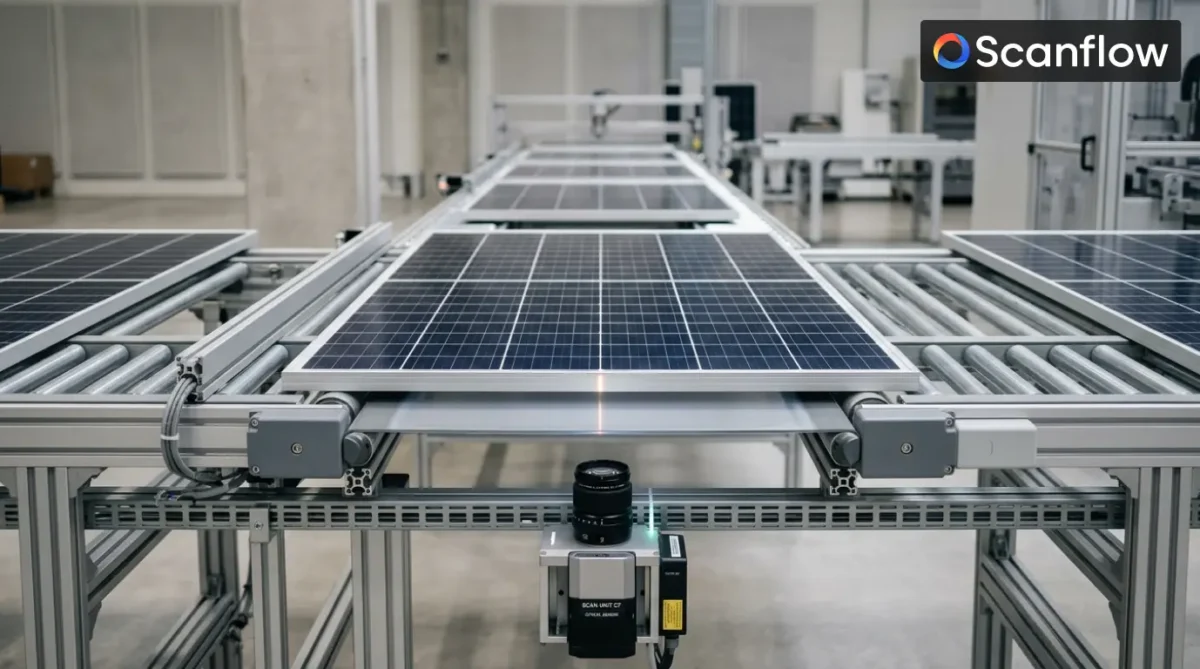
Fixed-mounted laser or imager scanners mounted on conveyor lines or end-of-line test stations at a manufacturing plant. They can read 1D barcodes, DataMatrix codes, QR codes, and laser-etched marks at production speeds without any manual intervention.  

Recommended For: 

High-volume solar panel production operations using a fixed point. They typically have a read rate greater than 99.9% when they are lined up properly and maintained correctly. 

2. Handheld Bluetooth Barcode Scanners  

Handheld Bluetooth barcode scanners connected to tablets or cellular phones are the primary option for installing and commissioning solar panels in the field. When used properly, the new generation Bluetooth handheld barcode scanners can read 1D barcodes, QR codes, and DataMatrix codes with limited restrictions in direct sunlight. The most important difference in handheld Bluetooth barcode scanners is the software.  

Commodity hardware is used for the scanner; the critical component of scanned asset data flowing into your asset management system in real-time. 

 Best suited for: 

Panel-level audits or fault finding for O&M teams in small to medium-sized installations should be considered; low upfront cost and flexibility for operational workflow integration.

3. Drone Aerial Scanning

Using drone-mounted camera systems with computer vision capabilities enables off-site scanning of panel serial numbers or asset tags across an entire array. Using drone aerial scanning is most efficient for large ground-mounted installations because ground walking through every row would be very time-consuming. The current scanning systems right now can achieve a read rate of 85%-95% against a good label condition. Therefore, scanned codes that are degraded due to soil or shading require manual verification. 

  Emerging Technology: Rapidly maturing, drone scanning is currently in use by numerous large Independent Power Producers (IPP) and asset managers for their annual portfolio inventory audits. By years end, you can expect scanning systems to demonstrate significant improvements with read rates and cost performance.

4. RFID Tracking of Panels

Several large panel manufacturers and large solar developers are beginning to utilize RFID tags either attached or embedded into the frames of the panels. RFID technology does not require direct line of sight, can be scanned even under moderate soiled panels, and many panels can be scanned simultaneously with batch scanning techniques. Cons of RFID technology are the higher price you pay for each panel and the expense associated with building the required reader infrastructure to use RFID tag technology. 

5. Next Generation Computer Vision + AI 

The development of computer vision systems that can be utilized in the field to recognize solar panels using images has matured from a research study to a commercial deployment activity. These computer vision systems will be installed in various locations and will use a camera technology already available (e.g., standard cameras mounted to tracker rows, drones, or maintenance vehicles) to provide asset management platforms with recognised identifiers associated to the associated panel image. 

TechnologyBest EnvironmentTypical Read Rate
Fixed industrial scannerManufacturing / factory>99.9%
Handheld Bluetooth scannerField installation / O&M97–99%
Drone + computer visionLarge ground-mount arrays85–95%
RFID readerAny (no line-of-sight)95–99%
AI computer vision (OCR)Arrays, trackers, drones88–97% (maturing)

 Automation of the Solar Panel Scanning Process 

While scanning hardware is an important piece of this puzzle, automation requires the development of a connected workflow to allow scanned data to be transferred directly from the field to systems that require the data without any human intervention. 

Step 1: Establish a Canonical Serial Number Standard 

Before implementing a new scanning solution, it is critical to establish a definitive standard for the serial number used for each panel. Although this may seem like an obvious step, many organisations either have multiple incomplete databases that contradict each other or have no established standard. Therefore, it is important to clearly define the following items: 

  • Master Record from whence the data originates (usually the asset management system, or CMMS)
    •    How manufacturer serial numbers correspond to the company’s internal asset number if it exists
    •    Any additional data captured at scan time, including GPS coordinates, installer ID, string assignment, image of the panel at the time it was installed, and time of image captured. 

Step 2: Choose Your Integration Architecture 

Your scanning system should connect to the databases of your backend platforms through APIs that are using Basic Authentication, most newer asset management systems (Salesforce, SAP PM, IBM Maximo, Infor EAM, SolarEdge or O&M systems) will have Web API’s (REST) available that can receive serialized asset record data The questions you need to ask to get started are:  

– Will scanned data be synced in real time (i.e., as it is scanned) or in batch (i.e., after a technician has finished their shift)? 

– What happens if the technician is scanning from a remote location and there is no internet connectivity? (The answer is to build an offline-first mobile application that queues scans and syncs them later) 

– How will your system validate serial numbers against the manufacturer’s product database (i.e., to catch errors right away) when a technician scans a serial number?  

Step 3: Use Real-time Data Validation 

The biggest benefit of an automated scanning database versus a manual database is being able to validate the data that is scanned as soon as it is scanned. When a technician scans the serial number of a panel, its validation will be:   

– Is this serial number in the manufacturer’s product database? (If you have an API integration or have uploaded the manufacturer’s product manifest) 

– Has this serial number already been scanned and logged at another site? (Working with criminals and catching them in the act) 

– Does the spec of this panel match the expectation for this position in the string (example: wattage, voltage class, cell technology)?   

Step 4: Record Commissioning Data 

Initiate the capture of a complete commissioning record, rather than just the serial number, using the scanning event you just completed. A mobile scanning program should prompt the installer to verify that the following items were performed:  

  • GPS location of the installation or manual row/string location of the installation (for structured installations) 
  • Inverter/string assignments 
  • Completion of initial visual inspection 
  • Photographic documentation of the front of the label and location of installation 
  • Installer certification and signature.

Step 5: Close the Loop with the Manufacturer’s and Warranty System 

The most sustainable use of automation is when the serial number documentation can be automatically sent back to the manufacturer/insurer. Work with your panel suppliers to develop the following:  

  • Automatic warranty registration via API at the time of commissioning scan 
  • Batch exports of serial number confirmation per manufacturer’s required format 
  • Recall notification triggers to immediately identify impacted assets within your portfolio.

Panel Label Durability-Field Perspective  

A poor scanning process prevents the code on the panel from being scanned. Label durability is often overlooked when discussing solar asset management; therefore, it should be considered when selecting the panels and maintaining existing fleets of panels.   

What Deteriorates Labels  

  • Adhesive labels are very vulnerable to UV rays; laminated polyester labels can endure longer periods of UV rays.
  • Temperature changes cause the edges of labels to curl, and the labels themselves to crack due to thermal movement.
  • The chemical attacks on labels occur from a variety of sources such as cleaning products, bird droppings, and pollutants.
  • Physical wear and tear causes damage to labels through mechanical means such as the use of cleaning tools, hailball impact or when panels move on tracking systems.  

Better Options:  

  • Laser etched codes on aluminium frames are very durable and will not fail as they do not use any adhesive material, thus lasting the entire life of the solar module.
  • Ceramic Ink printed code on the glass back of a solar module is resistant to ultraviolet light and chemical attacks, and is less susceptible to abrasion than the frame mounted labels.
  • RFID tags in the junction box are not exposed to environmental elements and can be scanned without a line of site.  

Pro Tip:  

If you are performing an audit on an existing fleet of solar modules with degraded labels, plan to relabel when you next perform scheduled maintenance rather than accepting gaps in read results. A lost serial number during warranty disputes between manufacturers can cost significantly more than a relabeling program.   

The ROI Case for the Automation of Solar Serial Number Scanning 

Developing the business case for automating serial number scanning becomes evident when calculating the real cost of not automating it.  Here’s an outline of how to calculate your return on investment.  

Decrease in Labour Cost  

Approximately 45–90 minutes of the labour required to scan and enter the data for 100 panels is used up to complete an installation that has been performed to industry standards. 

The amount of time that is required for automated scanning with real-time integration and reporting has been reduced from previously up to 90 minutes per 100 panels to only 10-15 minutes. This corresponds to an approximate saving of 150 hours of person time on a 10 MW project consisting of approximately 25,000 panels, when calculated using the average commercial electrician or specialty commissioning rates. This also means that there will be significant dollar savings before accounting for the costs of correcting errors.  

Verified Warranty Recovery 

Solar operators that utilize automated scanning and have the ability to track serial numbers and provide prior to installation commissioning documentation as part of the warranty recovery process have reported significantly improved warranty claim acceptance rates. Some have reported increases in acceptance from 60-70% to 90%+ when validation with time and GPS stamps is able to be provided as part of the warranty recovery process. The difference in warranty recovery between utilization of verification and not will be in the hundreds of thousands of dollars over the panel warranty period for large portfolios. 

Starting the Implementation Process – Getting Started   

Below are some relevant steps that you can take to start the automation of your solar panel scanning program of serial numbers:   

  • Audit the quality of your current serial number data (what your current quality is will help guide you in the deployment of new systems) 
  • Mapping of the serial number data flow from manufacturing, through delivery to installation, commissioning, and continuous data capture
  • Choose suitable scanning devices based on how you will be primarily using the devices (i.e. assembly line, installation in the field, and/or periodic inspecting). 
  • Test mobile scanning applications that can function while offline with an API connection to your asset management software. 
  • Obtain access to manufacture’s API for product validation or to obtain structured data export files for validation use. 
  • Run a pilot project or use a pilot location, the results will be used as a benchmark for your overall project success, including; read/scan rates, error rates, and man-hour rates. 
  • Establish label quality criteria to be used for new panel procurement. 
  • Plan a re-labeling program for all your existing fleet that have degraded bar coding. 
  • Teach your field installers on how to properly perform scanning activities based on how they are trained to use that equipment. 
  • Define key performance indicators, target read/scan rate of +99%; target error rate of <0.1%, target commissioning complete at time of new inventory. 

Common Pitfalls: 

  1. Treating scanning as an IT project instead of an operations project. If the installer or technician does not perform work correctly, then the system will not work. The scanning process must be considered in conjunction with installers and technicians so that it can be optimised for their operations. 
  2. Underestimating the need for offline scanning capabilities. Remote solar sites often do not have good or consistent mobile network connectivity. Therefore, when selecting a mobile scanning solution, it is important that it has the capability of providing offline scanning capabilities seamlessly (i.e. queuing the records to be sync’d once the system is back “online”). 
  3. Disassociating the panel manufacturers’ relationship to the data. The effectiveness of your scanning system is only as strong as your supplier’s ability to provide you with accuracy. Therefore, it is very important to work to develop those relationships early. 

Maximizing for scan speeds instead of scanning quality will result in a slower scan at a rate to capture the GPS position, photograph, and string assignment, for this data will provide a much larger total value over an asset’s expected usable life of 25 years. As compared to the value provided through a single scan of only a serial number, the slower scan will produce far more value. 

A failure to have a plan that addresses degradation on existing labels in the fleet will become necessary for asset owners to have a remediation plan to keep the fleet operational using automated scanning methods. All operators will be needing the work needed to remediate existing assets that use degraded labels in order to move forward with the automated scanning technologies.   

As the way forward becomes clear, the expansion of the solar energy sector and the increased complexity of the product offering through a combination of increasing the number of solar technology installations with the expansion of portfolios will be dependent on the development of a digital identity for every solar panel. Digital identities will enable:   

  • analytics related to performance,
  • predictive maintenance,
  • warranty management,
  • recycling compliance, and
  • secondary market transactions.  

The movement toward solar panel Digital Identities is being rapidly accelerated by:   

  • The introduction of EU Battery and Solar Regulations; and
  • The Digital Product Passport initiative of the European Commission. Both the regulations and the initiative will mandate that every solar panel is issued with machine-readable identifiers and a direct link to lifecycle documentation.

Provenance tracking based on blockchain technology: An increasing number of manufacturers and industry consortia are now implementing pilot programs utilizing blockchain technology to generate immutable, shared records of a panel’s identity and historical data that can be accessed by all participants in the value chain.    

 First, using Artificial Intelligence (AI)-powered anomaly detection, asset management platforms are now applying panel-level serial number data in conjunction with performance monitoring to identifyindividual panels that are beginning to exhibit early signs of degradation, allowing operators to proactively implement targeted maintenance prior to equipment failures.    

In summary:

Automating the scanning of serial numbers associated with solar panels creates significant enhancements throughout their life cycles by enabling the growth of faster and more accuratecommissioning, streamlining warranty management, improving operational and maintenance services (O&M), and ultimately meeting recycling compliance standards. In addition, the technology necessary to improve upon solar asset management processes is both mature and accessible. The major issue that exists is developing an effective integration strategy for incorporating the technology into cohesive workflows, while also maintaining the data integrity required for long-term use.  

The solar industry is experiencing an inflection point. Projects continue to increase in size with respect to the number of solar panels required (which in turn contributes to overall cost), but also continue to provide less profit margin than they have in the past. Therefore, those operators or manufacturers who establish an automated, robust system of data collection for solar asset management will have a competitive edge as the solar market continues to mature; not only with respect to increased operational efficiency but also with respect to providing greater financial returns than ever before to both their investors and customers. 

It’s important to make an immediate transition from using manual scans and spreadsheets for record keeping to something more advanced like an automated solution, otherwise you may experience disputes on your first warranty claim once the project is completed.