Why Some Solar Defects Are Invisible Until They’ve Already Cost You Power
The United States is in the middle of the largest solar buildout in its history. Developers are on t...
 6 Mins read
Posted on Jul 13, 2026
February 23, 2026
12 Mins read


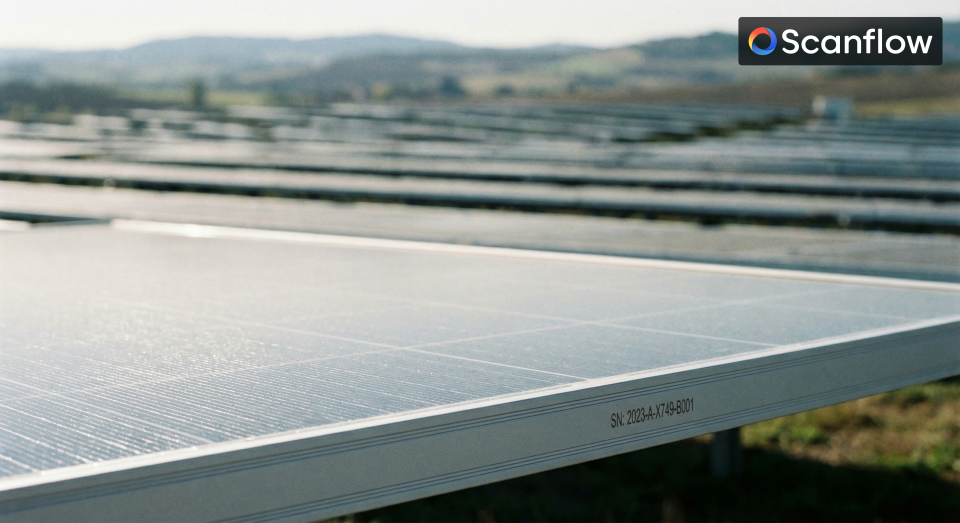
If you walk into a massive solar panel factory or a place where they’re putting solar panels on the utility grid, you’ll see technicians working on solar panel installations doing the same thing over and over again: Looking at each solar panel and using their hands to hold the solar panel up in front of them until they get to the correct position in the installation site; squinting at the small type on the solar panel; typing in the long code into a tablet or paper at the installation site. This is dreadfully slow, painfully inaccurate (mostly due to human error), and completely contrary to the speed with which the solar industry operatestoday.
The global growth of the solar market is expected to be $300 billion by 2030, which means the demand for solar panel installations, tracking, and servicing will continue to grow rapidly. Therefore, the days when automation for solar panel serial number scanning was a luxury are gone. As a result, manufacturers, EPCs (engineering, procurement, and construction), and O&M (operation and maintenance) companies need to implement solar panel serial number scanning in an automated fashion to maintain their competitive advantage.
The guide is focused on serial number tracking of solar panels; the following information should provide you with a good understanding of what you need to know: why solar panel serial number tracking is necessary, where manual processes will fail, what types of technology work best in solar panel environments, and how you can create an end-to-end, automated, field-tested process for scanning and tracking solar panel serial numbers.
Managing a utility-scale project comprising tens of thousands of solar panels from various manufacturers makes it a daunting task to manage accurate and up-to-date data.
The following describes the consequences of mistakes made while tracking serial numbers:
The pace of manual serial number input, or even one-by-one scanning via a handheld unit, is slow. This can result in failure on multiple levels as time passes.

Studies on manual data entry, primarily in manufacturing, show an error rate from 1–4%. For instance, assuming the installation of 50,000 panels, this would result in an estimated 500–2,000 serial numbers being recorded incorrectly creating potential problems with warranties, compliance and/or maintenance.
Solar panels are built to last 25–30 years and are subjected to UV, thermal cycling, moisture and physical wear and tear this all shows up as degradation of printed barcodes or QR codes on the labels of the panel. Laser etched codes on the glass or aluminum frames will last much longer than the adhesive labels that many of the older panels use and the adhesive labels are typically no longer readable past 5-7 years after being installed.
Larger utility scale installations generally have the scanning group working independently of the installation. If the scanning group has scheduling overlaps, the slower-running scannings can cause delays to the entire project, if they are too far behind, there is great temptation for the teams to skip records or perform batch recording based on the delivery manifests thus compromising the panel level accuracy completely.
Manufacturers record serial numbers with their internal ERP systems.
Contractors generally log their work into their construction management software. Owners and operators often utilize different systems than the contractors they hired. When these systems are disconnected, the same serial number for a solar panel is entered multiple times by various people and creates multiple opportunities for error and inconsistency.
One solar panel serial number scanning solution may not be as ideal as others because the solar environment is challenging for different types of barcode scanning. Below is a comparison of the different serial number scanning solutions:
1. Fixed Industrial Barcode Scanners (Manufacturing Plants)
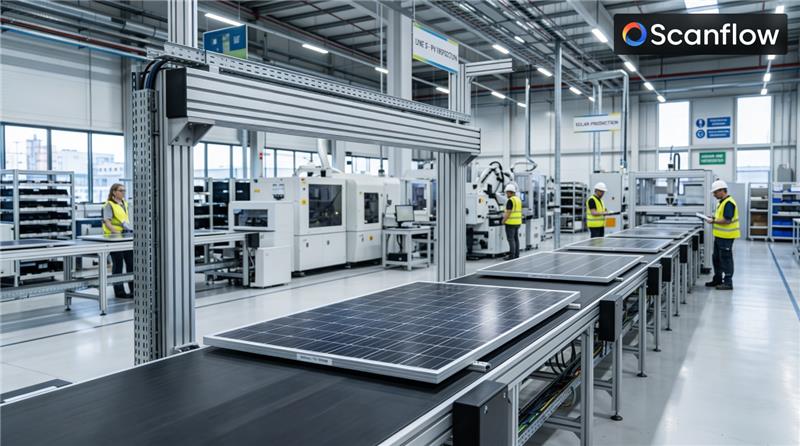
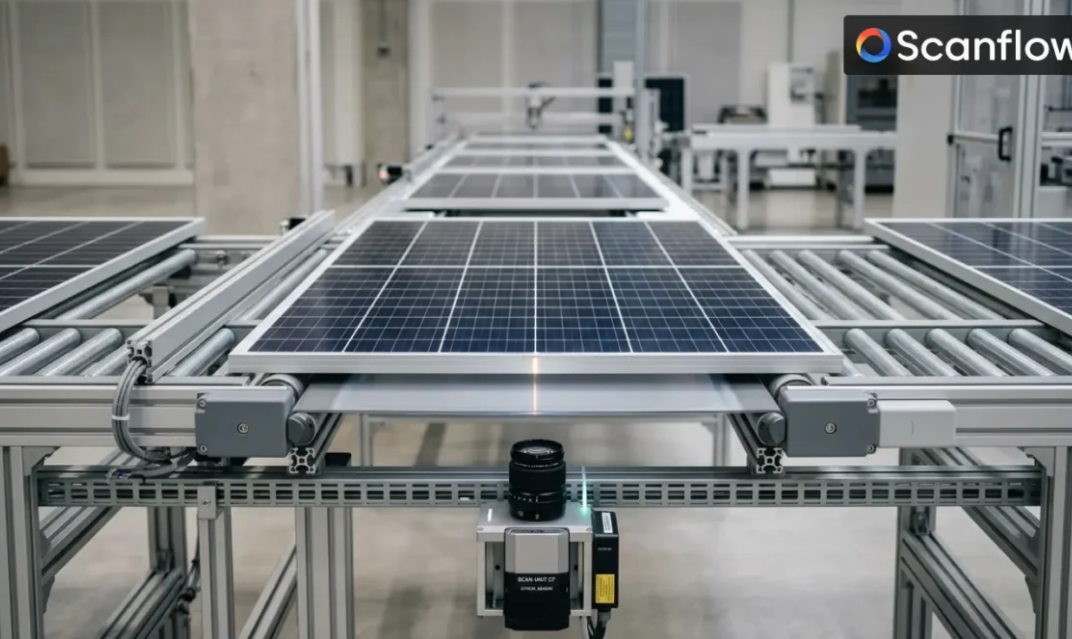
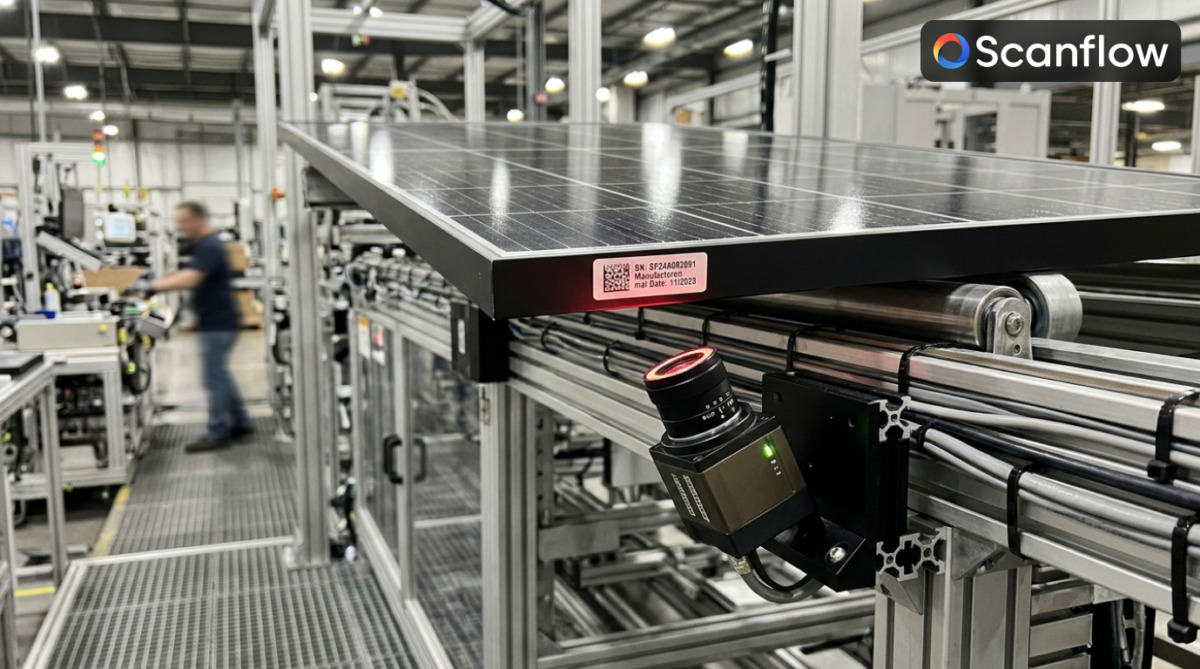
Fixed-mounted laser or imager scanners mounted on conveyor lines or end-of-line test stations at a manufacturing plant. They can read 1D barcodes, DataMatrix codes, QR codes, and laser-etched marks at production speeds without any manual intervention.
Recommended For:
High-volume solar panel production operations using a fixed point. They typically have a read rate greater than 99.9% when they are lined up properly and maintained correctly.
2. Handheld Bluetooth Barcode Scanners
Handheld Bluetooth barcode scanners connected to tablets or cellular phones are the primary option for installing and commissioning solar panels in the field. When used properly, the new generation Bluetooth handheld barcode scanners can read 1D barcodes, QR codes, and DataMatrix codes with limited restrictions in direct sunlight. The most important difference in handheld Bluetooth barcode scanners is the software.
Commodity hardware is used for the scanner; the critical component of scanned asset data flowing into your asset management system in real-time.
Best suited for:
Panel-level audits or fault finding for O&M teams in small to medium-sized installations should be considered; low upfront cost and flexibility for operational workflow integration.
3. Drone Aerial Scanning
Using drone-mounted camera systems with computer vision capabilities enables off-site scanning of panel serial numbers or asset tags across an entire array. Using drone aerial scanning is most efficient for large ground-mounted installations because ground walking through every row would be very time-consuming. The current scanning systems right now can achieve a read rate of 85%-95% against a good label condition. Therefore, scanned codes that are degraded due to soil or shading require manual verification.
Emerging Technology: Rapidly maturing, drone scanning is currently in use by numerous large Independent Power Producers (IPP) and asset managers for their annual portfolio inventory audits. By years end, you can expect scanning systems to demonstrate significant improvements with read rates and cost performance.
4. RFID Tracking of Panels
Several large panel manufacturers and large solar developers are beginning to utilize RFID tags either attached or embedded into the frames of the panels. RFID technology does not require direct line of sight, can be scanned even under moderate soiled panels, and many panels can be scanned simultaneously with batch scanning techniques. Cons of RFID technology are the higher price you pay for each panel and the expense associated with building the required reader infrastructure to use RFID tag technology.
The development of computer vision systems that can be utilized in the field to recognize solar panels using images has matured from a research study to a commercial deployment activity. These computer vision systems will be installed in various locations and will use a camera technology already available (e.g., standard cameras mounted to tracker rows, drones, or maintenance vehicles) to provide asset management platforms with recognised identifiers associated to the associated panel image.
| Technology | Best Environment | Typical Read Rate |
|---|---|---|
| Fixed industrial scanner | Manufacturing / factory | >99.9% |
| Handheld Bluetooth scanner | Field installation / O&M | 97–99% |
| Drone + computer vision | Large ground-mount arrays | 85–95% |
| RFID reader | Any (no line-of-sight) | 95–99% |
| AI computer vision (OCR) | Arrays, trackers, drones | 88–97% (maturing) |
While scanning hardware is an important piece of this puzzle, automation requires the development of a connected workflow to allow scanned data to be transferred directly from the field to systems that require the data without any human intervention.
Before implementing a new scanning solution, it is critical to establish a definitive standard for the serial number used for each panel. Although this may seem like an obvious step, many organisations either have multiple incomplete databases that contradict each other or have no established standard. Therefore, it is important to clearly define the following items:
Your scanning system should connect to the databases of your backend platforms through APIs that are using Basic Authentication, most newer asset management systems (Salesforce, SAP PM, IBM Maximo, Infor EAM, SolarEdge or O&M systems) will have Web API’s (REST) available that can receive serialized asset record data The questions you need to ask to get started are:
– Will scanned data be synced in real time (i.e., as it is scanned) or in batch (i.e., after a technician has finished their shift)?
– What happens if the technician is scanning from a remote location and there is no internet connectivity? (The answer is to build an offline-first mobile application that queues scans and syncs them later)
– How will your system validate serial numbers against the manufacturer’s product database (i.e., to catch errors right away) when a technician scans a serial number?
The biggest benefit of an automated scanning database versus a manual database is being able to validate the data that is scanned as soon as it is scanned. When a technician scans the serial number of a panel, its validation will be:
– Is this serial number in the manufacturer’s product database? (If you have an API integration or have uploaded the manufacturer’s product manifest)
– Has this serial number already been scanned and logged at another site? (Working with criminals and catching them in the act)
– Does the spec of this panel match the expectation for this position in the string (example: wattage, voltage class, cell technology)?
Initiate the capture of a complete commissioning record, rather than just the serial number, using the scanning event you just completed. A mobile scanning program should prompt the installer to verify that the following items were performed:
The most sustainable use of automation is when the serial number documentation can be automatically sent back to the manufacturer/insurer. Work with your panel suppliers to develop the following:
A poor scanning process prevents the code on the panel from being scanned. Label durability is often overlooked when discussing solar asset management; therefore, it should be considered when selecting the panels and maintaining existing fleets of panels.
Better Options:
Pro Tip:
If you are performing an audit on an existing fleet of solar modules with degraded labels, plan to relabel when you next perform scheduled maintenance rather than accepting gaps in read results. A lost serial number during warranty disputes between manufacturers can cost significantly more than a relabeling program.
Developing the business case for automating serial number scanning becomes evident when calculating the real cost of not automating it. Here’s an outline of how to calculate your return on investment.
Approximately 45–90 minutes of the labour required to scan and enter the data for 100 panels is used up to complete an installation that has been performed to industry standards.
The amount of time that is required for automated scanning with real-time integration and reporting has been reduced from previously up to 90 minutes per 100 panels to only 10-15 minutes. This corresponds to an approximate saving of 150 hours of person time on a 10 MW project consisting of approximately 25,000 panels, when calculated using the average commercial electrician or specialty commissioning rates. This also means that there will be significant dollar savings before accounting for the costs of correcting errors.
Solar operators that utilize automated scanning and have the ability to track serial numbers and provide prior to installation commissioning documentation as part of the warranty recovery process have reported significantly improved warranty claim acceptance rates. Some have reported increases in acceptance from 60-70% to 90%+ when validation with time and GPS stamps is able to be provided as part of the warranty recovery process. The difference in warranty recovery between utilization of verification and not will be in the hundreds of thousands of dollars over the panel warranty period for large portfolios.
Below are some relevant steps that you can take to start the automation of your solar panel scanning program of serial numbers:
Common Pitfalls:
Maximizing for scan speeds instead of scanning quality will result in a slower scan at a rate to capture the GPS position, photograph, and string assignment, for this data will provide a much larger total value over an asset’s expected usable life of 25 years. As compared to the value provided through a single scan of only a serial number, the slower scan will produce far more value.
A failure to have a plan that addresses degradation on existing labels in the fleet will become necessary for asset owners to have a remediation plan to keep the fleet operational using automated scanning methods. All operators will be needing the work needed to remediate existing assets that use degraded labels in order to move forward with the automated scanning technologies.
As the way forward becomes clear, the expansion of the solar energy sector and the increased complexity of the product offering through a combination of increasing the number of solar technology installations with the expansion of portfolios will be dependent on the development of a digital identity for every solar panel. Digital identities will enable:
The movement toward solar panel Digital Identities is being rapidly accelerated by:
Provenance tracking based on blockchain technology: An increasing number of manufacturers and industry consortia are now implementing pilot programs utilizing blockchain technology to generate immutable, shared records of a panel’s identity and historical data that can be accessed by all participants in the value chain.
First, using Artificial Intelligence (AI)-powered anomaly detection, asset management platforms are now applying panel-level serial number data in conjunction with performance monitoring to identifyindividual panels that are beginning to exhibit early signs of degradation, allowing operators to proactively implement targeted maintenance prior to equipment failures.
Automating the scanning of serial numbers associated with solar panels creates significant enhancements throughout their life cycles by enabling the growth of faster and more accuratecommissioning, streamlining warranty management, improving operational and maintenance services (O&M), and ultimately meeting recycling compliance standards. In addition, the technology necessary to improve upon solar asset management processes is both mature and accessible. The major issue that exists is developing an effective integration strategy for incorporating the technology into cohesive workflows, while also maintaining the data integrity required for long-term use.
The solar industry is experiencing an inflection point. Projects continue to increase in size with respect to the number of solar panels required (which in turn contributes to overall cost), but also continue to provide less profit margin than they have in the past. Therefore, those operators or manufacturers who establish an automated, robust system of data collection for solar asset management will have a competitive edge as the solar market continues to mature; not only with respect to increased operational efficiency but also with respect to providing greater financial returns than ever before to both their investors and customers.
It’s important to make an immediate transition from using manual scans and spreadsheets for record keeping to something more advanced like an automated solution, otherwise you may experience disputes on your first warranty claim once the project is completed.

Why Some Solar Defects Are Invisible Until They’ve Already Cost You Power
6 Mins read
Posted on Jul 13, 2026
How Solar Panel Manufacturers Lose Warranty Claims Due to Poor Serial Number Tracking
9 Mins read
Posted on Jun 10, 2026
Why Solar Panel Serial Number Traceability Is Critical for Warranty and Claims?
10 Mins read
Posted on Apr 27, 2026