Why Some Solar Defects Are Invisible Until They’ve Already Cost You Power
The United States is in the middle of the largest solar buildout in its history. Developers are on t...
 6 Mins read
Posted on Jul 13, 2026
March 6, 2026
5 Mins read


If you manage quality or compliance for a solar manufacturer or EPC firm, understanding the specific agencies enforcing regulations like UFLPA, ANSI/SEIA 101, and SSI standards helps you navigate the complex regulatory environment effectively. The Uyghur Forced Labor Prevention Act (UFLPA) has made supply chain documentation a key issue at customs checkpoints. The Solar Energy Industries Association’s newly ANSI-approved ANSI/SEIA 101 standard now provides a formal rubric requiring manufacturers and importers to trace product origins from raw materials to finished goods. And the Solar Stewardship Initiative’s Supply Chain Traceability Standard, published in December 2024, adds another layer of third-party accountability for silicon sourcing and for verification of production sites.
What ties all of these requirements together? Reliable panel-level identification data is essential, and AI-powered barcode scanning offers a dependable solution that can strengthen your confidence in compliance and traceability efforts.
For years, solar manufacturers have relied on manual data entry and handheld scanning with minimal software intelligence. The problem is well-documented. Manual data entry’s error rates of 1–4% can undermine trust; AI scanning significantly improves accuracy giving you peace of mind in your compliance records. Scale that across a utility installation of 50,000 panels, and you’re looking at potentially 500 to 2,000 incorrectly recorded serial numbers each one a gap in your compliance audit trail.
The physical reality of solar panels makes this worse, not better. Engineers design the panels to withstand 25–30 years of UV exposure, thermal cycling, and moisture. Adhesive barcode labels, however, are not many become unreadable within 5–7 years of installation. When an auditor asks for a panel’s provenance record or a warranty claim arrives years down the line, degraded or missing scan data is a liability, not just an inconvenience.
Manual processes also struggle to keep pace with the scale and speed of modern solar manufacturing. High-volume production lines require scan reads at production speed, with zero tolerance for missed reads or data gaps. A compliance manager relying on clipboards and spreadsheets is setting their organization up for audit failures before the first panel ships.

The leap from conventional barcode scanning to AI-enhanced scanning isn’t just about speed it’s about intelligence, reliability, and data integrity across the full panel lifecycle.
AI-powered image recognition enables scanning systems to read degraded, partially obscured, or damaged codes that traditional laser scanners would fail to read. This process is critical for end-of-life compliance obligations (required by regulations in the EU, US, and Australia) where panels must be traceable even decades after manufacture.
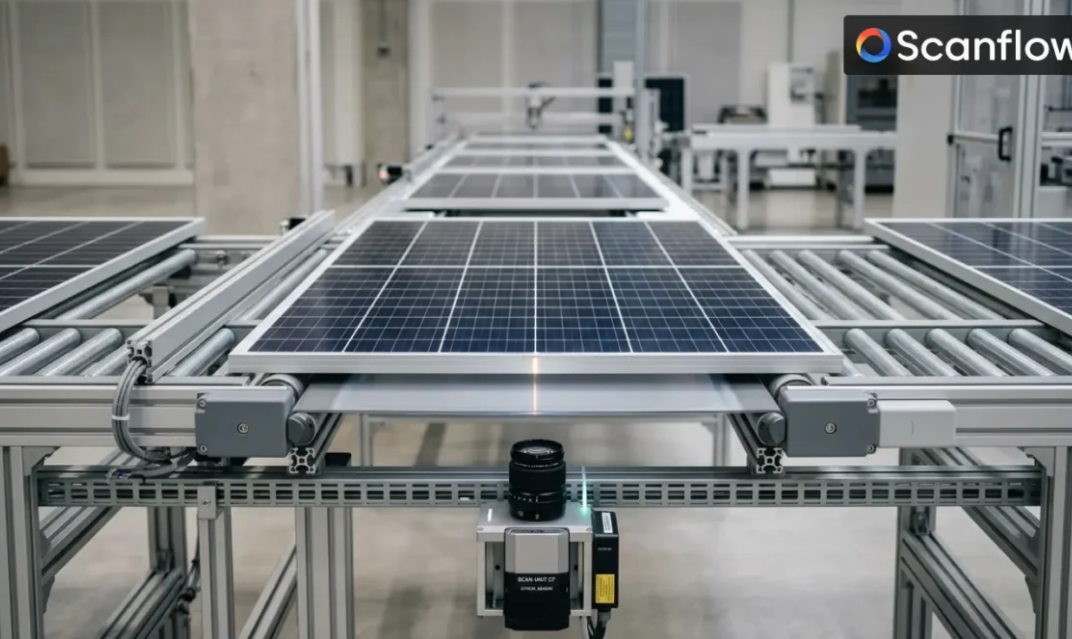
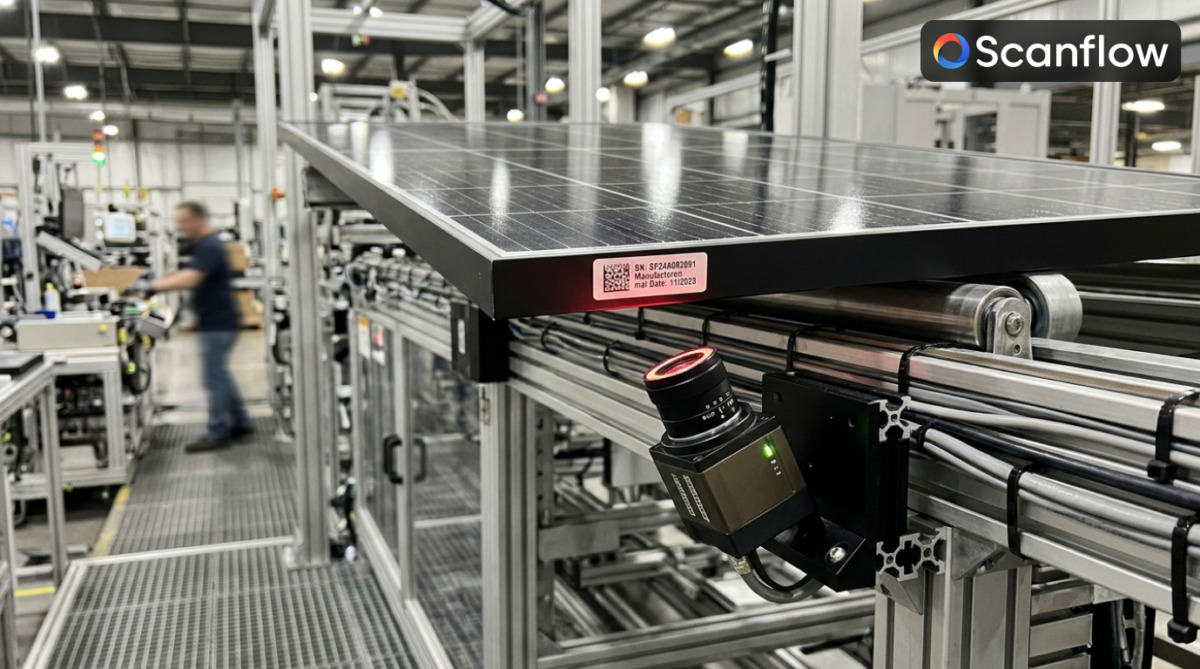
The fixed industrial AI scanners on production lines achieve read rates above 99.9% for DataMatrix, QR, and laser-etched serial codes when properly configured essentially eliminating the error margin that plagues manual entry. These systems are designed to integrate seamlessly with existing manufacturing execution systems (MES) and ERP platforms, ensuring that every scan creates an immutable, timestamped record that automatically feeds compliance documentation. Understanding this integration helps quality assurance professionals assess compatibility and implementation challenges.
AI-enhanced handheld scanners, connected via Bluetooth to mobile platforms, enable field technicians to read codes under challenging conditions direct sunlight, awkward angles, surface wear and to sync that data in real time to cloud-based asset management systems. Even in low-connectivity remote solar farm environments, modern solutions cache scan data offline and sync automatically when reconnected, ensuring no record gaps.
Drone-mounted AI vision systems represent the frontier for large ground-mounted installations, enabling aerial capture of serial numbers across entire arrays. This task would require days of manual walkthroughs compressed into hours, with computer vision handling the read-and-match logic automatically.
From a compliance standpoint, it’s important not only to scan the panels but also to ensure that every scan generates a verifiable, structured data trail capable of withstanding regulatory scrutiny.
ANSI/SEIA 101 specifically requires organizations to map the supply chain and collect traceability documentation for each component, down to the raw-material level. The standard also requires identification of high-risk suppliers and sub-tier materials. This task becomes tractable only when your panel-level records are clean and complete from day one of manufacturing.
An AI barcode scanning for solar architecture supports this by:
For quality managers, AI barcode scanning does double duty. The same serial number data that satisfies a compliance audit also powers root cause analysis and defect tracking.
When a performance anomaly is detected whether through thermal drone inspection, string monitoring, or a field technician’s report an AI-linked serial number record lets you immediately pull the panel’s full manufacturing history: production batch, cell supplier, line station, inspection results, and installation date. This capability transforms reactive quality responses into proactive corrective action.
If a batch of panels from a specific cell supplier starts showing early degradation, the traceability data lets you isolate exactly which panels are affected across your installed base, prioritize warranty claims, and notify downstream customers all without combing through disconnected spreadsheets or chasing down paper records.
This kind of closed-loop quality intelligence is increasingly expected, not optional. Insurers of large solar portfolios are beginning to factor record quality and asset traceability into risk assessments. Developers and asset managers want documented evidence that the panels they’ve acquired have a clean, verifiable history. A robust AI scanning infrastructure positions your organization to credibly meet these expectations.
Practical Considerations for Implementation
Not every scanning solution is appropriate for every solar environment. A compliance manager evaluating AI barcode scanning should consider the following:
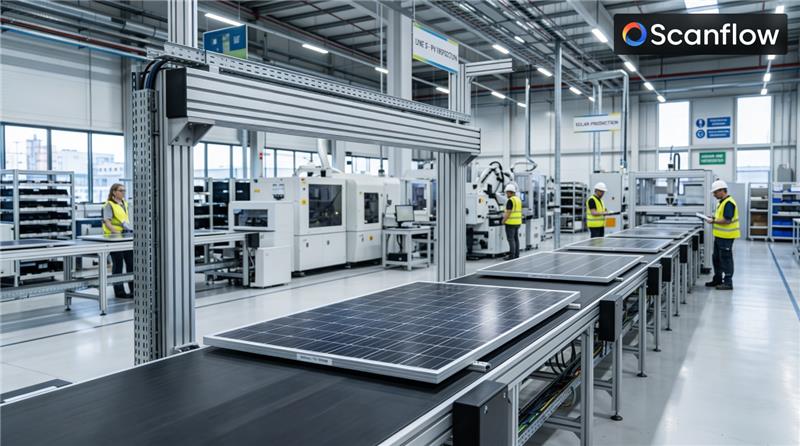
Manufacturing plants equipped with industrial AI scanners integrate directly into conveyor and end-of-line test stations. The priority here is throughput, read reliability, and MES integration for automatic record creation.
Field installation and O&M teams need AI-enhanced handheld solutions with offline capability and cloud sync. The software layer matters more than the hardware real-time data flow into your asset management system is what creates the compliance record.
Large utility-scale assets may justify investment in drone-based AI vision scanning for periodic full-array audits, particularly where physical access to every panel is difficult or time-consuming.
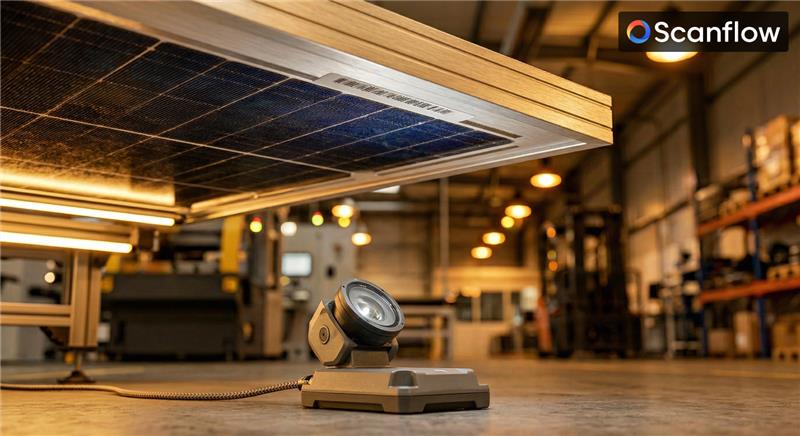
In all cases, the preference is for laser-etched codes on glass or aluminum frames over adhesive labels for long-term traceability, given the 25-year operational lifecycle of most panels.
The regulatory environment for solar is tightening, and standards like ANSI/SEIA 101 and the SSI Supply Chain Traceability Standard are setting a clear direction: documentation must be systematic, traceable, and defensible. Manual processes and disconnected records are no longer adequate to meet that bar.
AI barcode scanning doesn’t just reduce error rates it creates the kind of structured, automated, panel-level data infrastructure that makes compliance achievable at scale and quality management genuinely proactive. For compliance and quality managers tasked with keeping their organizations audit-ready, it’s one of the highest-leverage operational investments available today.

Why Some Solar Defects Are Invisible Until They’ve Already Cost You Power
6 Mins read
Posted on Jul 13, 2026
How Solar Panel Manufacturers Lose Warranty Claims Due to Poor Serial Number Tracking
9 Mins read
Posted on Jun 10, 2026
Why Solar Panel Serial Number Traceability Is Critical for Warranty and Claims?
10 Mins read
Posted on Apr 27, 2026