Why Some Solar Defects Are Invisible Until They’ve Already Cost You Power
The United States is in the middle of the largest solar buildout in its history. Developers are on t...
 6 Mins read
Posted on Jul 13, 2026
April 27, 2026
10 Mins read


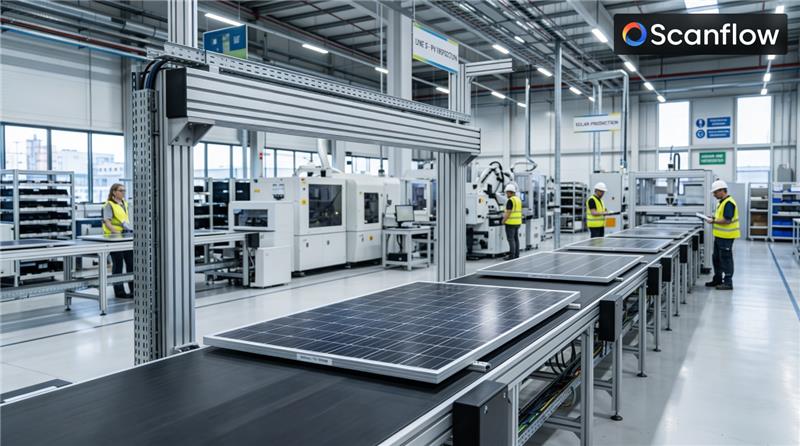
Somewhere on the aluminum frame of every solar panel shipped to a rooftop in Chennai, a utility-scale farm in Texas, or a community array in rural Germany, there is a small string of characters that carries an outsized responsibility: the module serial number. This alphanumeric code is not merely administrative for housekeeping. It is the single thread that connects a solar panel to its manufacturer, its production batch, its material origin, its performance guarantee, and, critically, its warranty rights.
As global solar installations accelerate at a pace few anticipated, the serial number has never mattered more. In the first half of 2025 alone, the world added 380 GW of new solar capacity, a staggering 64% higher than the same period in 2024. The global solar panel market, valued at approximately USD 202.8 billion in 2025, is on course to exceed USD 700 billion by 2036. Behind every gigawatt of that installed capacity is a mountain of panels, each with a warranty stretching 10 to 25 years into the future.
Managing warranty obligations and processing claims across billions of deployed panels without reliable serial-number traceability is not just operationally inefficient; it is also a significant business risk. It is financially catastrophic and, in an industry built on long-term trust, commercially devastating. This blog explores exactly why solar panel serial number traceability is critical for warranty and claims management, what the consequences of getting it wrong look like, and how forward-thinking manufacturers are building the systems to get it right.
Solar panel warranties are unlike most consumer product warranties. They are extraordinarily long-term commitments, tying manufacturers to obligations that can span three decades. The industry operates with two primary warranty types:
These cover defects in materials and craft. The industry standard has shifted significantly upward, from 10–12-year product warranties once the baseline to premium manufacturers now routinely offering 25-year warranties. Covered failures include delamination, cracking, cell discoloration, junction box failures, and frame corrosion. When a covered defect occurs, the manufacturer must repair, replace, or financially compensate the owner.
These guarantee that a panel will maintain a minimum percentage of its original power output over its service life, typically with no more than 0.5% annual degradation, and most manufacturers promise at least 80–90% of rated output after 25 years. Some leading manufacturers, such as Maxeon, now offer 40-year performance warranties with degradation rates as low as 0.25% per year. When a panel falls short of the guaranteed threshold, the manufacturer is liable.
| $ | MARKET EXPOSURE
USD 202.8 billion solar panel market in 2025 Projected to reach USD 700+ billion by 2036 at 13.2% CAGR — warranty liabilities scale proportionally (Research Nester, 2025) |
Every warranty claim begins with identifying the specific panel, making a reliable serial number essential for industry professionals to trust the warranty process and avoid operational risks.
“When claiming on your solar panel product warranty, you’ll always need to provide the serial number of each defective module, as well as photo evidence.” Sunsave Energy, Solar Panel Warranty Expert Guide 2026
A solar panel serial number is not arbitrary. Manufacturers encode a structured set of information into the alphanumeric sequence, typically including:
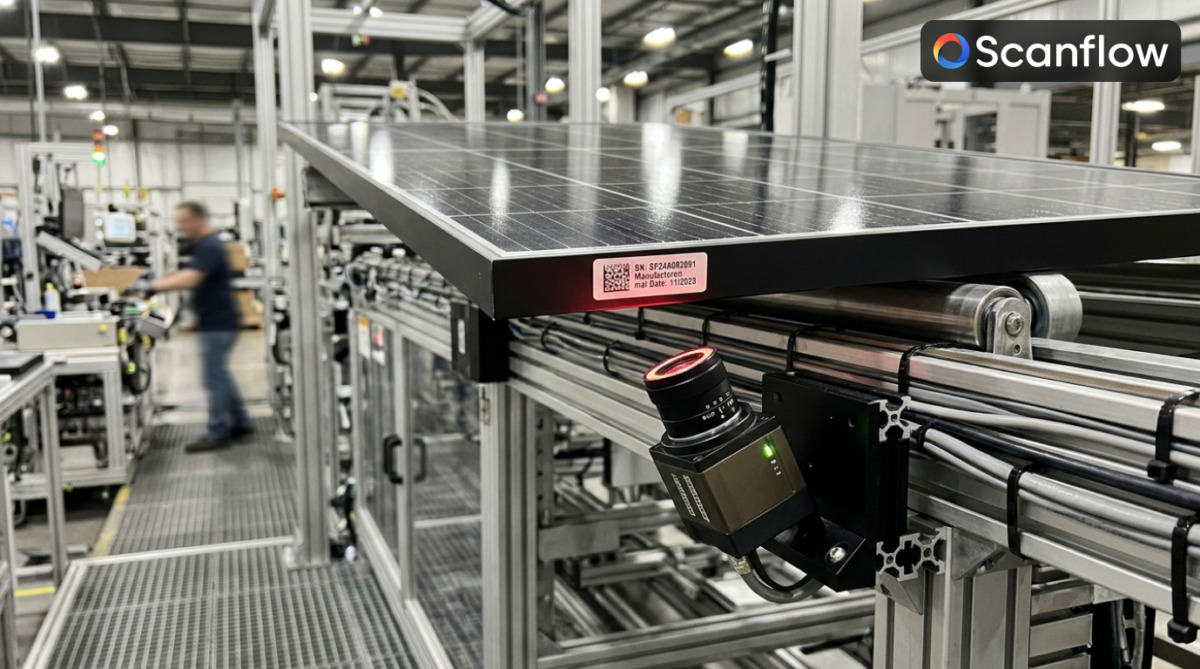
This encoded data makes the serial number the primary key for every record associated with that panel, from its raw silicon wafer through quality control test results, shipping manifests, installation records, monitoring data, and ultimately warranty claims. You can find the serial number printed on the panel’s rating plate label, which is on the back frame. Manufacturers increasingly encode it in a 2D QR code or Data Matrix barcode for easier machine-readable scanning.
In a well-designed traceability system, scanning serial numbers at any stage reassures industry peers that panels’ histories are secure, encouraging confidence in digital solutions over unreliable manual records.
| 📋 | WARRANTY DOCUMENTATION FACT
Serial numbers are mandatory for all warranty claims Successful warranty claims require serial numbers, performance data, installation records, and photos — typical processing takes 4–8 weeks (Solar Tech Online, 2025) |
Across large-scale solar deployments, utility farms running tens of thousands of panels, commercial rooftops with hundreds of modules, serial number capture is still often performed manually. Installers write numbers by hand onto paper commissioning forms or type them into spreadsheets from photographs. The error rate in manual transcription is significant: transposed characters, incomplete entries, and panels installed without any serial number record are common. A study of solar operations practices found that manually kept records frequently fail to hold up under audit, creating solar compliance exposure beyond just warranty implications.
Solar panels change hands multiple times before installation: manufacturer to distributor, distributor to project developer, developer to EPC contractor, contractor to O&M operator. Each handoff introduces the risk that teams fail to transfer serial number records cleanly or use incompatible formats. As a result, the panel reaches the site with a serial number on its frame but without any connected digital history.
The solar industry has learned painful lessons about what happens when warranty obligations outlive the companies that issued them. SunPower Corporation’s Chapter 11 bankruptcy filing in August 2024 was a stark reminder. The company had issued 25-year product warranties on panels it had installed across North America. When the business failed, the manufacturers of those components became directly liable for warranty fulfillment, provided they could identify, from serial numbers, exactly which panels were covered and whether they had been installed legitimately under SunPower programs.
| ⚠ | INDUSTRY WARNING CASE
SunPower filed for Chapter 11 bankruptcy on August 5, 2024 Issued 25-year product warranties that will now outlast the company — component manufacturers are on the hook for decades of claims, relying entirely on serial number traceability (Warranty Week, 2024) |
“We’re watching a feared scenario play out in real time with SunPower Corp. The manufacturers that supplied the specific components are all on the hook for fulfilling those warranty claims, potentially for decades to come.” Warranty Week, Solar Power Warranty Expenses Report, October 2024
In a global market where panels are commoditized and price pressure is intense, counterfeit modules and the substitution of lower-spec panels for premium models are real risks. Without end-to-end serial number traceability tied to verified manufacturing data, it becomes extremely difficult for manufacturers to defend against fraudulent warranty claims on panels they never actually produced, or to identify genuine claims on panels that have been tampered with.
A serial number linked to a manufacturer’s production database is definitive proof of origin. It establishes that a specific panel was produced on a specific line, on a specific date, using specific materials and process parameters. This traceability is the foundation of every valid warranty claim and the first thing a manufacturer checks when a claim is submitted. Without it, neither party can verify authenticity.
Not all defects affect all panels equally. A contamination event in a specific raw material batch, a process parameter excursion on a particular production line, or a quality issue tied to a specific shipment of encapsulant film may affect only panels within a narrow production window. Without serial number traceability mapped to production batches, a manufacturer facing defect reports cannot surgically identify and proactively remediate the at-risk population. Instead, they face the choice of ignoring the risk or issuing a blanket remediation, which is both financially and reputationally costly.
| 🔬 | NREL FINDING
Just 5 in 10,000 modern solar panels fail a 0.05% rate Low individual failure rates mask significant batch-level clustering traceability enables targeted response rather than blanket remediation (NREL, via Solar.com) |
Performance warranty claims require establishing a panel’s baseline output at commissioning and comparing it to the current output after years of field operation. This entire process depends on continuous, serial-number-linked monitoring data. A panel without a clean serial number record cannot be baseline-validated, and a performance warranty claim without monitoring data tied to a specific serial number will almost certainly be denied or heavily disputed.
Large solar portfolios are routinely used as collateral for project finance and are subject to specialist insurance coverage. Insurers and lenders are increasingly scrutinizing the quality of asset-traceability records as part of their underwriting and due diligence processes. Poor serial number traceability increases insurance claim costs and can affect credit terms on project debt, a material financial impact that extends well beyond the warranty department.
As Scanflow’s operational research (2025) notes, insurers of large solar energy portfolios are beginning to factor asset-tracking quality into their risk models, evaluating the traceability of investments and whether issues have been identified and managed. This process means that good traceability directly translates into lower insurance premiums and a quantifiable commercial return.
Solar panel traceability is not only a warranty issue. The US Uyghur Forced Labor Prevention Act (UFLPA), the EU Forced Labor Regulation, and the Solar Stewardship Initiative’s Supply Chain Traceability Standard (published December 2024) all require manufacturers and importers to demonstrate verifiable supply chain traceability from raw materials to finished product. Serial numbers are the anchor point of this traceability—they connect a specific panel to its specific supply chain records. US Customs and Border Protection has begun issuing supply chain questionnaires to solar companies requesting extensive disclosures, marking an expansion of enforcement scrutiny.
| 🌐 | REGULATORY MILESTONE
SSI Supply Chain Traceability Standard launched in December 2024 Certification now mandatory for Solar Stewardship Initiative manufacturing members serial number traceability is the chain-of-custody anchor (Solar Stewardship Initiative, 2024) |
The financial consequences of inadequate serial number traceability are not hypothetical. They surface in every layer of the solar business:
“Increased insurance claim costs, increased compliance risk, and reduced operational efficiency are the three compounding penalties of poor solar serial number traceability. The technology to avoid all three exists today.” Scanflow AI, Automate Solar Panel Serial Number Scanning, 2025
Manual serial number capture is the single largest source of traceability failure in solar manufacturing. Leading manufacturers are deploying automated AI-powered scanning systems at each production checkpoint, end of line, packaging, and warehouse dispatch to ensure that every panel’s serial number is machine-captured and immediately written to a central database. AI-based solar barcode and QR code readers achieve read rates above 99% and integrate directly with MES and ERP systems, eliminating the transcription errors endemic to manual processes.
Every transfer of custody, manufacturer to distributor, distributor to project developer, developer to installer, should be accompanied by a structured digital manifest that includes serial numbers for every panel in the shipment. Cloud-based solar asset management platforms enable instantaneous serial number verification at each handoff point, creating an auditable chain of custody that survives company changes, personnel turnover, and even manufacturer insolvency.
Mobile SDK-based scanning tools that enable field technicians to scan serial numbers directly from panel labels with a smartphone camera, with results automatically synced to a cloud asset register, have dramatically reduced the friction of installation-time serial number capture. Zeitview’s Solar Insights platform, for example, specifically enables field technicians to scan and capture serial numbers from PV modules affected by anomalies, directly accelerating warranty claim initiation.
The most valuable serial-number traceability systems link each module’s identifier to its real-time performance-monitoring data. When a panel’s output drops below warranted thresholds, the monitoring system can automatically flag the anomaly, cross-reference the serial number to identify the production batch and installation date, and pre-populate a draft warranty claim, reducing claim initiation time from weeks to hours.
Regulatory obligations increasingly extend to solar panel end-of-life. The EU, US, and Australian jurisdictions all have, or are developing, regulations requiring traceable records of solar panels for recycling and disposal. Serial number traceability maintained from manufacture through operation ensures compliance at disposal. It supports the recovery of valuable materials (silver, silicon, glass) with verified provenance that can command premium pricing in recycled materials markets.
Several manufacturers and industry consortia are using blockchain to build serial-number registries that track each panel’s production records, ownership transfers, and performance data on a distributed ledger. This practice makes traceability records tamper-proof and survivable, even if any individual company in the chain ceases to exist, directly addressing the bankruptcy scenario that has plagued solar warranty management.
The EU’s forthcoming Digital Product Passport regulation, which will apply to batteries and also expand to solar modules, will mandate that every product carry a machine-readable digital record accessible throughout its lifecycle. Serial numbers will be the keys to these passports, making traceability infrastructure not a competitive advantage but a regulatory baseline.
The convergence of serial-number-linked performance data with AI predictive analytics is enabling manufacturers to model warranty risk at the individual panel level, identifying units likely to fail before they do, enabling proactive replacement under warranty rather than reactive claims handling. This process transforms serial number traceability from a record-keeping function into a proactive risk management capability.
| 🚀 | MARKET TRAJECTORY
380 GW of solar capacity added globally in H1 2025 alone 64% higher than H1 2024 the traceability challenge scales with every gigawatt installed (Ember Energy, September 2025) |
The solar industry is in a period of extraordinary growth, and with that growth comes an expanding universe of warranty obligations. A solar panel manufactured in 2025 may carry a 25-year performance warranty that stretches to 2050. The manufacturer that issued that warranty and the serial-number system they use to manage it will undergo testing over decades of field operation, multiple ownership changes, regulatory shifts, and technological evolution.
Serial number traceability is not a back-office administrative function. It is the operational backbone of every warranty commitment a solar manufacturer makes. It is the mechanism that enables targeted recall and remediation rather than costly blanket action. It is the evidence trail that validates legitimate claims and defends against fraudulent ones. It is the compliance infrastructure that keeps panels moving through international supply chains. And increasingly, it is a metric that insurers, lenders, and regulators use to assess the professionalism and trustworthiness of a solar business.
The manufacturers who invest in robust, automated, end-to-end serial number traceability today are not spending money on overhead. They are laying the foundation for every warranty promise they make and protecting the long-term commercial relationships those promises represent.

Why Some Solar Defects Are Invisible Until They’ve Already Cost You Power
6 Mins read
Posted on Jul 13, 2026
How Solar Panel Manufacturers Lose Warranty Claims Due to Poor Serial Number Tracking
9 Mins read
Posted on Jun 10, 2026