Categories
Tire Sidewall

How Ohio Manufacturers Use Tire Sidewall Scanning to Eliminate Tire Mix-Ups

Tire Sidewall Scanning Prevents Mix-Ups in Ohio Tire Plants


Introduction

Ohio’s manufacturing sector has long been a backbone of North America’s automotive supply chain. With multiple tire plants, distribution hubs, and assembly-line operations powering the region, accuracy in tire identification has never been more important. As production volumes grow and SKU diversity increases, manufacturers face a familiar yet costly challenge: tire mix-ups. A single mismatched tire in a vehicle build sequence can trigger delays, rework, or full unit stoppage. Worse, recurring mix-ups compromise quality assurance, supply-chain visibility, and OEM confidence.

To solve this, Ohio manufacturers are turning to tire sidewall scanning. Instead of relying on printed labels that fall off, spreadsheets that drift out of sync, or manual reading of molded characters, they deploy AI-driven sidewall text recognition that instantly identifies each tire based on the information molded into its rubber. This creates a consistent, digital source of truth that follows every tire through receiving, storage, picking, and assembly-line fitment.

In this article, you’ll learn how sidewall scanning works in a real manufacturing environment, how it eliminates SKU mismatch events, and how Ohio facilities integrate it with warehouse workflows, MES systems, and quality gates. You’ll also see why sidewall scanning is evolving into a core capability for lean operations, automotive compliance, and production accuracy.


1. The Problem: Tire Mix-Ups and Manual Identification Risks


1.1 Why Manual Identification Fails in Modern Manufacturing

Many tire facilities still depend on processes developed decades ago: reading molded text by eye, matching tires to work orders manually, or trusting labels attached at receiving. These methods introduce several risks:

  • Labels detach, smudge, or become unreadable during handling.

  • Manually reading molded text leads to fatigue, misreads, and inconsistent accuracy.

  • Inventory data becomes outdated when tires are moved without proper scanning.

  • Assembly-line pickers select from visually similar tires, assuming they match.

As model diversity expands all-season, all-terrain, specialty lines, variances in size, load index, speed rating visual similarity becomes misleading. Human operators must interpret dozens of near-identical tires at high speed. Errors inevitably occur.

1.2 The True Cost of Tire Mix-Ups

A wrong tire reaching the assembly line can trigger:

  • Line disruptions and sequencing failures.

  • Unplanned rework or scrapping.

  • Delayed vehicle shipments.

  • Quality-control investigations.

  • Damaged supplier reputation with downstream OEMs.

Even when caught early, mix-ups consume time and create traceability gaps. Without a verifiable digital record of which tire went where, audits and root-cause investigations become slow and uncertain.


2. What Tire Sidewall Scanning Actually Is


2.1 AI Text Recognition for Molded Sidewall Characters

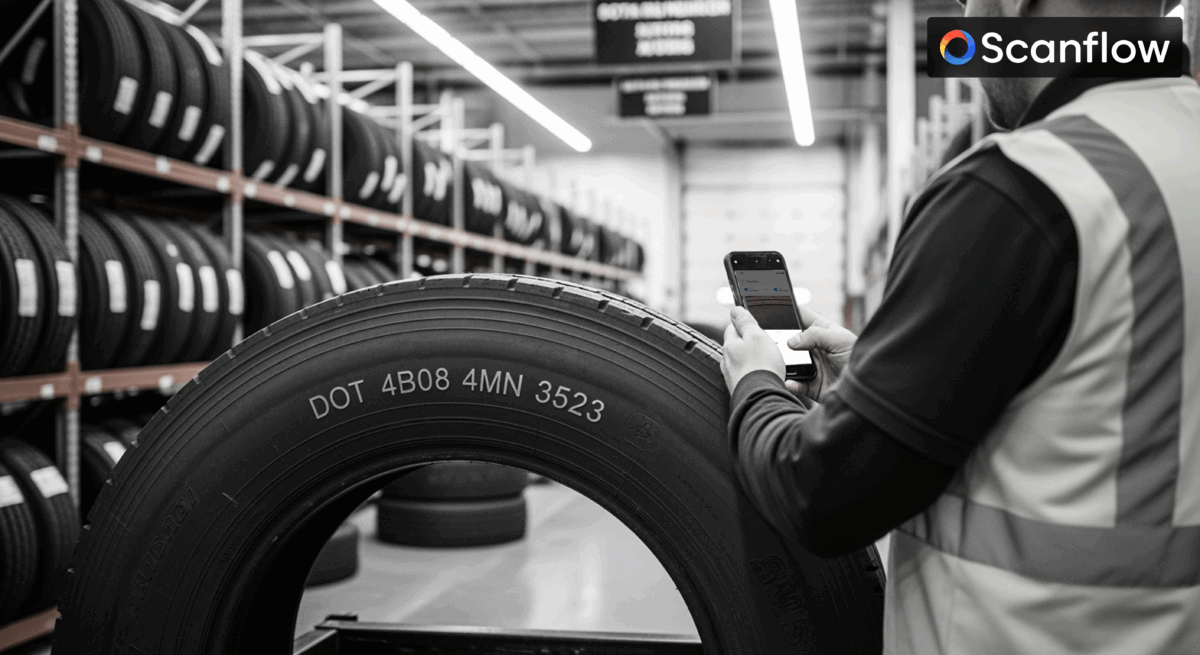
Tire sidewall scanning uses computer vision to read the molded text already present on every tire, including:

  • Tire size

  • Model

  • Load index

  • Speed rating

  • DOT-coded information

  • Manufacturing identifiers

  • Other alphanumeric markings

This method does not rely on printed labels, RFID tags, or externally applied markers. Instead, it captures the tire’s inherent information as the basis of identification.

2.2 Why This Approach Works Better Than Legacy Solutions

Because molded sidewall characters cannot fall off or degrade in the same way printed labels do, sidewall scanning ensures:

  • A permanent, tire-native identifier

  • Reliable recognition even after extended storage

  • Uniform accuracy regardless of storage conditions

  • Consistency across suppliers, plants, or batches

This makes sidewall scanning ideal for Ohio plants dealing with tight production timelines and diverse tire inventories.


3. How Sidewall Scanning Prevents Mix-Ups in Ohio Plants


3.1 Eliminating Human Interpretation Errors

Operators no longer read molded text manually. Instead, sidewall scanning instantly identifies the tire and checks whether it matches the expected SKU in the current workflow step. If not, the system blocks the move or triggers an alert.

3.2 Enhancing Warehouse Accuracy

In receiving, storage, and picking, scanning ensures:

  • Tires are placed in the correct bin or rack.

  • Inventory entries match the actual tire delivered.

  • Real-time visibility shows exactly where each SKU is located.

This prevents the root causes of mix-ups before tires even reach the assembly line.

3.3 Guaranteeing Fitment Accuracy on Assembly Lines

During assembly-line operations, scanning confirms:

  • The tire picked matches the vehicle’s build specification.

  • No alternative or wrong SKU can be fitted without detection.

  • A digital record links each tire to each vehicle build.

This creates a traceable, error-proof fitment process.


4. Integration in Ohio Manufacturing Environments


4.1 Retrofitting Existing Warehouses

Ohio facilities often operate mixed-age infrastructures. Fortunately, sidewall scanning:

  • Works with handheld devices, fixed gate stations, or mobile workstations.

  • Requires no dismantling of existing racks or conveyors.

  • Integrates into workflows without slowing throughput.

Plants can deploy scanning in phases: receiving first, then picking, then assembly.

4.2 Connecting with MES, ERP, and QMS Platforms

Scanflow’s sidewall scanning solution integrates with key production systems, allowing tire identification data to synchronize automatically. This enables:

  • Automated work-order validation

  • Real-time exception handling

  • End-to-end traceability

  • Error-proof production sequencing

For Ohio OEM-supplier plants, this ensures alignment with major automotive compliance requirements.

4.3 Reducing Reliance on Printed Labels

Printed labels create bottlenecks. They require printers, supplies, maintenance, and manual application. Sidewall scanning removes these dependencies entirely.


5. A Realistic Workflow: How Scanflow Operates in Practice


5.1 Step 1: Receiving Verification

When a shipment arrives:

  • Operators scan each tire.
  • The system reads the molded characters.
  • The tire is automatically matched to the purchase order.
  • Any mismatch size, model, or supplier discrepancy is flagged before storage.

This prevents incorrect inventory from entering circulation.

5.2 Step 2: Storage and Inventory Tracking

As tires move into racks:

  • Each scan updates the digital location.

  • Inventory accuracy becomes near-perfect.

  • FIFO or batch-based retrieval rules are applied automatically.

This ensures the right tire will be accessible when needed.

5.3 Step 3: Picking and Staging for Assembly

Pickers scan tires as they retrieve them. If a tire does not match the expected SKU on the work order, the system prevents progression. This protects the assembly line from upstream mistakes.

5.4 Step 4: Assembly-Line Fitment Verification

Before fitment:

  • Operators scan again to confirm the tire matches the build spec.

  • The system logs which tire went onto which vehicle.

  • Fitment errors are eliminated, not corrected afterward but prevented entirely.

This creates a clean digital audit trail without manual documentation.


6. Benefits for Quality Control and Assurance


6.1 Real-Time Validation of Every Tire Movement

Instead of periodic audits, every tire movement becomes a verification point. The system confirms identity at:

  • Receiving

  • Storage

  • Picking

  • Staging

  • Fitment

This protects both product quality and process consistency.

6.2 Traceability from Batch to Vehicle Build

Sidewall scanning ensures every tire carries a digital fingerprint. When recorded through MES integration, manufacturers can trace:

  • Which batch a tire came from

  • When it entered storage

  • Who picked it

  • Which vehicle it was fitted to

This level of lineage strengthens compliance, quality audits, and supplier transparency.

6.3 Eliminating Paper Logs and Manual Recording

Ohio plants often juggle a mix of paper sheets, spreadsheets, handwritten notes, and emails. Sidewall scanning centralizes everything into a consistent digital record, instantly accessible and editable.


7. Why Ohio Manufacturers Are Adopting This Now


7.1 Rising SKU Complexity

Tire manufacturers now produce:

  • More seasonal variants

  • More specialized applications

  • Wider fitment combinations

Human operators cannot differentiate dozens of similar SKUs reliably over long shifts. Automation fills this accuracy gap.

7.2 OEM Expectations for Traceability

Vehicle manufacturers increasingly demand:

  • Full part-level traceability

  • Digital audit records

  • Real-time reporting

Sidewall scanning helps Ohio suppliers meet these expectations without adding manual workload.

7.3 Lean Manufacturing Alignment

Lean principles require:

  • Predictable flow

  • Zero-defect processes

  • Minimal rework

Sidewall scanning fits naturally into lean systems by eliminating defects at the source.


8. Comparison: Sidewall Scanning vs Traditional Identification Methods


8.1 Printed Labels

Pros: Familiar and cheap to produce.
Cons: Fall off, smudge, or degrade; must be applied manually; generate waste.

8.2 Human Reading of Molded Text

Pros: No equipment required.
Cons: Slow, inconsistent, prone to error, fatiguing for operators.

8.3 RFID

Pros: Good for pallet tracking.
Cons: Costs increase when tagging individual tires; tags can fail or become detached.

8.4 Sidewall Scanning

Pros:

  • Reads the tire’s native identifiers

  • Requires no added labels or tags

  • Prevents mix-ups even in high-speed environments

  • Integrates directly with manufacturing workflows


9. Implementing Sidewall Scanning in an Ohio Facility


9.1 Best Practices

  • Start with a pilot in receiving or picking.

  • Evaluate lighting consistency in scanning zones.

  • Train operators to adopt scanning as a standard step.

  • Integrate with MES for real-time validation.

  • Use dashboards to monitor scan accuracy and exceptions.

9.2 Change Management Considerations

Operators need reassurance that scanning:

  • Speeds up their work

  • Reduces rework

  • Protects them from costly mistakes

Managers should present scanning as empowerment, not oversight.

9.3 Scalability for Multi-Plant Operations

Scanflow solutions support standardized workflows across multiple sites, enabling:

  • Unified data structures

  • Shared audit trails

  • Consistent pick-and-fitment logic


10. ROI: The Business Case for Sidewall Scanning


10.1 Cost Avoidance

Mix-up events create:

  • Lost labor

  • Lost materials

  • Line downtime

  • Quality spillover risk

Sidewall scanning prevents these before they occur.

10.2 Higher Throughput

With scanning:

  • Picking decisions are instantaneous

  • Fitment verification becomes frictionless

  • Exception handling is automated

This maintains flow even in high-volume Ohio plants.

10.3 Stronger Supplier Positioning

Manufacturers using sidewall scanning demonstrate:

  • Commitment to traceability

  • Error-proof fitment

  • Clean audit trails

These differentiate Ohio suppliers in the competitive automotive market.


11. Future Outlook: Where Sidewall Scanning Is Headed


Even without discussing defect detection or advanced diagnostics, the future of sidewall scanning is clear:

  • Deeper integration with plant analytics platforms

  • Automated sequencing with live production schedules

  • Machine learning to improve character recognition over time

  • Plant-wide consistency across receiving, storage, and assembly

Sidewall scanning is not a niche tool. It is becoming a foundational component of modern tire manufacturing.


Quick Takeaways


  • Tire sidewall scanning uses AI-driven reading of molded text to identify tires accurately.

  • It eliminates mix-ups caused by labels, manual reading, or mismatched inventory data.

  • Ohio manufacturers integrate scanning from receiving through assembly-line fitment.

  • It strengthens traceability, compliance, and quality assurance.

  • It aligns with lean principles and increasing OEM expectations.

  • It reduces rework, delays, and SKU confusion in high-volume environments.


Conclusion

Tire mix-ups pose a persistent threat to quality, efficiency, and customer satisfaction in the tire manufacturing and vehicle assembly sectors. As Ohio facilities continue to accelerate production and diversify product lines, reliance on manual identification or printed labels introduces unnecessary risk.

Tire sidewall scanning replaces these outdated methods with a stable, accurate, and fully digital identification process. By reading molded text directly from each tire, plants eliminate guesswork at every step. This creates a closed-loop, reliable system of verification from receiving to storage, picking, and assembly-line fitment.

The benefits are immediate: fewer errors, faster throughput, cleaner audits, and stronger compliance with OEM expectations. Over time, plants adopting this technology gain deeper production intelligence and higher consistency across multi-plant operations.

For Ohio manufacturers seeking a modern solution to long-standing identification challenges, tire sidewall scanning is now an essential capability. It strengthens your quality processes, protects your production flow, and ensures every tire reaches the right vehicle without exception.

If you’re ready to elevate your plant’s accuracy and end SKU mix-ups permanently, explore implementing sidewall scanning with Scanflow today.


We’d Love Your Feedback

Did this article help clarify how sidewall scanning improves accuracy and eliminates mix-ups? What’s the biggest identification challenge your facility faces today? Share your thoughts so we can explore solutions together and feel free to pass this article along to colleagues who might benefit.
Categories
Tire Sidewall

Why Intelligent Tyre Traceability Is Becoming Standard Practice for European Distributors 

Across Europe, tyre distribution is undergoing a quiet transformation. What was once a largely manual process dependent on visual checks, handwritten logs, and disconnected data systems is now being redefined by intelligent traceability technologies. Distributors are realizing that knowing exactly what tyre they are handling, from its brand and size to its DOT and TIN information, is no longer optional. It’s a requirement driven by tighter regulations, customer expectations, and supply chain efficiency. 

At Scanflow, we see this shift not just as a compliance necessity but as an opportunity. Intelligent tyre traceability brings accuracy, transparency, and speed to an industry long challenged by complexity. Our Tyre Sidewall Scanner was built to meet these evolving needs empowering distributors and warehouse operators with real-time tyre identification using advanced AI and mobile scanning technology. 

The Growing Demand for Tyre Traceability in Europe 

The European tyre market is one of the most tightly regulated in the world. With increasing emphasis on product authenticity, sustainability, and lifecycle tracking, distributors needs to ensure that every tyre is traceable from arrival to sale. European Union initiatives such as the Circular Economy Action Plan and Extended Producer Responsibility schemes have intensified this focus, pushing distributors to demonstrate full visibility over their tyre inventories. 

At the same time, the supply chain has become more dynamic. Tyres often move between multiple storage facilities, retail outlets, and regions before reaching their final destination. In such a distributed ecosystem, even minor data inconsistencies can lead to significant inefficiencies from shipment errors to warranty claim disputes. 

Real-World Pain Points in Tyre Distribution 

Despite advances in warehouse automation, tyre distribution still suffers from unique and persistent challenges that trace back to poor identification and data capture.

1. Time-Consuming Tyre Identification
In most distribution centers, workers still rely on manual reading of tyre markings to log DOT and TIN codes. These alphanumeric sequences are often embossed on curved, dirty, or low-contrast sidewalls. The result is frequent misreads, inconsistent entries, and wasted time. For large distributors handling thousands of tyres daily, this slows operations dramatically.

2. Stock Aging and Traceability Gaps

Without automated traceability, it’s easy for older tyres to remain unnoticed in inventory. Distributors risk shipping products that are nearing or beyond recommended shelf age creating liability concerns and dissatisfied customers. Maintaining visibility into tyre age and batch details becomes almost impossible when data capture is inconsistent or delayed.

3. Warranty and Recall Management Difficulties
When a manufacturer issues a recall or quality alert, distributors must act fast. But without precise DOT/TIN traceability, identifying affected tyres can take days or weeks. That delay not only risks compliance penalties but also damages customer trust.

4. Inconsistent Branding and Model Data
Tyres from multiple manufacturers arrive daily with varying layouts, fonts, and surface conditions. This diversity makes it hard to standardize records. A tyre might be logged as “Pirelli P7” in one system and “Pirelli Cinturato P7” in another. Such discrepancies complicate data analytics, forecasting, and ERP synchronization.

5. Pressure for Digital Integration
Distributors are modernizing rapidly, connecting their warehouse management systems (WMS) and enterprise resource planning (ERP) platforms. Yet, without accurate tyre-level data capture, the full potential of digital transformation remains out of reach.

How Scanflow Tyre Sidewall Scanner Solves These Challenges 

The Scanflow Tyre Sidewall Scanner was designed specifically to address these operational realities. Using AI-powered mobile scanning, it can recognize and extract critical tyre details including DOT and TIN codes, size, brand, and age instantly and accurately. 

Unlike traditional barcode or manual OCR methods, Scanflow’s solution interprets sidewall text and patterns through deep learning models trained on thousands of tyre variations. It operates effectively under the real conditions of warehouses: low light, uneven surfaces, and varying tyre orientations. 

Key Advantages: 

  • Mobile-First Design
    Scanflow Tyre Sidewall Scanner can be deployed on smartphones or rugged mobile devices. This gives warehouse operators flexibility to scan anywhere on the floor without fixed stations or specialized hardware. 
  • AI Precision in Real Conditions
    The system adapts to different fonts, engravings, and surface wear. Even partially obscured or aged sidewall markings can be recognized with high accuracy, minimizing manual intervention. 
  • Instant Data Capture and Integration
    Captured tyre data syncs automatically with warehouse or ERP systems, enabling seamless traceability across the supply chain. Every scan becomes a verified data point enhancing accuracy in stock records, inventory audits, and shipment planning. 
  • Traceability with Speed and Simplicity
    What once required slow manual logging can now be completed in seconds. Distributors gain both efficiency and compliance assurance without changing existing workflows.

The Operational Impact for European Distributors 

Adopting intelligent tyre traceability isn’t only about technology; it’s about transforming operations. With Scanflow Tyre Sidewall Scanner, distributors can expect measurable improvements in several areas: 

  • Reduced Handling Time: Workers can identify and record each tyre’s details instantly, accelerating inbound and outbound processing. 
  • Error-Free Data: Eliminates human input errors and ensures consistency across systems. 
  • Optimized Stock Rotation: Real-time visibility into tyre age and production batches prevents over-aging and improves inventory utilization. 
  • Regulatory Readiness: Maintains complete digital traceability aligned with emerging European sustainability and labeling standards. 
  • Streamlined Warranty Management: Enables rapid identification of affected tyres during recalls or audits. 

These capabilities give distributors a new level of control and visibility. Instead of reacting to errors or delays, they can proactively manage quality, compliance, and performance. 

Intelligent Traceability: The New Standard 

As the European tyre industry continues to evolve, intelligent traceability will become the standard expectation rather than a competitive advantage. Distributors who adopt early gain not just efficiency but trust from manufacturers, regulators, and customers alike. 

With growing scrutiny over tyre origin, sustainability, and lifecycle data, the ability to verify every tyre’s identity in real time is critical. Scanflow’s Tyre Sidewall Scanner brings that capability within reach of every distributor, combining AI intelligence with mobile convenience. 

 Conclusion 

The future of tyre distribution in Europe is digital, data-driven, and transparent. Intelligent tyre traceability is no longer an aspiration; it’s a necessity for competitiveness and compliance. 

At Scanflow, we are committed to helping distributors embrace this transformation seamlessly. Our Tyre Sidewall Scanner delivers the accuracy, speed, and integration capability required to make traceability a natural part of everyday operations. 

Categories
Tire Sidewall

Top 5 Reasons US Tire Distributors Are Switching to AI Tire Sidewall Scanners

Introduction

The tire distribution industry is changing faster than ever. As the U.S. market expands, distributors face increasing SKU diversity, tighter profit margins, and greater compliance demands. Every tire must be accurately tracked from arrival to dispatch yet manual data entry and visual inspections often cause costly errors and inefficiencies.

This is where AI tire sidewall scanners are revolutionizing tire distribution. By instantly capturing the vital sidewall data of every tire brand, model, size, and serial information they enable distributors to streamline inventory, enhance traceability, and operate more efficiently.

Across the U.S., forward-thinking tire distributors are adopting Scanflow’s AI Tire Sidewall Scanner, integrating advanced automation into their everyday operations. Below are the top five reasons driving this major shift in the industry.

1. Precision and Error-Free Identification in Tire Distribution

In traditional tire distribution, warehouse teams manually record tire details using handwritten notes or spreadsheets. This process often leads to misreads, incorrect SKU entries, and mismatched tires issues that cause delays, returns, and profit loss.

By contrast, a tire sidewall scanner powered by artificial intelligence eliminates these risks. With a quick scan, the system identifies each tire’s sidewall data including manufacturer name, size, and serial details ensuring that the correct information is instantly recorded in the digital inventory.

For distributors, this precision means:

  • Fewer shipping and labeling mistakes.
  • Consistent accuracy across multiple locations.
  • Stronger trust with retail and fleet customers.

In a competitive landscape, where customer satisfaction depends on fast, accurate fulfillment, error-free identification is the new standard and tire sidewall scanning makes it possible.

2. Real-Time Inventory Visibility Across the Warehouse

Inventory visibility is the heartbeat of successful tire distribution. Yet many warehouses still struggle with misplaced stock, aged inventory, and slow reconciliation processes.

With a tire sidewall scanner, each tire becomes digitally traceable from the moment it enters the warehouse. Every scan automatically updates the inventory system, giving distributors a real-time snapshot of stock levels and locations.

For example, with Scanflow’s AI tire sidewall scanner, warehouse teams can:

  • Track each tire’s journey through receiving, storage, and dispatch.
  • Prevent losses from misplacement or duplication.
  • Implement smarter rotation strategies (FIFO or FEFO).
  • Optimize space utilization and reduce manual stock counts.

The result is a seamless, data-driven operation where every tire is accounted for. This technology doesn’t just improve efficiency it transforms how warehouse teams manage and move inventory.

3. Speed and Scalability Across Distribution Centers

The U.S. tire distribution network is expanding, with larger facilities, growing product lines, and higher customer expectations. Manual tire checks simply can’t keep up with the pace and volume of modern operations.

A tire sidewall scanner offers scalability that traditional methods can’t match. It enables operators to process hundreds of tires per hour, cutting inspection and data entry times dramatically.

Scanflow’s solution provides flexible deployment options from mobile scanning on handheld devices to fixed scanning stations that handle high-volume workflows. As a result, tire distributors can:

  • Increase throughput across multiple facilities.
  • Maintain consistent accuracy regardless of warehouse size.
  • Expand operations without increasing labor costs.

Whether scanning individual tires or entire batches, AI sidewall scanning empowers teams to work faster, safer, and smarter giving distributors a tangible edge in speed-to-market.

4. Traceability, Compliance, and Risk Management

Traceability is no longer optional in tire distribution it’s a requirement. U.S. regulations demand complete visibility into tire manufacturing data (such as DOT and production codes) to ensure safety, facilitate recalls, and verify warranty claims.

Manually managing this data exposes distributors to compliance risks and inefficiencies. Tire sidewall scanners solve this by automatically capturing every key identifier directly from the tire surface, creating a digital record for each unit.

With Scanflow AI tire sidewall scanner, distributors can:

  • Maintain verifiable audit trails for every tire.
  • Respond instantly to recall or warranty requests.
  • Eliminate paperwork and manual tracking errors.
  • Build full transparency into the supply chain.

This level of traceability not only ensures compliance but also enhances brand reputation signaling professionalism, reliability, and accountability to partners and customers alike.

5. Competitive Advantage Through Digital Transformation

The shift toward automation and data-driven operations is defining the future of tire distribution. Distributors that embrace these tools are emerging as leaders in efficiency and customer satisfaction.

Scanflow AI tire sidewall scanner provides more than operational benefits it fuels strategic growth. The data insights captured through tire scanning can reveal patterns in stock movement, aging inventory, and product performance.

With this information, distributors can:

  • Forecast demand more accurately.
  • Optimize tire stocking levels.
  • Reduce waste and overstocking.
  • Provide faster, more reliable service to customers.

By positioning themselves as technology-driven partners, U.S. tire distributors using Scanflow’s solution gain a long-term competitive advantage. They’re not just managing inventory they’re driving the future of tire distribution.

Conclusion

From precision and visibility to compliance and scalability, AI tire sidewall scanners are reshaping the tire distribution industry.

Scanflow stands at the forefront of this transformation. Its AI tire sidewall scanner helps distributors automate the most error-prone part of their workflow tire identification while empowering teams with real-time data insights.

It’s clear: adopting tire sidewall scanning isn’t just an operational upgrade, it’s a strategic investment in the future of tire distribution.

Ready to take the next step?
👉 Contact Scanflow today to learn how AI tire sidewall scanning can change your warehouse and distribution operations.

Categories
Tire Sidewall

How tire distributors can reduce inventory errors by 96% with tire sidewall scanning

Introduction: The Hidden Cost of Inventory Errors

In the fast-moving tire distribution industry, every detail counts. Tire distributors manage thousands of SKUs, multiple brands, and a wide range of sizes, models, and production dates all while ensuring that the right tire reaches the right retailer or service center on time. Despite advancements in warehouse technology, inventory errors remain one of the most persistent and costly problems in the industry.

Misidentified tires, mismatched records, and misplaced inventory can cost distributors millions annually in lost revenue, inefficiency, and customer dissatisfaction. Traditional methods such as barcode labels and manual entry simply can’t keep up with the complexity and scale of modern tire logistics.

This is where AI tire sidewall scanning becomes a game changer. By using intelligent image recognition technology, tire distributors can automate the identification process, streamline warehouse operations, and reduce inventory errors by up to 96%.

The Limitations of Traditional Inventory Tracking

Most tire distributors have relied on conventional methods for decades barcode scanning, manual labeling, or RFID systems. While these approaches once represented the cutting edge of logistics, they now pose several challenges in the modern environment.

1. Label Dependence
Barcodes and stickers can easily fall off, fade, or become unreadable in warehouses where dirt, oil, and moisture are common. Once a label is missing or damaged, tracking that tire becomes a manual, error-prone task.

2. Manual Data Entry Errors
Human operators must often record tire specifications like size, brand, or DOT number manually, especially when dealing with unlabelled stock. This process is slow and subject to input mistakes, particularly in high-volume operations.

3. Time-Consuming Audits
Warehouse audits, often done manually, can take days or weeks to verify tire counts and models. Each round of checking interrupts operations and increases labor costs.

4. Limited Real-Time Visibility
Traditional tracking systems often update in batches, which means real-time accuracy is limited. This delay can cause mismatched stock reports and missed sales opportunities.

In short, outdated inventory management methods cannot provide the precision or speed today’s tire distributors need.

The Rise of AI-Driven Tire Sidewall Scanning

To solve these persistent issues, forward-thinking distributors are adopting AI-based tire sidewall scanners an advanced technology that leverages computer vision, pattern recognition, and machine learning to identify tires based on their unique embossed sidewall details.

Unlike barcodes or RFID tags, the AI tire sidewall scanner reads the tire itself extracting key details such as brand, model, size, and DOT code directly from the physical tire. By focusing on the natural imprints on the tire, AI scanning removes the dependency on external labeling altogether.

The result? Faster, more accurate, and fully automated tire identification.

How the Tire Sidewall Scanner Works

The tire sidewall scanner for distributors uses a high-resolution imaging system combined with AI-based pattern recognition algorithms. Here’s how it works step by step:

1. Image Capture:
As the tire passes through the scanning station or handheld unit, cameras capture multiple angles of the sidewall.

2. AI Recognition:
The system’s deep learning model identifies embossed details such as the manufacturer’s name, size (e.g., 205/55R16), load index, and DOT code.

3. Data Extraction and Verification:
Extracted information is matched against existing inventory databases to confirm the model and stock status.

4. Real-Time Syncing:
The scanner connects with warehouse management systems (WMS) or ERP software to automatically update stock counts, movement logs, and dispatch records. This automated process eliminates manual typing, barcode dependency, and the risk of human oversight all while ensuring that every tire in the warehouse is accounted for accurately and instantly.

Why Tire Distributors Are Adopting AI Scanning

1. Unmatched Accuracy and Consistency

Unlike human operators who may fatigue or overlook details, an AI tire sidewall scanner maintains consistent accuracy across thousands of scans. Even worn, dusty, or partially visible markings can be recognized with precision, ensuring reliable tracking in all warehouse conditions.

2. Significant Reduction in Inventory Errors

Studies and field data show that distributors using AI scanning experience up to 90% fewer inventory discrepancies. This improvement translates into fewer shipment delays, reduced customer complaints, and tighter control over stock valuation.

3. Improved Operational Speed

With manual methods, scanning and recording tire details might take 20–30 seconds per unit. AI scanning can process the same tire in under 3 seconds, resulting in a throughput increase of more than 10×.

4. Seamless Data Integration

AI tire identification systems are designed to integrate effortlessly with leading WMS and ERP solutions. That means all tire data from arrival to dispatch is automatically captured, stored, and synced, ensuring end-to-end visibility without manual intervention.

5. Enhanced Traceability and Compliance

For safety and regulatory compliance, tracking DOT codes is essential. AI scanning makes it easy to maintain a digital record of every tire’s lifecycle from manufacturing batch to end user. This capability supports faster recalls, audits, and customer service responses.

Real-World Applications in Tire Distribution

Inbound Inventory Management

When new stock arrives, tires are scanned automatically as they’re unloaded. The system identifies each tire’s brand, model, and size, and logs it into the warehouse system. Any mismatches between purchase orders and received goods are flagged immediately.

Storage and Shelf Organization

AI-scanned tires can be automatically sorted into appropriate zones or bins. The system suggests optimal placement for quick retrieval, improving space utilization and reducing search time for pickers.

Order Fulfillment and Shipping

Before shipping, every tire is re-scanned to confirm the correct model and size for each order. This double-verification process nearly eliminates shipping errors and ensures customers receive the right products.

Returns and Reverse Logistics

When returned tires come back, the scanner verifies their details instantly, confirming whether the product matches original sale data. This simplifies warranty claims and return processing.

Quantifying the Impact: From Errors to Efficiency

Let’s look at the measurable benefits achieved by distributors who have implemented AI tire scanning systems like Scanflow’s Tire Sidewall Scanner:

  • 90% Reduction in Inventory Errors: Automatic identification ensures each tire is logged correctly, minimizing loss and miscounts.
  • 50% Increase in Warehouse Throughput: Faster scanning reduces handling time per tire.
  • 30% Lower Labor Costs: Fewer manual checks and data entries allow staff to focus on high-value tasks.
  • 100% Real-Time Visibility: Live synchronization with WMS gives managers a clear picture of stock at all times.
  • Improved Customer Satisfaction: Accurate orders and faster deliveries enhance distributor reputation and repeat business.

These numbers reflect not just operational efficiency but also strategic value. Accurate inventory management supports better forecasting, smoother supply chain operations, and stronger customer relationships.

Why Scanflow Leads in Tire Sidewall Scanning

As a pioneer in AI scanning solutions for industrial operations, Scanflow has designed its tire sidewall scanning system specifically for the needs of tire distributors. Unlike generic image recognition tools, Scanflow’s solution has been trained on thousands of tire models across multiple brands to ensure near-perfect recognition accuracy.

Scanflow’s Competitive Advantages

  • Specialized AI Models: Built exclusively for tire identification, not general image recognition.
  • Hardware Flexibility: Available as fixed stations, mobile scanners, or integrated conveyor systems.
  • Plug-and-Play Integration: Connects easily with existing warehouse management platforms.
  • Cloud Analytics Dashboard: Provides real-time insights into stock movement, scan statistics, and warehouse performance.
  • Scalability: Suitable for both small regional distributors and large global supply networks.

With these capabilities, Scanflow enables distributors to automate their operations from the ground up without needing to replace existing systems.

The Business Case for AI Tire Scanning

The decision to invest in an AI tire sidewall scanner is not just about reducing human errors it’s about future-proofing your business.

Return on Investment (ROI)

Most distributors recover their investment within the first year of deployment through a combination of reduced losses, labor savings, and faster turnover. The improved data accuracy also helps optimize stock levels, freeing up working capital and improving cash flow.

Competitive Differentiation

In an industry where margins are tight and delivery accuracy determines client loyalty, the ability to guarantee near-perfect fulfillment is a major competitive advantage. Distributors who leverage AI scanning can promise accuracy and traceability that manual systems simply can’t match.

Sustainability Benefits

By improving inventory accuracy and reducing waste from misplaced or expired tires, AI scanning contributes to a more sustainable and environmentally responsible supply chain an increasingly important factor for global brands and partners.

Implementing AI Tire Scanning: What to Expect

Introducing AI tire scanning into an existing distribution setup is surprisingly straightforward.

  1. Assessment and Planning:
    Scanflow’s team analyzes the distributor’s warehouse layout, tire flow, and system integration needs.
  2. Installation and Integration:
    The tire sidewall scanner is installed at critical points — inbound, outbound, or quality control areas. Integration with existing software ensures seamless data transfer.
  3. Training and Onboarding:
    Operators receive brief training to handle the scanning interface. Most staff can start using the system effectively within a single day.
  4. Performance Monitoring:
    Scanflow provides ongoing support and analytics dashboards to measure performance improvements, track accuracy rates, and optimize throughput.

Looking Ahead: The Future of Tire Distribution

As AI technology continues to evolve, the potential applications for tire distributors are expanding rapidly. Future iterations of AI tire sidewall scanners will include predictive analytics, automated sorting robots, and even integration with vehicle service centers for full tire lifecycle tracking.

The goal is to create a completely connected tire ecosystem one where every tire is identifiable, traceable, and verifiable from manufacturer to end user.

In this future, distributors using AI scanning won’t just manage inventory; they’ll orchestrate intelligent supply networks that adapt, learn, and optimize themselves continuously.

Conclusion: A Smarter, More Accurate Future for Tire Distribution

Inventory errors have long been a silent drain on profitability for tire distributors. But with the advent of AI-powered tire sidewall scanners, the days of manual miscounts and mislabeled stock are coming to an end.

By adopting this innovative technology, distributors can achieve:

  • Up to 90% reduction in errors
  • Real-time inventory accuracy
  • Streamlined warehouse operations
  • Faster order fulfillment
  • Greater customer trust

Scanflow’s AI scanning solutions empower tire distributors to transition from reactive management to proactive intelligence setting new standards for efficiency, reliability, and growth.

Categories
Tire Sidewall

How Tire Sidewall Scanner for Commercial Vehicles is Optimizing Fleet Operations

Why Tire Data Matters More Than Ever for Fleets

Fleet management has entered a new era where data accuracy determines efficiency and safety. Tires are among the most critical and often overlooked components of a vehicle. Every tire carries a unique identity through sidewall information like the DOT and TIN numbers, which track manufacturing details, size, and compliance.

In commercial fleets with hundreds or thousands of tires, tracking this information manually is time consuming and error prone. That’s where Scanflow’s tire sidewall scanner for commercial vehicles transforms operations by digitizing and automating how tire information is captured, stored, and managed.

The Challenge: Manual Tire Inspections Don’t Scale

Fleet maintenance teams often rely on manual note-taking or barcode stickers to track tires. But these methods introduce several operational challenges:

  • Inaccurate records: Illegible handwriting and transcription errors can result in data inconsistencies.
  • Lost traceability: Tires are replaced or rotated frequently, making it difficult to match them to vehicles.
  • Compliance risk: Missing or wrong TIN data can complicate recalls or audits.
  • Time waste: Inspecting each tire manually can take 2–3 minutes, slowing down fleet checks.

With hundreds of tires to inspect, these inefficiencies add up quickly resulting in lost productivity and missed insights.

Automating Tire Identification for Commercial Vehicles

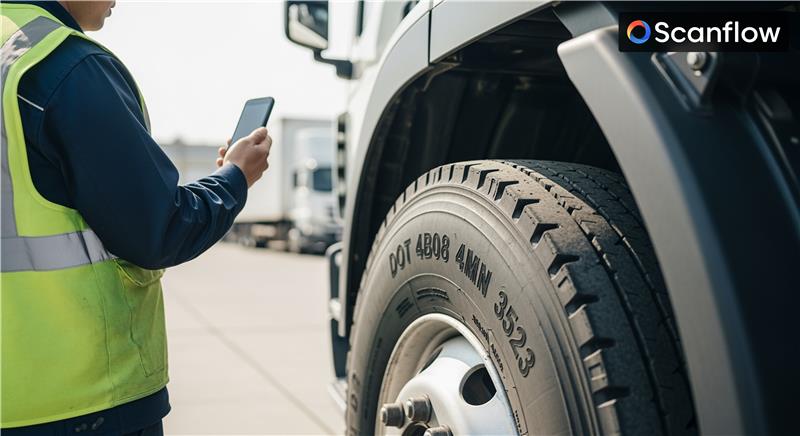
Scanflow’s tire sidewall scanner uses computer vision and AI to recognize embossed and printed codes directly from tire sidewalls. Using a smartphone, tablet, or handheld device, technicians can scan each tire in seconds even in dirty, low-light, or worn conditions.

The system captures key information including:

  • DOT and TIN codes
  • Manufacturer and model
  • Size and serial numbers
  • Optional QR or barcode data

Once captured, this information syncs automatically with fleet management or maintenance systems, giving managers a real-time view of every tire in their operation.

Key Benefits for Fleet Managers

1.Rapid Inspections and Real-Time Updates

Technicians can scan and record tire details in under 10 seconds. This enables more frequent checks and faster decision-making.

2.Improved Tire Traceability

Each tire is digitally linked to a vehicle and location, ensuring full traceability through its lifecycle from installation to replacement.

3.Lower Operational Costs

By automating inspections, fleets save hundreds of labor hours annually while preventing costly errors related to misidentified tires.

4.Enhanced Safety and Compliance

The system ensures accurate TIN and DOT data capture, simplifying recall compliance and safety audits.

5.Integration-Ready Technology

Scanflow connects seamlessly with existing fleet management platforms, enabling data synchronization without disrupting current workflows.

Built for the Real World: Why Fleets Trust Scanflow

Commercial fleets operate in challenging environments dusty depots, outdoor yards, and low-light garages.

Scanflow’s AI-driven system is designed specifically for these conditions, offering:

  • Low-contrast text detection for worn or dirty sidewalls.
  • Offline scanning capability for remote locations.
  • Multi-device compatibility across Android, iOS, and rugged scanners.
  • API and SDK support for custom fleet integrations.

These features make it a practical and scalable solution for logistics companies, trucking fleets, and transport providers across the U.S.

Real-World Impact: Smarter Fleet Maintenance

With Scanflow, fleets can monitor tire performance across every vehicle. Instead of manually checking each tire, managers receive live data on:

  • Tire age
  • Replacement history
  • Usage distribution across routes
  • Upcoming maintenance requirements

This visibility leads to better tire rotation strategies, optimized replacement schedules, and longer tire life translating into measurable cost savings.

Mobile Flexibility: Tire Scanning Anywhere, Anytime

One of Scanflow’s biggest strengths is mobility.

Technicians don’t need specialized hardware; they can use their smartphones to scan and upload tire data instantly. This makes it easy to:

  • Conduct roadside inspections.
  • Track tire changes during long-haul trips.
  • Validate tire data at delivery or return points.

Every scan is timestamped and geo-tagged, creating a verifiable record of tire maintenance across the fleet.

Implementation and ROI

Step 1: Deploy Scanflow’s SDK or app to your mobile devices.

Step 2: Train field staff  typically within a few minutes.

Step 3: Integrate tire scan data into your fleet management system.

Step 4: Track results in your dashboard error reduction, time saved, and compliance metrics.

Let’s take a comparison of measurable outcomes between manual inspection and Scanflow.

Metric Manual Process With Scanflow
Time per tire 2–3 minutes Under 10 seconds
Error rate 5–10% <1%
Average savings Up to 80% time reduction


The Future of Tire Management in Fleets

As tire distributors adopt digital identifiers like QR codes and embedded chips, the role of scanning will expand even further. Scanflow’s platform is built to evolve supporting QR and barcode recognition, and preparing for upcoming standards in smart tire identification.

This ensures your fleet remains ready for the next generation of digital vehicle maintenance.

Conclusion: Smarter Fleets Start with Smarter Scanning

Managing commercial vehicles efficiently depends on reliable, accurate data. With Scanflow tire sidewall scanner for commercial vehicles, fleets can replace manual, error-prone inspections with a seamless digital workflow.

From faster inspections to improved compliance and lower operational costs, Scanflow helps fleet managers take control of their tire data  turning every inspection into actionable intelligence.

If your fleet is ready to move faster, safer, and smarter, Scanflow is the technology partner to get you there.

QR Floating