Introduction
The tire distribution industry is changing faster than ever. As the U.S. market expands, distributors face increasing SKU diversity, tighter profit margins, and greater compliance demands. Every tire must be accurately tracked from arrival to dispatch yet manual data entry and visual inspections often cause costly errors and inefficiencies.
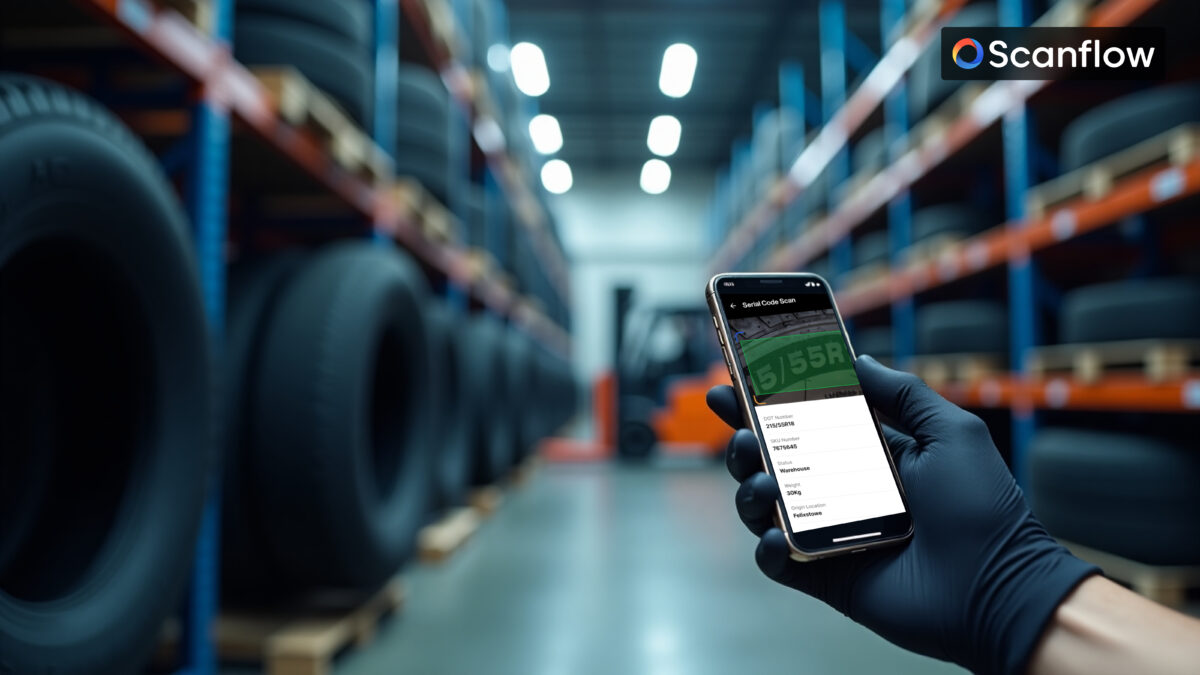
This is where AI tire sidewall scanners are revolutionizing tire distribution. By instantly capturing the vital sidewall data of every tire brand, model, size, and serial information they enable distributors to streamline inventory, enhance traceability, and operate more efficiently.
Across the U.S., forward-thinking tire distributors are adopting Scanflow’s AI Tire Sidewall Scanner, integrating advanced automation into their everyday operations. Below are the top five reasons driving this major shift in the industry.
1. Precision and Error-Free Identification in Tire Distribution
In traditional tire distribution, warehouse teams manually record tire details using handwritten notes or spreadsheets. This process often leads to misreads, incorrect SKU entries, and mismatched tires issues that cause delays, returns, and profit loss.
By contrast, a tire sidewall scanner powered by artificial intelligence eliminates these risks. With a quick scan, the system identifies each tire’s sidewall data including manufacturer name, size, and serial details ensuring that the correct information is instantly recorded in the digital inventory.
For distributors, this precision means:
- Fewer shipping and labeling mistakes.
- Consistent accuracy across multiple locations.
- Stronger trust with retail and fleet customers.
In a competitive landscape, where customer satisfaction depends on fast, accurate fulfillment, error-free identification is the new standard and tire sidewall scanning makes it possible.
2. Real-Time Inventory Visibility Across the Warehouse
Inventory visibility is the heartbeat of successful tire distribution. Yet many warehouses still struggle with misplaced stock, aged inventory, and slow reconciliation processes.
With a tire sidewall scanner, each tire becomes digitally traceable from the moment it enters the warehouse. Every scan automatically updates the inventory system, giving distributors a real-time snapshot of stock levels and locations.
For example, with Scanflow’s AI tire sidewall scanner, warehouse teams can:
- Track each tire’s journey through receiving, storage, and dispatch.
- Prevent losses from misplacement or duplication.
- Implement smarter rotation strategies (FIFO or FEFO).
- Optimize space utilization and reduce manual stock counts.
The result is a seamless, data-driven operation where every tire is accounted for. This technology doesn’t just improve efficiency it transforms how warehouse teams manage and move inventory.
3. Speed and Scalability Across Distribution Centers
The U.S. tire distribution network is expanding, with larger facilities, growing product lines, and higher customer expectations. Manual tire checks simply can’t keep up with the pace and volume of modern operations.
A tire sidewall scanner offers scalability that traditional methods can’t match. It enables operators to process hundreds of tires per hour, cutting inspection and data entry times dramatically.
Scanflow’s solution provides flexible deployment options from mobile scanning on handheld devices to fixed scanning stations that handle high-volume workflows. As a result, tire distributors can:
- Increase throughput across multiple facilities.
- Maintain consistent accuracy regardless of warehouse size.
- Expand operations without increasing labor costs.
Whether scanning individual tires or entire batches, AI sidewall scanning empowers teams to work faster, safer, and smarter giving distributors a tangible edge in speed-to-market.
4. Traceability, Compliance, and Risk Management
Traceability is no longer optional in tire distribution it’s a requirement. U.S. regulations demand complete visibility into tire manufacturing data (such as DOT and production codes) to ensure safety, facilitate recalls, and verify warranty claims.
Manually managing this data exposes distributors to compliance risks and inefficiencies. Tire sidewall scanners solve this by automatically capturing every key identifier directly from the tire surface, creating a digital record for each unit.
With Scanflow AI tire sidewall scanner, distributors can:
- Maintain verifiable audit trails for every tire.
- Respond instantly to recall or warranty requests.
- Eliminate paperwork and manual tracking errors.
- Build full transparency into the supply chain.
This level of traceability not only ensures compliance but also enhances brand reputation signaling professionalism, reliability, and accountability to partners and customers alike.
5. Competitive Advantage Through Digital Transformation
The shift toward automation and data-driven operations is defining the future of tire distribution. Distributors that embrace these tools are emerging as leaders in efficiency and customer satisfaction.
Scanflow AI tire sidewall scanner provides more than operational benefits it fuels strategic growth. The data insights captured through tire scanning can reveal patterns in stock movement, aging inventory, and product performance.
With this information, distributors can:
- Forecast demand more accurately.
- Optimize tire stocking levels.
- Reduce waste and overstocking.
- Provide faster, more reliable service to customers.
By positioning themselves as technology-driven partners, U.S. tire distributors using Scanflow’s solution gain a long-term competitive advantage. They’re not just managing inventory they’re driving the future of tire distribution.
Conclusion
From precision and visibility to compliance and scalability, AI tire sidewall scanners are reshaping the tire distribution industry.
Scanflow stands at the forefront of this transformation. Its AI tire sidewall scanner helps distributors automate the most error-prone part of their workflow tire identification while empowering teams with real-time data insights.
It’s clear: adopting tire sidewall scanning isn’t just an operational upgrade, it’s a strategic investment in the future of tire distribution.
Ready to take the next step?
👉 Contact Scanflow today to learn how AI tire sidewall scanning can change your warehouse and distribution operations.