Categories
Tire Sidewall

How to Ensure Traceability of Scrap Tires from Intake to Processing Using AI Scanning

Introduction: The Growing Challenge of Tire Traceability 

Every year, billions of scrap tires reach the end of their useful life. Managing these tires responsibly is not just an environmental duty but a regulatory requirement in many regions. Yet, one of the biggest challenges facing recyclers and scrap tire handlers is ensuring traceability knowing exactly where each tire came from, its composition, and how it is processed. Traditional manual logging or barcode tagging falls short when handling large volumes or mixed sources.

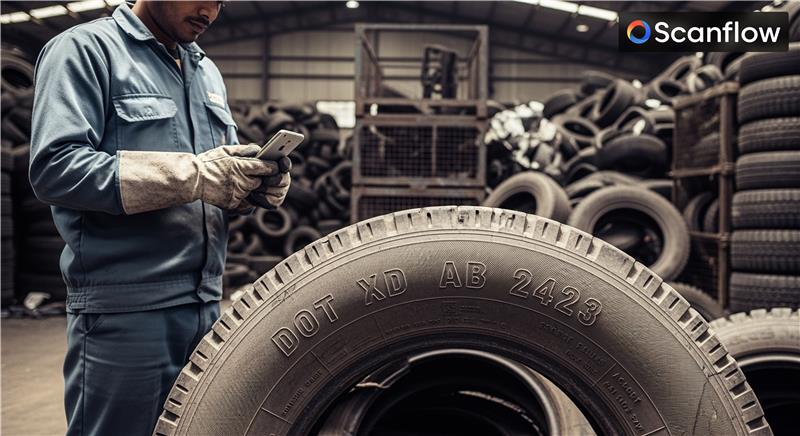
This is where tire sidewall scanning solutions, like those from Scanflow, are transforming the recycling process. By automating identification through tire sidewall scanners and AI vision models, recyclers can establish a complete digital chain of custody from intake to final processing.

 Why Traceability Matters in Tire Recycling 

Traceability is critical for both regulatory compliance and operational efficiency. 

  • Regulatory compliance: Many regions require proof that scrap tires are processed or disposed of safely. Automated traceability reduces errors and ensures transparent reporting. 
  • Operational insight: Knowing tire types, brands, and conditions helps recyclers separate retreadable tires from shredding-grade ones, optimizing resource use. 
  • Sustainability and accountability: In a circular economy, data transparency ensures materials are reintroduced responsibly into the production cycle. 

Traditional methods manual data entry, stickers, or barcodes can be unreliable. Dirt, wear, or handling conditions often obscure identifiers. An AI-based tire scanner overcomes these challenges with machine vision that reads even worn-out markings. 

How AI Tire Scanning Works 

Modern tire scanners use high-resolution cameras combined with deep learning models trained to identify and extract text and structural patterns from tire sidewalls. 

At Scanflow, the tire sidewall scanner captures key data points such as:

  • DOT code / TIN (Tire Identification Number)
  • Brand and model
  • Size and load index
  • Date of manufacture and age
  • Stencil numbers and serial details

Once captured, the system automatically validates and stores these details in a digital database. Each scanned tire is assigned a unique digital profile, linking it to subsequent handling steps collection, sorting, shredding, or reuse. 

From Intake to Processing: End-to-End Traceability 

Let’s break down how AI scanning ensures full traceability across the tire recycling workflow.

1. Intake and Registration

When scrap tires arrive at a facility, they are scanned using AI tire sidewall scanners at the intake point.
The system automatically reads DOT numbers, brand names, and sizes, registering each tire without manual input.
This step replaces paper-based logs and immediately creates a digital record that can be tracked throughout its lifecycle.

2. Sorting and Classification

Once identified, tires are automatically classified using AI algorithms. For example:

  • Retread candidates are directed to recovery lines.
  • Scrap tires are queued for shredding or pyrolysis.
    The scrap tire scanning data helps optimize sorting efficiency while maintaining a verifiable audit trail.

3. Integration with Backend Systems

Scanflow integrates seamlessly with ERP, waste management, or recycling plant software. This allows tire data to sync automatically with operational workflows inventory, logistics, or compliance modules ensuring that the traceability data remains consistent across all systems.

4. Processing and Final Reporting

At each processing stage cutting, shredding, or pyrolysis the tire’s unique ID is maintained. The system logs which tires have been recycled, repurposed, or destroyed.
With a few clicks, facility managers can generate comprehensive traceability reports showing each tire’s journey, satisfying both internal audits and external regulatory requirements.  

Key Advantages of Using AI-Based Tire Scanning 

Implementing AI-driven tire scanning technology delivers tangible benefits:

  • Accuracy and speed
    Automated tire sidewall scanners eliminate human error, processing thousands of tires daily with unmatched precision. 
  • Regulatory compliance
    Ensures that every tire processed has a verifiable origin and documented disposal method. 
  • Operational transparency
    Digital traceability enhances accountability between collection partners, transporters, and recyclers. 
  • Data-driven optimization
    Real-time analytics from Scanflow dashboards enable better forecasting, inventory management, and process improvement. 
  • Sustainability alignment
    AI-enabled traceability supports circular economy goals by ensuring tires are reused or recycled responsibly. 

How Scanflow Leads the Way 

Scanflow specializes in intelligent scanning and vision solutions for industrial automation. Its AI tire scanner platform is built specifically for the tire recycling sector, combining advanced image recognition with cloud-based data management. 

Some standout features include: 

  • Edge AI processing for real-time scanning even in rugged environments 
  • Automatic OCR for DOT/TIN recognition 
  • Brand and size classification using deep learning models 
  • Seamless integration with recycling ERP and waste management systems 
  • Analytics dashboards to track throughput and performance metrics 

By automating the entire identification and traceability chain, scanflow helps recyclers reduce manual work, improve accuracy, and ensure full compliance with local and international recycling standards.  

Future Outlook: AI-Powered Circular Tire Management 

The future of tire recycling will rely heavily on connected data ecosystems. As more facilities adopt scrap tire scanning technologies, it will become possible to share traceability data across regional or global recycling networks. 

Imagine a world where every tire has a digital twin accessible through an AI-driven database allowing producers, regulators, and recyclers to collaborate seamlessly toward sustainability goals. 

AI-driven tire scanning is not just an efficiency tool. It’s a foundation for transparent, circular, and data-driven waste management. 

 Conclusion 

Traceability is no longer optional in tire recycling it’s essential. AI scanning bridges the gap between manual inefficiency and automated intelligence, making it possible to track every tire from intake to final processing with speed and accuracy. 

With its specialized tire sidewall scanner and AI tire recognition system, Scanflow empowers recyclers and scrap tire handlers worldwide to achieve full visibility, regulatory compliance, and sustainability alignment. 

As the global circular economy evolves, technologies like scrap tire scanning will play a central role in ensuring that no tire goes untracked and every resource is reused responsibly. 

Categories
Tire Sidewall

Comparison Guide: Scanflow Tire Sidewall Scanner vs. Drive-Over Scanners vs. Gauges

The ultimate guide to tire sidewall scanning tools that boost speed, accuracy, and automation.

It’s 07:45 and the line is already backed up

Stacks of tires wait to be identified. Workers tilt and rotate each one, trying to spot DOT or TIN codes buried under dust, while the next delivery is already waiting at the gate. In that moment, your inspection method determines whether your workflow moves efficiently or slows to a crawl.

Across tire recycling yards, distribution hubs, and service centers, teams rely on one or a combination of three tools: manual gauges, drive-over scanners, and AI-driven tire sidewall scanners like Scanflow.

This comparison guide outlines the strengths, trade-offs, and real-world fit of each solution, helping you choose the right technology based on speed, accuracy, mobility, automation, and total cost to operate.

What Makes Scanflow Different

Scanflow is an AI-powered tire sidewall scanner that automatically captures DOT/TIN, tire size, brand, QR codes, and barcodes in less than a second. It delivers fast, structured tire data without manual entry, improving traceability, compliance, and productivity.

Built for flexibility, Scanflow runs on mobile devices, CCTV, or IP cameras, connects to any backend system, and works without internet access using local edge intelligence. It can operate as a ready-to-use app or as a customizable SDK integrated into existing software.

From tire recyclers and distributors to assembly-line operations and workshops, Scanflow turns any camera into an automated tire identification scanner no dedicated lane or hardware build-out required.

Manual Gauges: Familiar, Fast but Limited on Proof

Why teams still use them: Manual gauges remain the cheapest and most portable option for quick spot checks or tread measurements. They’re lightweight, easy to use, and have minimal startup cost.

The trade-offs:
Gauges only measure specific points on the tread and don’t capture any sidewall data like DOT codes or tire brand. Without visual documentation or digital traceability, manual readings can’t support detailed reports or automation. Errors in transcription and subjective measurements make data inconsistent especially across large teams or multi-site operations.

Operational impact:

  • Slower reporting and manual input into databases
  • No proof for audits or recycling compliance
  • Limited scalability for automated sorting or tire tracking

Best fit:
Small workshops or low-volume operations where tires are checked manually and digital documentation isn’t a priority.

Drive-Over Scanners: Throughput with a Trade-Off

What they do well:
Drive-over scanners provide automated tread measurement in seconds. Vehicles roll over embedded plates equipped with sensors or cameras, delivering 3D tread scans, color-coded heatmaps, and wear analytics. These systems are highly effective for throughput optimization in fixed service lanes.

The limitations:
Despite their speed and accuracy for tread wear, drive-over scanners cannot capture tire sidewall information. They miss critical data like DOT/TIN, tire size, and brand essential for traceability, recycling, and inventory management.

Installation is costly and space-intensive, requiring dedicated lanes, controlled lighting, and periodic calibration. Mobility is zero; once installed, the system stays fixed.

Operational impact:

  • Excellent for tread analysis, poor for sidewall identification
  • High setup and maintenance costs
  • Not suitable for mobile inspections or outdoor recycling environments

Best fit:
Large dealer networks or service centers with permanent drive-over lanes focused primarily on tread wear and vehicle alignment.

Scanflow Tire Sidewall Scanner: Automated, Accurate, and Mobile

What it is:
The Scanflow Tire Sidewall Scanner is an AI-driven tire identification system that captures every key sidewall element DOT/TIN, brand, size, QR code, and barcode in less than a second. It transforms manual inspections into structured, digital data collection.

How it works:
Using edge AI, Scanflow processes images locally for near-instant recognition. The system runs on mobile devices, mounted cameras, or existing IP/CCTV setups, requiring no internet connection. It’s flexible enough to adapt to tire recyclers, assembly lines, or retail workshops scaling easily across multiple sites.

Capabilities You Can Put to Work

  • Instant Tire Data Capture: Identify full sidewall information in under one second.
  • Edge AI Processing: Operates securely offline no cloud latency or data dependency.
  • Flexible Deployment: Compatible with smartphones, CCTV, and IP cameras.
  • System Integration: Connects seamlessly with ERP, WMS, CRM, and recycling software.
  • Customizable Setup: Configure workflows for sorting, assembly, or service inspections.

Key Benefits of Scanflow

  • Speed & Accuracy: AI recognition eliminates manual entry and human error.
  • Safety: Reduces physical handling of tires and improves ergonomics for staff.
  • Automation: Tire data syncs automatically with your digital systems.
  • Mobility: Works anywhere warehouse floor, yard, or remote station.
  • Scalability: Expand from one device to hundreds without infrastructure overhaul.
  • Data Confidence: Every record includes timestamped, structured tire details for audits and compliance.

Why Tire Sidewall Scanning Matters

Accurate sidewall data capture is essential for:

  • Recycling traceability: Ensuring correct disposal or re-use tracking through DOT/TIN and brand data.
  • Distribution and inventory management: Reducing manual SKU errors and improving warehouse automation.
  • Assembly-line fitment: Matching correct tire size and brand to vehicle models with zero human input.
  • Retail and service transparency: Providing clear documentation of tire condition and manufacturing details to customers.

Feature Comparison: Gauges vs. Drive-Over Scanners vs. Scanflow

Method Speed Sidewall Data Mobility Integration Accuracy Best Fit
Manual Gauges Low None High None Operator-dependent Spot checks & verification
Drive-Over Scanners Medium-High Tread only None Limited High (controlled lane) High-volume fixed service lanes
Scanflow Tire Sidewall Scanner Instant (<1s) Full (DOT/TIN, brand, size, QR, barcode) High Seamless (ERP, CRM, WMS) AI-Driven Precision Recyclers, distributors, assembly lines, service centers

Unlike traditional tread-only systems, Scanflow’s tire sidewall scanner gives you the complete picture of each tire’s identity, lifecycle, and compliance status.

Feature Comparison: Gauges vs. Drive-Over Scanners vs. Scanflow

A Practical Combo That Works

Some organizations combine technologies for full-spectrum coverage: using drive-over scanners to analyze tread wear during service intake and Scanflow to record tire sidewall data for documentation, traceability, and inventory automation. Together, they create a unified tire inspection workflow visual, verifiable, and data-driven.

Which Approach Fits Your Operation?

  • Gauges: Lowest cost but minimal documentation or automation.
  • Drive-Over Scanners: Great for tread analysis; limited for identification or mobility.
  • Scanflow Tire Sidewall Scanner: AI-powered, fast, mobile, and integrable ideal for organizations prioritizing automation, data accuracy, and scalability.

See how the Scanflow Tire Sidewall Scanner transforms tire data capture bringing instant recognition, automation, and connectivity to your workflow.

Whether you manage a recycling yard, distribution center, or tire service operation, Scanflow delivers accurate results in real time without disrupting your existing setup.

Try Scanflow and Request a Demo Today.

QR Floating