Categories
Tire Sidewall

Why Tire Shops Need a Tire Sidewall Scanner

The Tire Industry Is Changing Fast

The tire industry is no longer just about rubber and rims. Today, it’s about data, precision, and trust. Tire shops are under growing pressure to work faster, maintain accuracy, and deliver transparency all while managing complex inventories and diverse tire models.

At Scanflow, we’ve seen this challenge up close. That’s why we developed the tire sidewall scanner an intelligent, automated solution that helps tire shops streamline their operations and enhance customer confidence.

Let’s explore why every modern tire shop needs to adopt this game-changing technology.

What Exactly Is a Tire Sidewall Scanner?

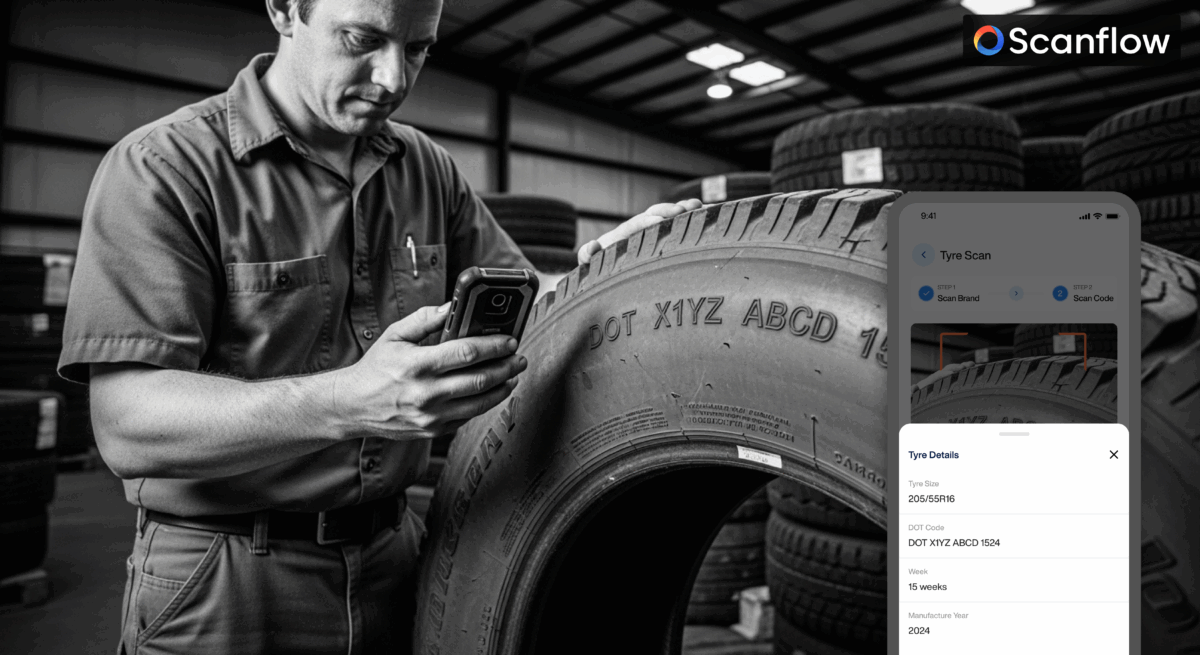
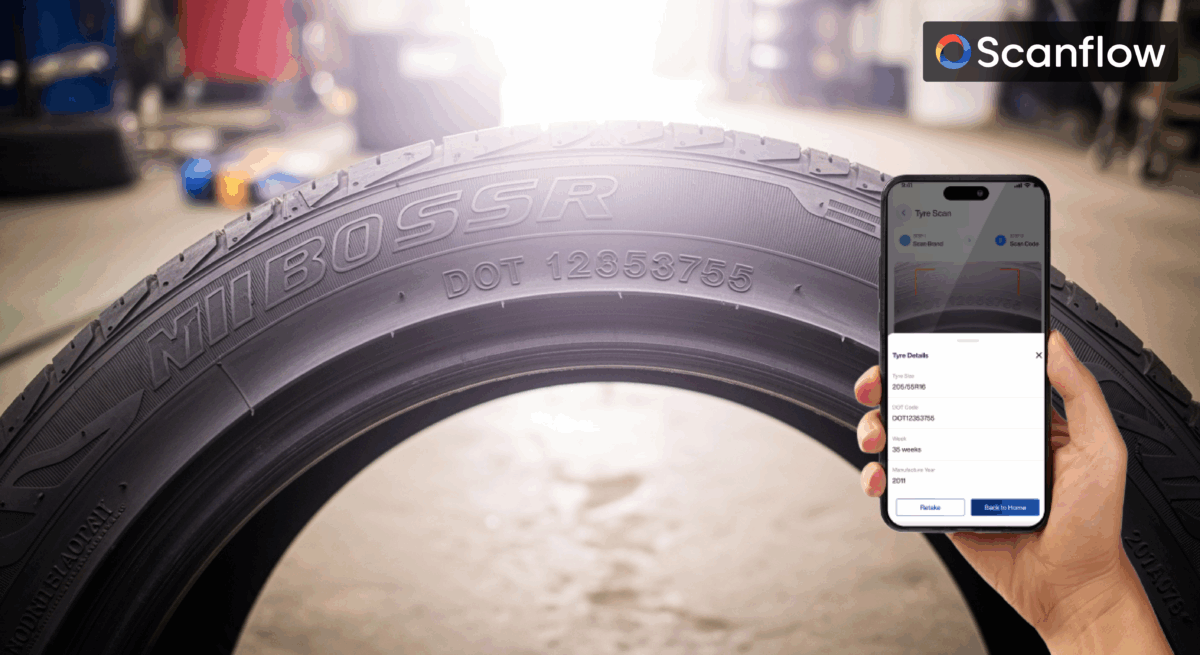
A tire sidewall scanner is a smart, vision-based solution designed to automatically capture and digitize information printed on a tire’s sidewall such as DOT codes, manufacturer details, model, and size.

Instead of technicians manually reading and typing each code (a process prone to human error), the scanner captures this data instantly with unmatched accuracy.

How the Technology Works

The scanner uses AI to read tire sidewalls in real time. It recognizes text and patterns regardless of lighting, dirt, or wear, then organizes that data into a structured digital record.

This means no manual data entry, no transcription mistakes and no time wasted flipping tires or guessing faded characters. It’s fast, accurate, and fully automated.

1. The Problem with Manual Tire Inspections

Manual processes have served the industry for decades, but as operations scale and customer expectations rise, they’re showing their limits.

2. Human Error and Time Waste

Technicians can misread or mistype information, especially in high-volume environments. A single incorrect DOT code can lead to inventory mismatches, compliance risks, or customer dissatisfaction.

3. Limited Transparency

Customers want confidence that their tires meet safety standards and that shops handle their vehicles professionally. Without accurate digital records, it’s difficult to build that level of trust consistently.

4. Inefficient Workflows

Manual tire identification slows down operations. When staff spend extra minutes per tire, productivity drops and those minutes add up fast.

5. Why Tire Shops Need a Tire Sidewall Scanner

A tire sidewall scanner is not just a convenience  it’s a competitive advantage. Here’s why more and more shops across the USA are making the switch.

1. Accurate Tire Identification

Every tire tells a story and accuracy matters. The scanner ensures every code is captured exactly as it appears, removing human variability and ensuring compliance with manufacturer and regulatory standards.

2. Faster Service Delivery

With instant tire identification, technicians can process vehicles faster. What once took several minutes per tire now takes seconds, allowing shops to serve more customers in less time.

3. Seamless Inventory and Record Management

The scanner automatically logs tire data into your system. That means perfect tracking for replacements, warranty claims, and stock management without the paperwork.

4. Enhanced Customer Experience

When customers see a shop using advanced technology like Scanflow tire sidewall scanner, they perceive professionalism and trustworthiness. It’s proof your shop invests in precision and quality service.

Tire Sidewall Scanner USA: Market Adoption and Momentum

Across the USA, more tire retailers and service centers are embracing automation. The reason is clear as vehicle technology advances, the supporting ecosystem must evolve too.

The tire sidewall scanner USA market has seen rapid growth, fueled by the need for compliance, accuracy, and digital transformation. Tire shops that adopt this technology today are positioning themselves as industry leaders tomorrow.

Integrating a Tire Sidewall Scanner into Your Workflow

Transitioning to automation doesn’t need to be complicated. With Scanflow, setup and integration are designed to be smooth, intuitive, and scalable.

1. Choosing the Right Solution

When evaluating scanners, focus on accuracy, speed, and compatibility. Scanflow solution integrates easily with existing POS and tire management systems, so your data flows seamlessly across operations.

2. Easy Training and Adoption

Our intuitive design ensures technicians can start scanning within hours not days. The system requires minimal training and blends naturally into daily workflows.

How a Tire Sidewall Scanner Delivers ROI

1. Reduced Human Error

Every error corrected is money saved. By eliminating manual entry mistakes, shops save on wasted labor, mismatched tires, and warranty disputes.

2. Higher Throughput

Faster service means more jobs per day. Shops using Scanflow tire sidewall scanner often see measurable gains in productivity within weeks of implementation.

3. Customer Loyalty and Trust

Transparency builds loyalty. When customers receive verified tire data, they trust your shop more and return more often.

How Scanflow Is Powering the Next Generation of Tire Shops

At Scanflow, we’re redefining how the tire industry handles data. Our AI-powered tire sidewall scanner helps shops work smarter, not harder combining automation with accuracy to deliver the highest level of service.

We’ve built our platform to meet the unique needs of tire shops across the USA, helping them modernize operations, maintain compliance, and elevate customer experience all in one seamless solution.

The Future: Smart, Data-Driven Tire Shops

Automation is no longer a luxury it’s the new standard. Tire shops that embrace tools like the tire sidewall scanner will set the benchmark for precision, performance, and trust.

The future is data-driven, efficient, and customer first and Scanflow is helping tire shops across the USA lead that transformation.

Conclusion

In today’s competitive tire industry, accuracy, efficiency, and customer trust define success. The tire sidewall scanner has become an essential tool for tire shops that want to stay ahead not just keep up.

By automating identification and data capture, Scanflow empowers shops across the USA to deliver faster service, eliminate errors, and provide the transparency customers demand.

With Scanflow, your tire shop isn’t just adapting to the future it’s leading it.

Categories
Tire Sidewall

How Tire Sidewall Scanner for Commercial Vehicles is Optimizing Fleet Operations

Why Tire Data Matters More Than Ever for Fleets

Fleet management has entered a new era where data accuracy determines efficiency and safety. Tires are among the most critical and often overlooked components of a vehicle. Every tire carries a unique identity through sidewall information like the DOT and TIN numbers, which track manufacturing details, size, and compliance.

In commercial fleets with hundreds or thousands of tires, tracking this information manually is time consuming and error prone. That’s where Scanflow’s tire sidewall scanner for commercial vehicles transforms operations by digitizing and automating how tire information is captured, stored, and managed.

The Challenge: Manual Tire Inspections Don’t Scale

Fleet maintenance teams often rely on manual note-taking or barcode stickers to track tires. But these methods introduce several operational challenges:

  • Inaccurate records: Illegible handwriting and transcription errors can result in data inconsistencies.
  • Lost traceability: Tires are replaced or rotated frequently, making it difficult to match them to vehicles.
  • Compliance risk: Missing or wrong TIN data can complicate recalls or audits.
  • Time waste: Inspecting each tire manually can take 2–3 minutes, slowing down fleet checks.

With hundreds of tires to inspect, these inefficiencies add up quickly resulting in lost productivity and missed insights.

Automating Tire Identification for Commercial Vehicles

Scanflow’s tire sidewall scanner uses computer vision and AI to recognize embossed and printed codes directly from tire sidewalls. Using a smartphone, tablet, or handheld device, technicians can scan each tire in seconds even in dirty, low-light, or worn conditions.

The system captures key information including:

  • DOT and TIN codes
  • Manufacturer and model
  • Size and serial numbers
  • Optional QR or barcode data

Once captured, this information syncs automatically with fleet management or maintenance systems, giving managers a real-time view of every tire in their operation.

Key Benefits for Fleet Managers

1.Rapid Inspections and Real-Time Updates

Technicians can scan and record tire details in under 10 seconds. This enables more frequent checks and faster decision-making.

2.Improved Tire Traceability

Each tire is digitally linked to a vehicle and location, ensuring full traceability through its lifecycle from installation to replacement.

3.Lower Operational Costs

By automating inspections, fleets save hundreds of labor hours annually while preventing costly errors related to misidentified tires.

4.Enhanced Safety and Compliance

The system ensures accurate TIN and DOT data capture, simplifying recall compliance and safety audits.

5.Integration-Ready Technology

Scanflow connects seamlessly with existing fleet management platforms, enabling data synchronization without disrupting current workflows.

Built for the Real World: Why Fleets Trust Scanflow

Commercial fleets operate in challenging environments dusty depots, outdoor yards, and low-light garages.

Scanflow’s AI-driven system is designed specifically for these conditions, offering:

  • Low-contrast text detection for worn or dirty sidewalls.
  • Offline scanning capability for remote locations.
  • Multi-device compatibility across Android, iOS, and rugged scanners.
  • API and SDK support for custom fleet integrations.

These features make it a practical and scalable solution for logistics companies, trucking fleets, and transport providers across the U.S.

Real-World Impact: Smarter Fleet Maintenance

With Scanflow, fleets can monitor tire performance across every vehicle. Instead of manually checking each tire, managers receive live data on:

  • Tire age
  • Replacement history
  • Usage distribution across routes
  • Upcoming maintenance requirements

This visibility leads to better tire rotation strategies, optimized replacement schedules, and longer tire life translating into measurable cost savings.

Mobile Flexibility: Tire Scanning Anywhere, Anytime

One of Scanflow’s biggest strengths is mobility.

Technicians don’t need specialized hardware; they can use their smartphones to scan and upload tire data instantly. This makes it easy to:

  • Conduct roadside inspections.
  • Track tire changes during long-haul trips.
  • Validate tire data at delivery or return points.

Every scan is timestamped and geo-tagged, creating a verifiable record of tire maintenance across the fleet.

Implementation and ROI

Step 1: Deploy Scanflow’s SDK or app to your mobile devices.

Step 2: Train field staff  typically within a few minutes.

Step 3: Integrate tire scan data into your fleet management system.

Step 4: Track results in your dashboard error reduction, time saved, and compliance metrics.

Let’s take a comparison of measurable outcomes between manual inspection and Scanflow.

Metric Manual Process With Scanflow
Time per tire 2–3 minutes Under 10 seconds
Error rate 5–10% <1%
Average savings Up to 80% time reduction


The Future of Tire Management in Fleets

As tire distributors adopt digital identifiers like QR codes and embedded chips, the role of scanning will expand even further. Scanflow’s platform is built to evolve supporting QR and barcode recognition, and preparing for upcoming standards in smart tire identification.

This ensures your fleet remains ready for the next generation of digital vehicle maintenance.

Conclusion: Smarter Fleets Start with Smarter Scanning

Managing commercial vehicles efficiently depends on reliable, accurate data. With Scanflow tire sidewall scanner for commercial vehicles, fleets can replace manual, error-prone inspections with a seamless digital workflow.

From faster inspections to improved compliance and lower operational costs, Scanflow helps fleet managers take control of their tire data  turning every inspection into actionable intelligence.

If your fleet is ready to move faster, safer, and smarter, Scanflow is the technology partner to get you there.

Categories
Tire Sidewall

Why Capturing Tire Sidewall Data is Critical in Tire Assembly Operations

Discover why capturing tire sidewall data through advanced tire scanning technology is essential for improving accuracy, traceability, and compliance in tire assembly operations. Learn how Scanflow’s automated solutions empower modern manufacturing plants to optimize quality control and production efficiency. 

Understanding Tire Scanning and Sidewall Data 

In the tire manufacturing world, every component must be precisely identified and verified to ensure safe, reliable performance on the road. Each tire’s sidewall holds critical information including the DOT code, batch number, dimensions, serial identifiers, and manufacturer details that defines its unique identity. This sidewall data links the tire to its production history, materials, and quality inspections, forming a key part of traceability within manufacturing systems.Tire scanning technology automates the capture of this data by reading and recording these codes quickly and accurately. Instead of relying on manual inspection or handwritten notes, manufacturers can now use vision-based scanning systems to capture this information in seconds. This data then becomes part of a connected digital record, ensuring that every tire’s journey from production to assembly to final delivery is traceable and verifiable at any moment. For QC and assembly managers, this accuracy transforms daily operations. It eliminates uncertainty, reduces bottlenecks, and strengthens confidence that every tire assembled meets both internal quality benchmarks and OEM compliance requirements. 

How Tire Scanning Works in Assembly Operations 

Modern tire assembly operations rely on speed, precision, and data-driven decisions. Tire scanning fits perfectly into this environment. By placing scanners at strategic points along the line, the system automatically reads and extracts relevant information from each tire’s sidewall as it passes. These details are instantly linked to the manufacturing database, enabling plant teams to view the tire’s identity, production stage, and status in real time.The process is designed to be completely hands-free. Operators no longer need to stop, read, or record tire details manually. Instead, the scanning system ensures consistent, reliable data capture under various lighting and environmental conditions. This seamless automation minimizes errors and allows production lines to maintain flow without interruption.With tire scanning, assembly heads gain improved visibility and traceability across operations. The result is a faster, more reliable, and audit-ready workflow that supports lean manufacturing goals and continuous improvement initiatives. 

Challenges in Manual Tire Identification and Tracking 

Errors in Manual Data Entry

Despite rigorous training, manual data entry remains vulnerable to human error. In large manufacturing plants producing thousands of tires each day, even a small misread or misplaced entry can lead to costly complications. Tire sidewalls often include embossed text that’s difficult to read under production lighting or when dust and residue build up over time. A single incorrect digit in a DOT code can create confusion in tracking, product mismatches, or errors during tire fitment.These manual errors can cascade through the system from assembly alignment issues to quality hold-ups and even delays in dispatch. Over time, such inefficiencies reduce productivity and increase rework costs, directly affecting profitability and delivery timelines. 

Loss of Traceability Across Production Stages 

Maintaining continuous traceability across tire production and assembly stages is one of the biggest challenges for managers. Without automated scanning, it’s difficult to link each tire’s identity to its production data once it leaves the initial inspection stage. As a result, identifying which tire came from which mold or batch becomes nearly impossible in the event of quality concerns.This lack of traceability doesn’t just slow down problem-solving it can also complicate regulatory audits, warranty validation, and root-cause investigations. For manufacturers focused on global export or OEM partnerships, these traceability gaps can be major compliance risks. 

Why Capturing Tire Sidewall Data Matters 

Ensuring Product Quality and Consistency 

Each tire must meet strict dimensional, material, and performance criteria before it reaches final assembly. Automated sidewall data capture ensures that only correctly identified tires move forward in the process. This maintains consistent quality standards and prevents mismatched or incorrectly labeled products from entering distribution. Tire scanning becomes a crucial quality checkpoint that reinforces brand reliability and customer trust. 

Enabling Faster Quality Control Decisions 

When tire data is available instantly, quality control becomes proactive rather than reactive. Managers can quickly identify production deviations, verify batch alignment, and confirm that each tire meets specification before reaching the next stage. This data transparency helps teams make faster, data-driven decisions that prevent potential defects from escalating. The result is fewer disruptions and a smoother overall workflow. 

Meeting Regulatory and OEM Compliance Requirements 

Today’s automotive OEMs and regulatory bodies require end-to-end traceability for every component. Capturing tire sidewall data is a vital part of demonstrating compliance with these expectations. Automated data capture ensures that each tire’s details are securely stored and retrievable at any point simplifying audits, warranty claims, and quality certifications. It’s a cornerstone of compliance-driven manufacturing excellence. 

Tire Scanning in Smart Manufacturing Environments 

Integration with MES and ERP Systems 

As tire manufacturing evolves toward Industry 4.0, tire scanning is emerging as a critical enabler of digital integration. The captured data can seamlessly connect with Manufacturing Execution Systems (MES) and Enterprise Resource Planning (ERP) tools, creating a closed-loop production ecosystem. This integration ensures that every tire’s journey from raw materials to finished goods is digitally documented, traceable, and actionable in real time. 

Data Analytics for Process Optimization 

Once tire sidewall data is captured and stored digitally, it opens the door for advanced analytics. By examining patterns across production lines, managers can identify inefficiencies, predict maintenance needs, and optimize equipment scheduling. This data-driven decision-making enhances process stability, reduces waste, and improves overall yield. Over time, these insights can drive significant gains in productivity and cost efficiency. 

Introducing Scanflow: Automating Tire Sidewall Data Capture

How Scanflow’s Tire Scanning Solutions Work 

Scanflow delivers next-generation tire scanning solutions designed to make sidewall data capture effortless and precise. Its imaging and vision-based technology identifies every tire uniquely, regardless of lighting, surface texture, or environmental conditions. The system can be deployed in new assembly lines or easily retrofitted into existing ones, enabling manufacturers to upgrade without disruption.Once installed, Scanflow captures sidewall data automatically, uploads it to the central quality database, and links it to the corresponding production record. This closed-loop process creates a permanent digital footprint for every tire produced ensuring full visibility and control across the assembly operation. 

Key Advantages of Using Scanflow in Tire Assembly Lines 

  • 100% traceability: Every tire’s journey is digitally documented, ensuring full visibility. 
  • Error elimination: Automated scanning removes human errors and mislabeling risks. 
  • Increased throughput: Real-time identification accelerates assembly flow and inspection cycles. 
  • Audit-ready data: Easy access to traceable records simplifies internal and regulatory audits. 
  • Fast ROI: Reduced downtime, enhanced accuracy, and improved operational efficiency yield measurable returns. 

Real-World Impact: Transforming Tire Assembly Operations 

Reducing Downtime and Improving Throughput 

One of the most tangible benefits of Scanflow’s tire scanning technology is the reduction in assembly downtime. By automating data capture, operators no longer need to pause production for verification or labeling. This constant line flow improves throughput and supports lean production principles. In high-volume facilities, these time savings translate directly into higher daily output and improved equipment utilization. 

Enhancing Data Accuracy and Traceability 

Digitizing tire data with Scanflow strengthens operational transparency and accountability. Every tire can be traced back to its specific production parameters from mold data to curing conditions providing a complete record for analysis. This traceability not only enhances internal quality control but also simplifies external audits and OEM compliance checks. The result is a smarter, more connected, and more responsive manufacturing environment. 

Choosing the Right Tire Scanning Solution for Your Facility 

When selecting a tire scanning solution, manufacturers should focus on accuracy, scalability, and ease of integration. A system should seamlessly fit into existing production lines, minimize operator intervention, and provide reliable data outputs under real-world factory conditions. Scanflow stands out by combining proven industrial performance with flexibility supporting both large-scale production environments and specialized assembly setups.With Scanflow, manufacturers gain a partner committed to driving digital transformation in tire manufacturing. Its end-to-end scanning and data management capabilities not only improve operational control but also align with long-term Industry 4.0 and smart factory goals. 

Conclusion: Driving Quality, Efficiency, and Compliance with Tire Scanning 

Capturing tire sidewall data is no longer just a quality assurance measure it’s a strategic necessity for competitive manufacturing. Automated tire scanning ensures unmatched precision, traceability, and speed while reducing manual effort and compliance risks. It bridges the gap between human expertise and digital intelligence on the factory floor. With Scanflow’s advanced tire scanning solutions, manufacturers can modernize their assembly lines, strengthen quality assurance, and gain a powerful edge in efficiency and data-driven decision-making. Scanflow’s technology transforms routine inspection into an intelligent, automated process that scales effortlessly with production growth.

👉 To Book a demo to see how Scanflow can transform your tire assembly operations. 

Categories
Text Scanning

How 3PL Providers Use Mobile Serial Number Scanning to Enhance Traceability

Understanding the Role of Serial Number Scanning in 3PL Operations

In today’s hyperconnected logistics world, traceability and visibility are the backbone of efficient 3PL operations. Every product, from an automobile tire to a retail shipment, carries a unique serial identity. Managing this massive flow of serialized items manually can lead to errors, delays, and compliance risks.

That’s where mobile serial number scanning comes into play offering real-time, high-accuracy asset identification at every node of the supply chain. With solutions like Scanflow’s serial number scanner, 3PL providers can bridge the visibility gap and achieve seamless traceability from pickup to delivery.

What Is a Serial Number Scanner and Why It Matters

A serial number scanner is a digital solution that reads and verifies unique identifiers (like alphanumeric serials) directly from products or labels. Unlike traditional barcode systems that rely on fixed-position scanners, mobile serial number scanners such as those offered by Scanflow enable scanning via smartphones or rugged handheld devices.

This flexibility empowers warehouse workers and delivery teams to instantly capture serial data anywhere, ensuring that every asset is tracked precisely across multiple facilities or partners.

The Shift Toward Mobile-Based Scanning Solutions

Legacy warehouse tracking systems often depend on bulky, fixed-position scanners or manual log entries. However, today’s distributed 3PL ecosystem demands mobility. Mobile-based serial number scanning enables on-the-go visibility, ensuring data is captured at the source not later from a clipboard.

By leveraging Scanflow’s mobile-first design, 3PL providers gain agility and accuracy, ensuring traceability extends to remote yards, delivery trucks, and client warehouses.

Traceability Challenges Faced by 3PL Providers

1. Manual Data Capture and Its Limitations

Many 3PLs still depend on manual data entry or basic barcode systems. This approach often leads to duplicate records, missing items, or inaccurate asset logs. Errors at even one node can cascade across the entire logistics chain.

2. Inconsistent Asset Identification and Visibility

Without a unified system for serial number capture, it becomes difficult to ensure consistency across various clients and partners. Mobile serial number scanners solve this by offering a centralized data capture layer, ensuring every product is uniquely tracked from source to destination.

How Mobile Serial Number Scanning Works

1. Real-Time Scanning on the Warehouse Floor

With a mobile device, operators can instantly scan serial numbers during receiving, picking, packing, or dispatching. Each scan automatically links the product to its digital record, maintaining traceability throughout its journey.

2. Data Synchronization Across Supply Chain Platforms

Scanflow enables real-time integration with 3PL management systems, ERP, and WMS platforms. This ensures data flows seamlessly, offering complete visibility for both clients and operators.

Key Benefits of Using Scanflow’s Mobile Serial Number Scanner

1. Accurate Asset Identification and Reduced Human Error

Scanflow’s precision scanning technology drastically reduces manual entry mistakes. Every asset is validated instantly, minimizing costly errors during shipping or audits.

2. Improved Inventory Traceability and Transparency

3PLs gain end-to-end visibility, from inbound shipments to final delivery. Real-time data improves response times and enables proactive issue resolution.

Seamless Integration With 3PL and ERP Systems

Scanflow integrates easily with existing enterprise systems, ensuring that serial data flows into dashboards and analytics tools without manual intervention.

Enhanced Speed and Scalability for 3PL Networks

Whether managing one warehouse or fifty, Scanflow scales effortlessly empowering 3PL providers to onboard new clients and workflows faster than ever.

Use Case: Tire Sidewall Serial Number Capture

1. Challenges of Tracking Tire Movement Across 3PL Channels

For automotive and tire manufacturers, each tire has a unique sidewall serial number. Traditional tracking methods often fail to capture these identifiers efficiently, especially when the tires are stacked or stored in large volumes.

2. How Scanflow’s Tire Sidewall Scanner Simplifies Serialization

Scanflow’s tire sidewall scanner enables technicians and warehouse teams to capture these serials instantly, even in low-light or challenging warehouse environments. This innovation ensures complete visibility from manufacturing to last-mile distribution improving compliance, recall management, and overall traceability.

Comparative Analysis: Traditional Tracking vs. Mobile Serial Number Scanning

Aspect Traditional Tracking Mobile Serial Number Scanning (Scanflow)
Data Entry Manual or partial barcode scans Fully automated mobile capture
Traceability Limited across partners End-to-end visibility across all nodes
Accuracy Prone to human error 99.9% accuracy with instant validation
Scalability Difficult to expand Easily scalable for multiple 3PL sites
Integration Siloed systems Integrates with ERP, WMS, and TMS platforms

Impact of Serial Number Scanners Across Industries

Automotive and Tire Logistics

Automotive suppliers and tire manufacturers rely on serial number scanners to track high-value assets, prevent counterfeiting, and manage recalls efficiently.

Retail Distribution Networks

For retail 3PLs, mobile serial scanning ensures product-level traceability, reducing lost shipments and enabling faster returns processing.

Manufacturing and Reverse Logistics

Manufacturers use Scanflow’s solution to track serialized parts during production and recovery phases, closing the loop on asset management.

3PL Industry Benefits of Mobile Serial Number Scanning

1. Strengthened Compliance and Audit Readiness

By maintaining an accurate digital log of serialized assets, 3PL providers can instantly produce audit trails to meet client and regulatory standards.

2. Improved Customer Trust Through Transparent Data

Clients value transparency. Scanflow empowers 3PLs to share real-time tracking data, strengthening customer confidence and relationships.

3. Enabling Digital Transformation for 3PL Providers

Beyond traceability, mobile serial number scanning drives broader digital transformation, supporting data-driven decisions, predictive insights, and operational agility.

Why Scanflow Stands Out in the 3PL Ecosystem

1. Purpose-Built for Mobile Environments

Scanflow is designed with mobile-first logistics in mind easy to deploy, compatible with existing devices, and usable even in field conditions.

2. Scalable, Configurable, and Future-Ready

Whether scanning tires, pallets, or product batches, Scanflow adapts to every 3PL use case, ensuring scalability and customization for growth.

Conclusion: Traceability as the Future of 3PL Efficiency

The future of logistics belongs to data-driven, transparent, and agile operations. With Scanflow’s mobile serial number scanner, 3PL providers can unlock unparalleled traceability, accuracy, and client trust turning complex multi-asset networks into efficiently orchestrated ecosystems.

From tire serialization to retail fulfillment, the ability to identify and trace every item in motion isn’t just a feature it’s a competitive edge.

👉 Learn more about Scanflow’s Mobile Serial Number Scanning Solutions

Categories
Tire Sidewall

What does DOT/TIN data really mean for scrap tire traceability and reporting? 

In the complex world of tire recycling and waste management, accurate data collection and traceability have become critical challenges for tire recyclers and scrap tire handlers. The Department of Transportation (DOT) and Tire Identification Number (TIN) codes printed on tire sidewalls contain a wealth of information that, when properly captured and processed, can enhance the industry’s approach to compliance, reporting, and operational efficiency. 

Understanding DOT/TIN data: The foundation of tire traceability 

Every tire manufactured for highway use carries a DOT code that serves as its unique fingerprint. This alphanumeric sequence contains crucial information, including the manufacturer’s plant code, tire size, brand code, and most importantly, the production date. For tire scrapers and recycling facilities, this data represents far more than simple identification; it’s the key to comprehensive scrap tire traceability and regulatory compliance. 

The TIN portion of the DOT code identifies explicitly the date and place of manufacture, enabling precise tracking throughout its lifecycle. This information becomes invaluable when preparing manifests, meeting state regulatory requirements, and maintaining accurate inventory records for tire disposal operations. 

The challenge of manual data collection 

Traditional methods of collecting tire data involve manual inspection and handwritten logs, a process that’s not only time consuming but prone to significant errors. Scarp Tire recyclers often struggle with: 

  • Data entry errors that compromise manifest accuracy 
  • Inconsistent documentation across different operators 
  • Time-intensive processes that slow down operations 
  • Difficulty in maintaining structured tire data for reporting purposes 
  • Challenges in meeting state compliance requirements efficiently 

These manual processes create bottlenecks in tire recycling operations, increasing the risk of regulatory non-compliance and potentially resulting in costly penalties and operational disruptions. The relief from these challenges is a significant benefit of AI tire scanning. 

How AI scrap tire scanning transforms operations? 

Modern AI scanners have emerged as a game-changer for the tire recycling industry. Tire sidewall scanning solutions leverage artificial intelligence to automatically capture, interpret, and process DOT/TIN data with unprecedented accuracy and speed, empowering industry professionals with more control and confidence. 

Scanflow’s Tire Sidewall SDK represents a breakthrough in automated tire identification, offering tire recyclers and scrapers a comprehensive solution that addresses the industry’s most pressing data collection challenges. The solution utilizes advanced computer vision for tires to: 

Capture data with mobile flexibility 

The solution works seamlessly with mobile applications and IP cameras, allowing operators to scan tire sidewalls using existing devices. This mobile tire scanning capability means facilities can implement the technology without significant infrastructure investments, making it accessible and convenient for operations of all sizes. 

Integrate with existing systems 

One of the key advantages of Scanflow’s approach is its ability to integrate with any backend system customers already have in place. This tire data management integration ensures that scanned information flows directly into existing workflows, eliminating data silos and maintaining operational continuity. 

Deliver structured data and analytics 

The Tire Sidewall scanning SDK automatically structures collected data into actionable insights through comprehensive dashboards. This capability provides real-time visibility into tire volumes, types, and processing status, enabling better decision-making and resource allocation. 

Streamlining manifest preparation and compliance 

The most significant benefit of automated tire scanning is its impact on manifest preparation. State regulations require detailed documentation of tire disposal activities, and manually preparing these documents is both time-consuming and error-prone. 

With AI Tire Sidewall Scanning, manifest creation becomes automated mainly. The system captures all necessary tire specifications, including size, brand, and TIN/DOT codes, and formats this information in accordance with regulatory requirements. This digital tire tracking approach not only saves time but also significantly reduces the risk of compliance issues. 

The future of tire recycling/scarp operations 

As state regulations become increasingly stringent and the volume of scrap tires continues to rise, the need for efficient and accurate data collection becomes more critical. Tire scanning solutions not only improve operational efficiency and compliance but also represent a significant step towards more sustainable, environmentally friendly tire recycling operations. 

The implementation of AI tire sidewall scanning offers immediate benefits in terms of operational efficiency and compliance, while also providing the foundation for advanced analytics and process optimization. Facilities that adopt these technologies position themselves to meet growing regulatory demands while maintaining competitive advantages through improved efficiency. This can lead to significant cost savings in terms of reduced manual labor, fewer compliance issues, and optimized resource allocation. 

Conclusion: Embracing digital transformation in tire recycling 

The integration of DOT/TIN data capture through advanced scrap tire scanning technology represents more than just an operational upgrade; it’s a fundamental shift toward data-driven tire recycling operations. By leveraging Scanflow’s Tire Sidewall SDK, tire recyclers and scrapers can transform their approach to compliance, reporting, and operational management. 

 As the industry continues to evolve, those who embrace intelligent tire scanning solutions will find themselves better positioned to navigate regulatory complexities, reduce operational costs, and build more sustainable business models. The future of tire recycling lies in accurate, automated data collection, and that future is available today. 

Discover how Scanflow enables recyclers to capture DOT/TIN data with accuracy and speed.  

[Schedule a Demo]

Categories
Tire Sidewall

How Inconsistent Manifests in Texas Slow Down Tire Scrap Transport and Disposal

The Texas scrap tire industry faces a critical challenge that has persisted for years: inconsistent manifest reporting that creates bottlenecks throughout the entire tire disposal chain. From small-scale tire recyclers to large processing facilities, businesses across Texas struggle with manifest inaccuracies that lead to costly delays, regulatory fines, and operational inefficiencies. 

Understanding the Texas Manifest System Challenge 

In Texas, the Texas Commission on Environmental Quality (TCEQ) requires comprehensive manifest documentation for all scrap tire transport and disposal activities. These manifests serve as crucial tracking reports that document tire quantities, conditions, and movement throughout the disposal process. However, the traditional manual approach to manifest creation has created a web of inconsistencies that plague the industry. 

Tire transporters must maintain detailed records using manifest systems and file annual reports with TCEQ, while scrap tire collectors and processing facilities rely on accurate manifest data to ensure compliance with state regulations. When these documents contain errors or inconsistencies, the entire supply chain suffers. 

The Pain Points Plaguing Texas Tire Recycle/Scarp Industry 

Manual Entry Errors and Data Inconsistencies 

The most significant challenge facing tire recycling operations is the reliance on manual data entry for manifest creation. Workers manually count tires and record sidewall information a process prone to human error. These manual entry mistakes cascade through the system, creating discrepancies between pickup documentation and delivery records. 

Scrap tire collectors often discover that tire counts don’t match between collection sites and processing facilities, leading to rejected shipments and costly return trips. Large processing facilities report that up to 30% of incoming manifests contain some form of data inconsistency, requiring time-consuming verification processes. 

Incomplete Tire Counts and Quantity Discrepancies 

Accurate tire quantification remains a persistent challenge. Traditional counting methods struggle with: 

  • Mixed tire sizes and types in single loads 
  • Damaged or partial tires that are difficult to categorize 
  • Time pressures that encourage rushed counting 
  • Lack of standardized measurement protocols 

These quantity discrepancies create regulatory compliance issues and financial disputes between transporters and processing facilities. 

Tire Condition Classification Problems 

TCEQ regulations require specific classification of tire conditions, but manual assessment leads to inconsistent categorization. Workers may classify the same tire differently, creating manifest discrepancies that trigger regulatory scrutiny. Without standardized tire condition assessment tools, the industry struggles to maintain consistency across different operators and facilities. 

Documentation Errors Between Pickup and Delivery 

The journey from tire collection to final disposal involves multiple handoffs, each presenting opportunities for documentation errors. Manifests often show discrepancies between: 

  • Initial pickup documentation 
  • Transport records 
  • Final delivery confirmation 
  • Processing facility intake reports 

These errors create audit trails that don’t align, raising red flags during TCEQ inspections and creating compliance challenges for all parties involved. 

Regulatory Consequences and Business Impact 

TCEQ Compliance Challenges 

The Texas Commission on Environmental Quality takes manifest accuracy seriously. Inconsistent documentation can trigger: 

  • Regulatory investigations 
  • Compliance violations 
  • Operational restrictions 
  • Increased scrutiny on future submissions 

Tire recyclers and processors must maintain meticulous records to satisfy TCEQ requirements, but manual manifest systems make this increasingly difficult as operations scale. 

The Emerging Solution: Scanflow Tire Sidewall Scanning 

Tire Sidewall Scanner 

Scanflow tire sidewall scanner solution represents a breakthrough solution for manifest accuracy challenges. This advanced solution can capture and identify and catalog tire specifications, conditions, and quantities with unprecedented precision. By eliminating manual data entry, tire sidewall scanners significantly reduce the human error factor that plagues traditional manifest creation. 

Comprehensive Tire Scanner Solutions 

Scanflow tire scanner solution go beyond simple identification to provide comprehensive tire analysis. These solutions can: 

  • Automatically count tire quantities with high accuracy 
  • Provides Dashboard with the real time data. 
  • Generate consistent manifest data across all operations 
  • Create audit that satisfy TCEQ requirements 

Moving Forward: Embracing Technological Solutions 

The Texas scrap tire industry stands at a crossroads. Traditional manual manifest processes have reached their limitations, creating persistent bottlenecks that impact the entire disposal chain. However, Scanflow Tire sidewall scanner offers a path forward that addresses the root causes of manifest inconsistencies. 

Tire transporters, processors, and collectors who embrace these technological solutions position themselves for: 

  • Improved TCEQ compliance 
  • Reduced operational costs 
  • Faster processing times 
  • Enhanced data accuracy 
  • Competitive advantages in the marketplace 

The transition from manual to automated manifest creation represents more than just a technological upgrade it’s a fundamental shift toward operational excellence that benefits the entire Texas tire recycling ecosystem. 

As the industry evolves, businesses that invest in advanced tire scanning technology will find themselves better positioned to navigate Texas’s complex regulatory environment while achieving sustainable operational efficiency. 

Ready to eliminate manual tire data entry and simplify scrap tire compliance? Discover how Scanflow’s mobile tire scanning solution delivers fast, accurate, and actionable insights.
👉 Request a Free Demo

Categories
Tire Sidewall

Top 5 Benefits of Smart Scanning Solution for Tire Scrap and Recycling Businesses with Scanflow

Top 5 Benefits of Smart Scanning Solution for Tire Recycling Businesses 

The tire recycling industry faces constant challenges in handling large volumes of scrap tires, ensuring sustainability, and reducing operational costs. Traditional sorting and identification methods are often time-consuming and prone to errors. This is where smart scanning solutions like Scanflow come into play. 

By using advanced recognition systems and SDK integration, tire recycling businesses can streamline operations, cut costs, and support a greener planet. Let’s explore the top 5 benefits of smart scanning solutions for tire recycling companies. 

Introduction: Why Smart Scanning Matters in Tire Recycling 

Every year, billions of tires reach the end of their lifecycle. Recycling these tires effectively requires precise identification of types, materials, and potential reuse options. Smart scanning solutions automate this process, minimizing human error and increasing speed. 

1.The Role of Scanflow in Modern Recycling Processes 

Scanflow is a powerful smart scanning solution designed to help industries, including tire recycling, improve recognition and data management. With its SDK integration, Scanflow enables businesses to customize scanning processes according to their unique needs, making recycling more efficient and scalable. 

Benefit 1: Enhanced Efficiency in Tire Identification 

1.Real-Time Recognition of Tire Types 

Smart scanning can instantly recognize tire models, brands, and conditions. This ensures that recycling facilities can sort materials quickly without relying on manual inspection. 

2.Reduction in Manual & Sorting Errors 

By automating identification, smart scanning reduces and eliminates mistakes during sorting. This translates into faster turnaround times for recycling facilities. 

 Benefit 2: Improved Accuracy with Smart Scanning SDK 

1.How SDK Integration Streamlines Recycling Operations 

The SDK provided by Scanflow allows recycling businesses to integrate scanning functions into their existing workflows. This leads to smoother operations and consistent accuracy in tire recognition. 

2.Compatibility with Existing Recycling Systems 

Scanflow’s Tire SDK is designed for seamless compatibility, meaning businesses don’t need to overhaul their entire recycling infrastructure to adopt smart scanning. 

 Benefit 3: Cost Savings for Recycling Businesses 

1.Lower Operational Costs through Automation 

Automation powered by smart scanning drastically reduces labor costs while increasing overall productivity. 

2.Long-Term ROI for Tire Recycling Facilities 

Though initial setup may require investment, the long-term return on investment (ROI) is significant. Reduced errors, faster processing, and optimized operations all contribute to cost savings. 

 Benefit 4: Data-Driven Sustainability 

1.Tracking Material Flow for Eco-Friendly Processing 

Smart scanning provides real-time data on tire materials and conditions. This helps businesses track recycling efficiency and ensure eco-friendly practices. 

2.Supporting Circular Economy Practices 

By enabling precise sorting, smart scanning supports a circular economy, where materials are reused and waste is minimized. 

 Benefit 5: Scalability and Flexibility of Scanflow Solutions 

1.Adapting to Different Tire Recycling Needs 

Whether handling passenger car tires, truck tires, or specialty tires, smart scanning solutions adapt to different use cases. 

2.Future-Proofing Businesses with Smart Scanning 

As regulations and environmental demands evolve, Scanflow ensures businesses stay ahead by offering flexible and scalable scanning solutions. 

Conclusion: Driving the Future of Tire Recycling with Smart Scanning 

The tire recycling industry is undergoing a major transformation, and smart scanning solutions are at the forefront of this change. By adopting Scanflow and leveraging its SDK integration, recycling businesses can achieve faster tire identification, greater accuracy, reduced costs, and stronger sustainability outcomes.

Ready to transform your Tire scarp and recycling business? 
Book a Demo with Scanflow Today and see how smart scanning can make a difference in your scarp and recycling processes. 


Categories
Tire Sidewall

Why Traceability is Key for Tyre Movement Between Warehouses and Retailers

Introduction

The automotive tyre industry moves millions of units each year across warehouses, retailers, distributors, and service centers. But with such high volume and complex movement, traceability becomes a critical challenge. Tyres often get misplaced, duplicated in records, or lack visibility in their lifecycle, leading to inefficiencies, compliance issues, and financial losses.

This is where AI tyre scanning and digital traceability solutions are transforming how the industry manages tyre movement. By ensuring every tyre is uniquely identifiable and trackable from warehouse shelves to retailer floors businesses gain not only efficiency but also accuracy, safety, and customer trust.

The Challenge of Tyre Movement Without Traceability

For decades, warehouses and retailers have relied on manual processes, barcodes, or spreadsheets to manage tyre stock. While functional, these approaches create problems at scale:

  • Misplaced Inventory: Tyres move from storage to retailers without accurate logs, creating gaps.

  • Duplicate Records: Without real-time validation, tyres may appear twice in systems.

  • Audit Stress: Compliance checks become slow and error-prone without clean traceability.

  • Lifecycle Blindness: Retailers often lack history of each tyre (production date, usage, warranty).

In industries like automotive, where safety and regulatory compliance are non-negotiable, these gaps can be costly.

Why Traceability Matters in the Automotive Tyre Supply Chain

1. Inventory Accuracy

Every tyre has a unique DOT or serial number. By capturing this at each movement point (warehouse entry, shipment, retail shelf), businesses maintain real-time, error-free inventory records. This reduces discrepancies, prevents overstocking, and eliminates misplacements.

2. Compliance and Audits

Authorities and manufacturers often demand detailed records of tyre origins, conditions, and sales timelines. Digital tyre traceability ensures warehouses and retailers can generate audit-ready reports instantly no scrambling through paper logs.

3. Retail Confidence

For retailers, selling tyres isn’t just about stock it’s about trust. Customers increasingly demand transparency: tyre age, manufacturing details, and usage history. With traceability, retailers can provide this at the point of sale, boosting confidence.

4. Supply Chain Transparency

Traceability creates a connected supply chain. Warehouses know what left their shelves, retailers know what’s arriving, and distributors can monitor flow. This visibility reduces disputes, strengthens vendor relationships, and cuts delays.

5. Lifecycle Management

Traceability doesn’t stop at the sale. With digital history tied to each tyre, businesses can track lifecycle for warranty claims, recalls, and predictive maintenance turning a sale into a long-term customer relationship.

How AI Tyre Scanning Powers Traceability

Traditional methods like barcodes or manual entry aren’t built for tyres. They fail to capture the complexity of DOT markings and serials across tyre brands. AI-powered tyre scanning changes the game.

  • Instant DOT/Serial Capture: Mobile devices scan and digitize tyre identifiers in seconds.

  • Error-Free Data Entry: AI eliminates human mistakes from manual typing.

  • Cloud-Based Records: Every scan updates a central database accessible across warehouses and retailers.

  • Seamless Integration: Works with existing warehouse or retail apps via SDKs and APIs.

With AI tyre scanning, traceability isn’t an added process  it’s embedded into daily operations.

Benefits for Warehouses and Retailers

For Warehouses:

  • Faster stock reconciliation with AI-driven scans.

  • Reduced misplacement during inbound/outbound tyre movement.

  • Easier compliance during inventory audits.

For Retailers:

  • Real-time visibility of incoming tyre shipments.

  • Instant access to tyre details for customers (brand, model, age, warranty).

  • Stronger credibility through transparent sales practices.

Together, this creates a closed-loop system where tyres can be traced from manufacturer → warehouse → retailer → customer, with no blind spots.

The Scanflow Advantage

At Scanflow, we believe tyre traceability should be simple, reliable, and scalable. Our Track and Trace App and AI Tyre Scanning SDK empower automotive businesses to:

  • Scan DOT/serial numbers instantly with a mobile device.

  • Maintain a centralized, digital tyre database.

  • Reduce misplacement, duplication, and audit delays.

  • Enable complete tyre lifecycle visibility for warehouses, retailers, and fleets.

By turning tyres into digital assets, Scanflow ensures that every movement is traceable, every record is reliable, and every sale is transparent.

Conclusion

In the fast-moving automotive industry, tyre traceability is no longer optional  it’s essential. Warehouses need accurate stock records, retailers need customer trust, and the entire supply chain needs transparency.

With AI tyre scanning and digital traceability, businesses can reduce errors, save time, and future proof their operations.

Ready to transform your tyre inventory?

Try Scanflow Track and Trace App for Tyre Management and see how easy tyre traceability can be.

Categories
Logistics

Top 5 Reasons Supply Chains Fail Without Centralized Container Information

Supply chains keep the world moving. From clothes and electronics to food and raw materials, almost everything we use travels inside containers. These containers may look like simple steel boxes, but the data linked to them what’s inside, where they are going, who is moving them, and when decides how smoothly the supply chain runs.

The problem? Many companies still track containers the old-fashioned way. A container number is written down on paper, details like weight and driver information are typed into a system hours later, and lifecycle updates are sometimes forgotten altogether. This creates gaps, delays, and confusion. One small error might not seem like much, but when multiplied across hundreds or thousands of containers, it can cause serious supply chain failures.

Here are the top five reasons supply chains fail without centralized container information and how Scanflow Track & Trace helps avoid them.

1.Delays That Spread Across the Chain

In logistics, delays are expensive. If a container’s details are missing or entered late, the driver waits longer, the yard team can’t plan properly, and shipments get held up. One small delay creates a chain reaction, slowing down the entire supply line.

How Scanflow Helps:

With Create & Save, staff can simply scan the container number and instantly capture important details like vehicle, driver, weight, and storage type. No waiting, no backlogs, no retyping later. Information is live the moment the container arrives, keeping everything moving on time.

2.Blind Spots in Container Status

Supply chains depend on knowing where containers are and what stage they’re in. Was the container pulled, stripped, or returned? Without centralized updates, people make guesses or work with outdated information. This creates blind spots that lead to wrong decisions sending a truck too early, storing cargo in the wrong yard, or marking a shipment as late even when it isn’t.

How Scanflow Helps:

The Update Status feature solves this by letting staff scan the container or QR code and update its stage in real time. Everyone from yard staff to planners to customers sees the same accurate status instantly. No more blind spots, no more guessing.

3.Poor Planning and Wasted Resources

Good planning is only possible with good data. If container records are scattered across different systems, planners are forced to guess about yard space, truck allocation, or shipping schedules. This leads to wasted fuel, idle trucks, and inefficient use of storage areas.

How Scanflow Helps:
By centralizing container information with a complete history, Scanflow gives planners the clear picture they need. They can see where each container is, what condition it’s in, and what’s coming next. That means smarter planning, less waste, and smoother operations.

4.Compliance and Audit Problems

Regulations in shipping and logistics are strict. Customs, port authorities, and clients all require accurate, complete container records. Without a central system, companies risk missing details like weight, movement logs, or driver information. When that happens, fines, shipment holds, and failed audits quickly follow.

How Scanflow Helps:
Every action in Scanflow creates a full audit trail. Each scan and update is stored with complete history, so proof is always available when needed. Instead of scrambling to find missing records, companies can be confident they’re always compliant.

5.Misalignment Between Partners

Supply chains involve many players shippers, carriers, warehouses, and customers. But when container data is kept in separate systems or shared late, each partner ends up with a different version of the truth. This leads to finger-pointing, disputes, and lost trust.

How Scanflow Helps:

Scanflow acts as the single source of truth for all container data. Everyone sees the same live updates, which means better coordination and fewer disputes. Transparency builds trust, and trust keeps supply chains strong.

Keeping Supply Chains Strong

Supply chains rarely collapse because of one big mistake. Instead, they break down slowly through small, repeated problems: delays, blind spots, poor planning, compliance risks, and disputes. The root cause behind all of these? Fragmented and unreliable container information.

Scanflow Track & Trace built to fix this.

  • With Create & Save, details are captured instantly at the point of scanning.

  • With Update Status, container lifecycles are tracked in real time.

  • With centralized history, planning, compliance, and teamwork all improve.

The result: faster processes, fewer errors, and stronger supply chains that don’t fail under pressure.

Ready to Try Scanflow?

Your supply chain is only as strong as your container information. Don’t let small cracks turn into major breakdowns. With Scanflow Track & Trace, you can:

  • Speed up processing with instant scanning

  • Centralize container data with full history

  • Improve logistics planning and compliance tracking

Try Scanflow Track and Trace App for Container Management and see how easy traceability can be.

Categories
Logistics

Why Suppliers Are Moving to Mobile SDKs for Cargo Data Capture

In the fast paced world of logistics, accuracy is everything. A single wrong entry in cargo details can trigger a cascade of problems disputes with receivers, delayed handovers, misplaced items, and even financial losses. For suppliers, manual data entry remains one of the biggest culprits behind these issues. But in an age where supply chains are becoming smarter and faster, why should suppliers still be relying on paper forms and spreadsheets?

The answer lies in digitizing cargo management. With Scanflow SDK, suppliers can eliminate paperwork and manual entry errors, while ensuring secure, transparent, and traceable cargo handovers directly from their mobile devices.

The Hidden Cost of Manual Errors

Every supplier has faced the fallout of a simple mistake:

  • A missing digit in a cargo code results in a mismatch.

  • Incorrect item counts spark disputes with receivers.

  • Paper records go missing, leaving no audit trail.

These seemingly small errors add up. They waste time, strain supplier receiver relationships, and create unnecessary operational costs. More importantly, they weaken credibility at a time when reliability is critical in supply chains.

How Scanflow SDK Helps Suppliers Digitize Cargo Creation

The Scanflow SDK provides suppliers with a mobile first way to digitize cargo operations. Whether from a smartphone or tablet, suppliers can easily manage cargo details on the go without relying on desktops or manual paperwork.

Here’s how it works:

  • Create Cargo Details Digitally – Suppliers use the mobile app or SDK-integrated system to log cargo details instantly and accurately.
  • Add Items Effortlessly – Each item is entered into the digital record via mobile, reducing duplication or typos.
  • Generate Unique QR/Barcodes Automatically – For every cargo and item, the SDK generates a secure QR or barcode that can be scanned right from a mobile screen or printed if needed.
  • Share with Receivers for Instant Verification – Receivers scan the codes with their own mobile devices, confirming details in seconds.

This mobility means suppliers don’t have to wait until they’re at a desk to update or verify cargo it can all happen in real time, anywhere.

Secure and Transparent Handover

For suppliers, handovers are often a tense moment. Any discrepancy real or perceived can delay acceptance. With Scanflow, each cargo and item carries a unique digital identity that’s scannable on mobile.

  • Receivers scan QR/barcodes instantly with their phones to validate shipment contents.

  • Both parties access the same trusted data, ensuring transparency.

  • Cargo disputes are minimized, and handovers become faster and more secure.

End-to-End Traceability with Scanflow

Traceability is no longer a “nice-to-have” it’s essential. With the Scanflow SDK:

  • Suppliers know exactly what was shipped, with mobile-accessible proof.

  • Receivers confirm that cargo arrived as intended.

  • Both sides have a digital, mobile-friendly audit trail for compliance and accountability.

This mobility enabled transparency builds trust and reduces the risk of costly disputes.

Why Suppliers Can’t Ignore This Shift

By adopting Scanflow SDK and using mobile enabled workflows, suppliers benefit from:

  • Fewer Errors – Digital, mobile first entry eliminates mistakes caused by manual inputs.

  • Faster Operations – QR/barcode scans on mobile replace slow, manual checks.

  • Greater Trust – Secure handovers and transparent records strengthen partnerships with receivers.

  • Scalability – Mobile workflows allow suppliers to scale operations flexibly without investing in complex infrastructure.

Final Thoughts

Manual entry errors may feel like a small detail, but for suppliers, they can snowball into serious challenges. The good news? They’re entirely preventable.

With the Scanflow SDK, suppliers can eliminate paperwork and manual entry errors, achieve secure and transparent cargo handovers, and improve traceability from supplier to receiver all from the convenience of their mobile devices.

In today’s competitive logistics landscape, suppliers that embrace mobile-enabled digitization will stand out as faster, more reliable, and more trusted partners.

Ready to eliminate manual entry errors in your cargo operations?
Download the Scanflow Mobile App and experience error-free cargo management today.

QR Floating