How to Find Your Car’s Tire Size Using Just the VIN Number
Every vehicle manufactured for road use carries a 17-character Vehicle Identification Number, a uniq...
 4 Mins read
Posted on Sep 11, 2026
October 28, 2026
5 Mins read


Picture an auction lane on a busy sale day. Cars roll through one after another, each with a few seconds in front of the buyers. Behind the scenes, someone has already typed the VIN of every car into the system. One of those entries has a single wrong character. Nobody notices. The listing goes live with the specs of a different vehicle, a buyer bids on what the screen says and the problem only appears after the sale, when the car in the yard does not match the car on the paperwork. This is how one wrong VIN digit can cost an auction deal.
This blog looks at why a single wrong character matters so much, how it creeps in at auctions and how mobile VIN scanning removes the typing step that causes it.
A VIN is 17 characters and almost every character carries meaning. The first few identify the manufacturer and region. Others describe the model, body style and engine. One position records the model year and the rest identify the individual car. In many markets, including North America, one position is a check character that is calculated from the others so that a mistyped VIN can be spotted.
Change one character and the story changes. The decoded model, year, trim, or engine can come out wrong. The VIN may fail validation. Or it may happen to match a different real vehicle, which is worse, because the system accepts it without complaint. In either case, the listing no longer describes the car it is attached to.
Auctions are high-volume, fast, and messy, which is exactly where typing mistakes thrive. A consignment team may handle hundreds of vehicles in a day. VIN plates sit behind dirty windshields, with glare in daylight and shadow at the edge of a lot. Door labels get scuffed. Characters that look alike, such as a zero and the letter O or a one and the letter I, are easy to confuse by eye. VINs do not use the letters I, O and Q, but a tired person still has to work out which one they are looking at.
Handwritten sheets add another step. A number gets copied from a plate to a sheet, then from the sheet to a system, sometimes by a different person. Each copy is a new chance for a slip.
For a seller, the first cost is a listing that describes the wrong vehicle. A buyer who bids on a certain trim and engine and then finds something different will ask for a price adjustment, raise a dispute or walk away. The sale gets delayed while someone investigates and the car sits on the lot.
For a buyer, the risk is paying for the wrong thing. A history report ordered on a mistyped VIN returns the history of another car or nothing at all. Decisions about price and condition get made on information that does not belong to the vehicle.
There are paperwork costs too. Title and registration depend on a correct VIN and an error found late can hold up the transfer. Beyond the direct cost, repeated mismatches damage trust in the auction’s data. Buyers who cannot rely on the listing start to discount every car on the lane.
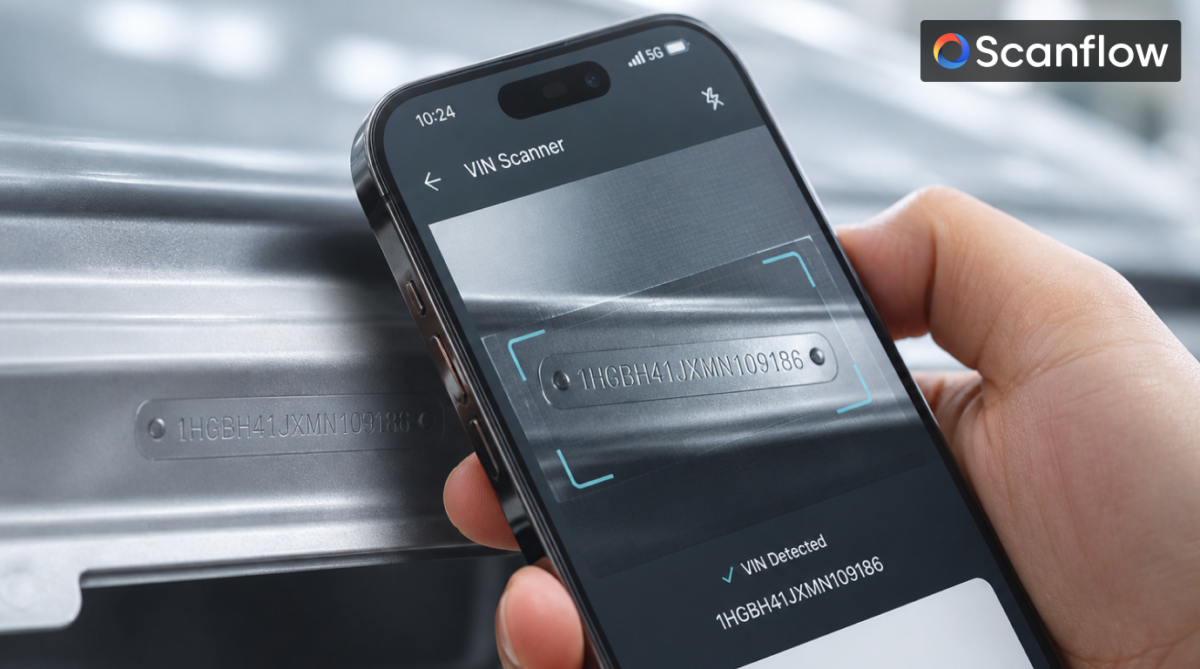
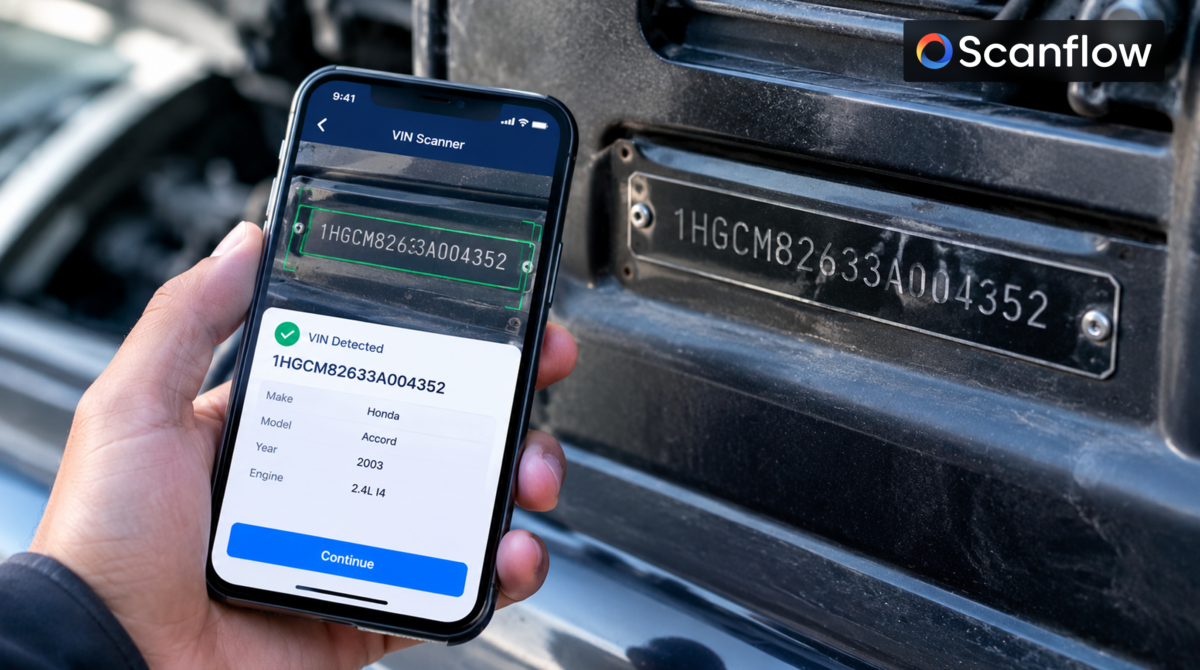
The simplest fix is to stop typing. Mobile VIN capture lets a team point a phone at the VIN plate, chassis or windshield sticker and have the software read it. Scanflow’s mobile-first VIN barcode reader works with any smartphone camera, so there is no dedicated hardware to buy or maintain. It handles damaged labels, poor lighting and non-standard printing, which is exactly what a real lot looks like.
The scan reads more than one kind of marking. Door-frame VIN barcode scanning, etched chassis numbers, dashboard stickers and windshield serials are all supported, so the team can capture the VIN from whichever location is clearest on that particular car.
After the scan, the software decodes the 17-digit VIN serial code and returns structured vehicle identity data. With instant VIN decode to vehicle specs, the person at the lane can see straight away whether the decoded make, model and year match the car in front of them. If they do not, the problem is caught at check-in, when it takes seconds to fix, not after the sale.
The same record can be pushed to the DMS or auction platform, so the listing starts from the correct data instead of a number someone typed. Scanflow describes this intake process as reliable across glare, low light and high-volume intake lanes, which fits the conditions at a busy sale.
Auction yards are large and signal can be patchy between rows. VIN data is scanned and inferred on-device, so scanning continues without a connection and records sync automatically once the phone is back online. The SDK does not store any data on the device, which is a useful point for teams with data handling rules.
Mobile scanning can be used at several points. At consignment, when a seller’s vehicle is checked in. At the lane, to confirm the car matches its listing before it runs. At buyer inspection, so a buyer can scan the VIN on a car they are considering and compare it with the listing. And in the transport yard after the sale, to confirm the right car is loaded for the right buyer. Scanflow notes that scanning at dealership intake can significantly reduce lot walk audit times, and the same logic applies to auction yards counting and checking large numbers of cars.
Scanning helps the buying side as much as the selling side. A dealer or independent buyer walking a lot can scan the VIN of any car they are interested in and see the decoded specs on their phone, then compare them with the listing. If the engine, trim, or year differ, they know before they bid. They can also scan the same VIN again when the car arrives at their own lot, which gives them a clean starting record instead of one copied from a sheet. Over time, buyers who see matching data on every lane are more willing to bid with confidence.
Being Realistic About What It Fixes
Scanning removes the typing error, not every risk. A correct VIN does not tell you the car’s condition, title status or whether the number has been tampered with, so a history report and an inspection are still needed. And if the seller provides the wrong paperwork, a scan will confirm the number on the car but not fix the document. Scanflow’s page states 99 percent or better scan accuracy, which is a vendor figure worth testing on your own lanes before relying on it.
A small change goes a long way. Scan every VIN at check-in instead of typing it. Compare the decoded specs with the car and the listing before the sale. Save every scan so there is a record of what was read and when. And agree who handles a mismatch so it is resolved quickly.
It will not save every deal, but it removes one of the most avoidable reasons a deal goes wrong. A single digit costs almost nothing to get right when a camera reads it, and a lot to get wrong when a person types it. For auctions that depend on trust in their data, that is a small change with a clear payoff.
#VINScanning #UsedCarAuction #AutoAuction #MobileScanning #DealershipTech #AutomotiveRetail #VehicleData #DataAccuracy #AutomotiveAI #ComputerVision #UsedCars #VehicleInspection #AutomotiveIndustry #AssetIdentification #SmartScanning #DigitalTransformation #VehicleRemarketing #B2B #AutomotiveTech #DealerOperations

How to Find Your Car’s Tire Size Using Just the VIN Number
4 Mins read
Posted on Sep 11, 2026
How AI VIN Scanning Cuts Gate Check-In Time And Reduces Condition Dispute Liability
8 Mins read
Posted on Jun 24, 2026