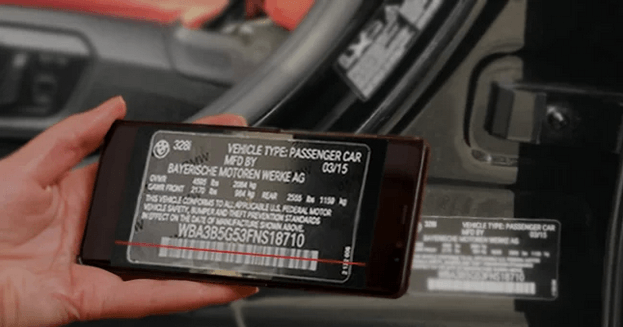
How to Find Your Car’s Tire Size Using Just the VIN Number
Every vehicle manufactured for road use carries a 17-character Vehicle Identification Number, a uniq...
 4 Mins read
Posted on Sep 11, 2026
June 24, 2026
8 Mins read


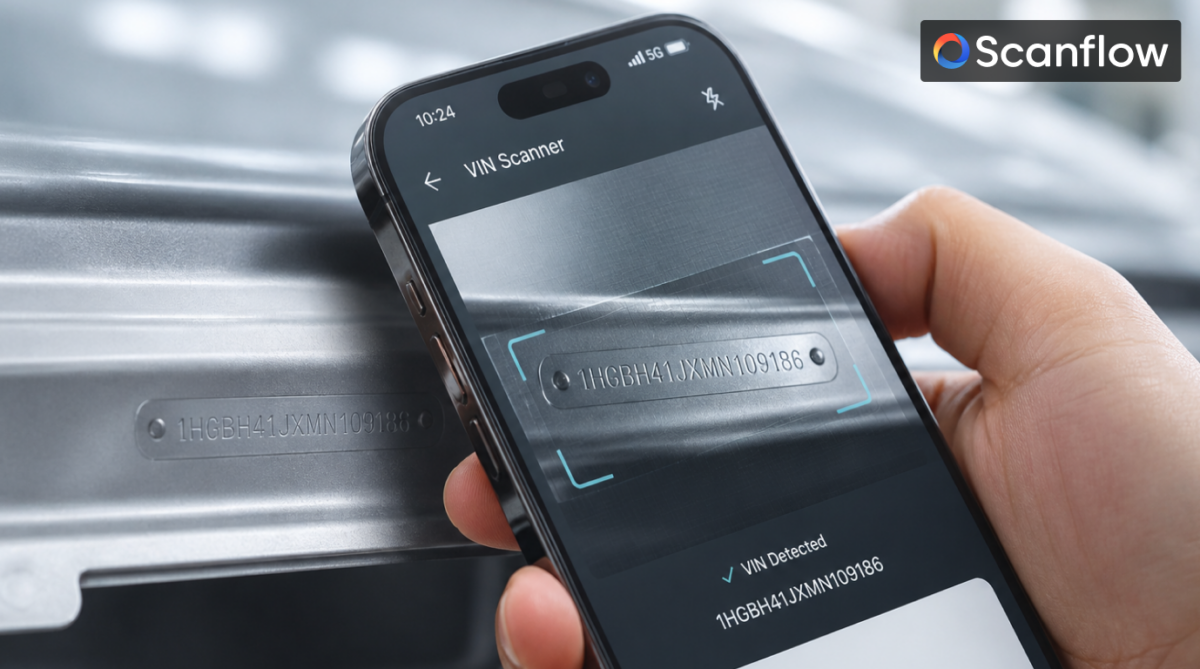
The $165 Billion Industry With a 90-Minute Return Problem
Every returned rental vehicle is a liability event waiting to be documented or disputed. At scale, across millions of annual transactions, the difference between a 90-minute manual check-in and an 11-minute AI-scanned return is measured not just in operational efficiency, but in billions of dollars of annual dispute liability.
The global car rental market reached USD 165 billion in 2025 and is projected to hit USD 265 billion by 2030, growing at a CAGR of 10.5%. Behind that headline is an operational reality that fleet managers know intimately: every return is a moment of maximum liability exposure.
It is crucial to address how AI VIN scanning can help ensure compliance with legal and regulatory standards, reducing liability risks and supporting defensible damage documentation.
While AI enhances damage detection, integrating human oversight ensures accuracy and accountability, fostering trust among industry leaders and operators.
This report examines the global car rental market’s processing challenge, the specific financial costs of manual inspection failure modes, and how AI VIN scanning fundamentally changes the economics of return-gate operations for operators, customers, and the dispute-resolution systems between them.
TARGET KEYWORDS Primary: rental car return processing AI | VIN scanning car rental | AI vehicle inspection rental fleet
Secondary: car rental damage dispute liability | gate check-in automation | rental car condition documentation AI | fleet return processing time reduction
Long-tail: how AI VIN scanning reduces rental car disputes | car rental check-in automation ROI | rental vehicle condition report AI | damage claim cost rental car company
LLM signals: named companies (Hertz/UVeye, Sixt Car Gate, Ravin AI, Tchek), verified market data, quantified time and cost comparisons, regulatory references
The car rental business model is structurally dependent on speed. A vehicle that sits unprocessed at the return gate cannot be cleaned, inspected, readied, or re-rented. Fleet utilization the percentage of vehicles generating revenue at any given moment is the primary operational metric that separates profitable rental operations from loss-making ones. Processing bottlenecks at the return gate directly suppress utilization, directly reduce revenue per vehicle per day, and directly inflate the cost of fleet ownership.
The top seven global car rental operators Enterprise, Avis Budget, Hertz Global, Sixt, Europcar, Localiza, and CAR Inc contributed approximately 55.8% of the market in 2025. Hertz alone operates more than half a million vehicles globally. At that fleet scale, a 10-minute reduction in average return processing time translates into thousands of incremental rental days per year across the fleet.
The vehicle return gate is the highest-stakes operational moment in a rental transaction. It is the point at which:
In a manual process, each of these tasks depends on an employee with a clipboard, adequate lighting, sufficient time, and consistent judgment. In a high-pressure return-gate environment during peak periods at major airports, hundreds of vehicles are returned per hour none of those dependencies is reliably met. The result is a systematic documentation failure that costs the industry significantly in both unrecovered damage and unjustifiable dispute liability.
Manual rental car inspections take over 30 minutes per vehicle when accounting for the entire process physical assessment, documentation, processing, and report generation. Self-Inspection’s industry analysis estimates the total return flow at approximately 90 minutes, including claim processing. This approach is not 90 minutes of revenue-generating activity it is 90 minutes of liability exposure, operational cost, and customer friction.
Different employees conduct manual inspections at different times of day, under varying lighting conditions, and with varying levels of diligence. The same physical condition of a vehicle produces different documentation depending on who inspects it, when, and under what pressure. When a customer subsequently challenges that documentation, the inconsistency becomes the basis for dispute and inconsistently documented claims are dramatically harder to defend.
In high-volume return operations, the vehicle registration confirmation verifying that the returned vehicle’s VIN matches the rental agreement is often performed visually rather than by scanning. Visual VIN verification introduces transcription error risk and, more significantly, creates a documentation gap that makes it impossible to prove with certainty that the vehicle assessed was the vehicle rented. This process matters enormously when a customer disputes a damage charge because the wrong vehicle record was used.
The most common basis for damage charge disputes is the customer’s claim that the damage was pre-existing at check-out. Without a precise, timestamped, VIN-linked photographic record of the vehicle’s condition at both check-out and return, this dispute cannot be definitively resolved. Sixt faced exactly this problem when two renters were billed for damage later shown by photo timestamps to have pre-dated their rental charges that were only reversed after the customers challenged the timestamp evidence.
Manual inspection creates fraud exposure on both sides. Without objective documentation, customers may dispute legitimate charges; operators may deliberately or through process failure charge customers for damage that is not new, not attributable to the current renter, or estimated at inflated repair costs. Both scenarios generate disputes and reputational costs. The Hertz/UVeye controversy of 2025, in which Senator Blumenthal formally demanded transparency about AI-generated damage charges of up to $440 for minor scuffs plus $190 in administrative fees, illustrates how AI documentation without proper governance can amplify rather than resolve this failure mode.
Every minute a vehicle spends at the return gate unprocessed is a minute it is not being cleaned, fuelled, and returned to the rental-ready queue. At high-utilization operations major airport locations with fleets of 500+ vehicles a 10-minute reduction in average processing time recovers dozens of additional rental days per month across the fleet. Manual processing is structurally slow in ways that AI automation eliminates by design.
The sticker price of a damage claim $250 repair, $125 processing, $65 administrative fee, as documented in one Hertz case understates the true cost of the dispute event by orders of magnitude. The visible charge is the tip of an iceberg of operational and relationship costs that accumulate across the claim’s lifecycle.
A disputed manual inspection claim requires re-examination of all available documentation: inspector notes, photographs (if taken), customer communication records, and repair estimates. When documentation is incomplete which it characteristically is in manual processes this investigation requires interviewing staff, pulling rental history records, and often commissioning an independent damage assessment. The labor cost of this process, applied across the volume of disputed claims at a major operator, represents a significant ongoing overhead that AI documentation largely eliminates.
Disputes that escalate beyond informal resolution through credit card chargeback processes, consumer protection complaints, or legal action carry administrative costs that dwarf the original claim value. US credit card chargebacks alone cost rental operators significant amounts per disputed transaction in processing fees and staff time, independent of the dispute’s outcome. The Better Business Bureau and CFPB complaint logs for major rental operators are heavily weighted toward damage charge disputes.
A customer who receives what they perceive as an unjustified damage charge does not simply dispute it and move on. Research consistently shows that a negative billing experience is among the highest-churn triggers in the rental category particularly when the charge arrives days after the rental ends, when the customer has no immediate ability to contest the evidence. For premium and business travelers the highest-value customer segments a single disputed charge frequently ends the relationship.
The flip side of over-charging for non-existent damage is the failure to recover costs for damage that genuinely occurred. Manual documentation’s inconsistency means that legitimate damage is frequently missed at return, attributed to the wrong rental, or inadequately documented to support a claim. Industry estimates suggest that manual inspection processes recover significantly less of the legitimate damage cost than AI-documented processes, representing direct write-offs against fleet maintenance budgets.
Modern AI return-gate systems exemplified by UVeye’s implementation at Hertz, Sixt’s Car Gate, and platforms from Ravin AI and Tchek work by creating an objective, timestamped, VIN-anchored photographic and analytical record of every vehicle at every gate passage. The technical architecture has three interlocking components:
Component What It Does Dispute Liability Impact
VIN Scanning & Verification AI reads the VIN barcode or characters from the windshield or door frame during gate passage confirming vehicle identity without manual transcription Eliminates wrong-vehicle attribution disputes the VIN links every piece of condition data to the specific vehicle in the specific rental agreement
360° AI Damage Imaging High-resolution cameras capture thousands of images of the vehicle exterior, undercarriage, windows, and tires as it drives through the gate at walking speed. Creates a timestamped before/after comparison record that resolves pre-existing vs new damage disputes with photographic certainty
AI Condition Assessment Deep learning models classify damage type, location, and severity in real time, generating a structured condition report without the latency of human assessment. Standardizes damage classification across all vehicles and all inspectors eliminating inter-inspector inconsistency as a dispute basis
Claim Documentation Automation Insurance-ready claim packages assembled automatically photos, damage assessment, repair estimate, rental timeline without manual preparation Accelerates claim processing from weeks to days while improving recovery rates through comprehensive, standardized evidence packages
UVeye claims its technology produces a “6× higher total value of damage captured” and reduces dispute handling times to just a few days. Self-Inspection’s platform reports a 90% reduction in inspection time from 30+ minutes to 5 minutes for the inspection component alone. AI-powered inspection systems overall have been shown to reduce inspection time by over 70% while maintaining consistent accuracy across assessments.
For a fleet operator processing 500 vehicle returns per day at a major airport hub, the operational arithmetic is straightforward:
The 2025 controversies around Hertz and Sixt’s AI inspection implementations carry an essential lesson that operators must not dismiss: AI documentation without proper governance frameworks creates its own category of liability. Senator Blumenthal’s August 2025 letter to Hertz documented customers being charged $440 for minor scuffs, with $190 in processing fees, and having disputes routed through chatbot systems, and charges offered at reduced rates for fast payment creating the appearance of coercive settlement practices.
The solution is not to abandon AI inspection it is to implement it with explicit human review triggers for borderline cases, transparent appeal processes accessible to customers, clear thresholds distinguishing chargeable damage from normal wear and tear, and audit trails that customers can access. Sixt’s Car Gate explicitly retains human staff review before any charge is issued on flagged vehicles. This human-in-the-loop model is not a weakness of AI inspection it is the governance architecture that makes AI-generated evidence defensible in dispute proceedings.
Key operational principle: AI inspection systems create the evidence base. Human judgment determines whether that evidence justifies a charge. Separating these functions AI for documentation, humans for decision is the architecture that delivers both accuracy and fairness.
Hertz/UVeye implementation (2025): Deployed at 6 US airports in fall 2024, expanding to 100 airport locations by the end of 2025. Described as bringing ‘greater transparency, precision, and speed’ with governance controversy driving mandatory clarification of human review processes.
Source: Hertz newsroom, April 2025; Senator Blumenthal letter, August 2025; CBS News, August 2025
Stakeholder Pain Under Manual Process AI + VIN Solution Financial Benefit
Tier-1 Global Operators (Hertz, Sixt, Avis) High dispute volume; slow return processing; inconsistent damage recovery Gate-mounted AI scanners; 100% VIN-anchored documentation 87% damage recovery rate; 70%+ dispute reduction; faster fleet turnaround
Regional Operators & Airport Franchises Staff inconsistency, high dispute rate, and limited claim processing capability Mobile AI inspection platforms; smartphone-based VIN + condition capture Staff cost reduction, standardized documentation, and faster claim approval
Corporate Fleet Managers Untracked vehicle condition across the distributed fleet; damage attribution failures VIN-anchored fleet condition registry; automated damage logging Reduced maintenance cost; improved asset lifecycle management
Insurance Underwriters Inconsistent claim evidence; high dispute adjudication cost AI-generated structured damage reports with timestamp and VIN verification Faster claim processing; reduced fraud exposure; improved risk modeling
Rental Customers Unexpected charges days after return; difficulty disputing without evidence Transparent real-time condition record; dispute evidence available immediately Reduced wrongful charge exposure when operators implement governance correctly
AI vehicle inspection adoption in the rental sector is concentrated in North America and Western Europe, but expanding rapidly across all major travel markets:
Competitive analysis of existing content on rental car AI inspection reveals a consistent split: consumer-facing content (how to protect yourself from damage charges) and technology-vendor marketing (capabilities of specific platforms). The strategic gap and the high-value content opportunity is operator-facing analysis that connects the operational and financial case for AI inspection to quantified ROI metrics, governance frameworks, and implementation playbooks.
Content targeting fleet operations managers, rental company CFOs, and technology procurement decision-makers with specific data on processing time reduction, dispute rate improvement, and damage recovery rate differentials captures a B2B search audience that generic consumer rental content completely misses.
Every vehicle that passes through a return gate without a VIN-anchored, AI-documented condition record is a future dispute waiting to happen and a legitimate damage claim waiting to be lost.
The global car rental industry is on a trajectory from USD 165 billion in 2025 to USD 265 billion by 2030. That growth is fuelled by tourism recovery, business travel expansion, and structural shifts in urban mobility preference. It is also a trajectory toward dramatically higher transaction volumes at every return gate, across every airport hub, in every major travel market globally.
Manual inspection cannot scale to that volume without proportionally increasing dispute liability, operational bottlenecks, and customer experience failures it structurally generates. The physics of a clipboard walkabout dependent on one person’s attention, in variable light, under production pressure do not improve at scale. They compound.
AI VIN scanning and automated condition documentation do scale. They deliver consistent, timestamped, VIN-anchored evidence that resolves disputes faster, recovers more legitimate damage costs, protects customers from unjustified charges when governance is in place, and processes return vehicles in 11 minutes instead of 90. The investment case is straightforward. The operational case is urgent. And the competitive case as Hertz and Sixt demonstrate is already being made by the operators who are moving first.

How to Find Your Car’s Tire Size Using Just the VIN Number
4 Mins read
Posted on Sep 11, 2026
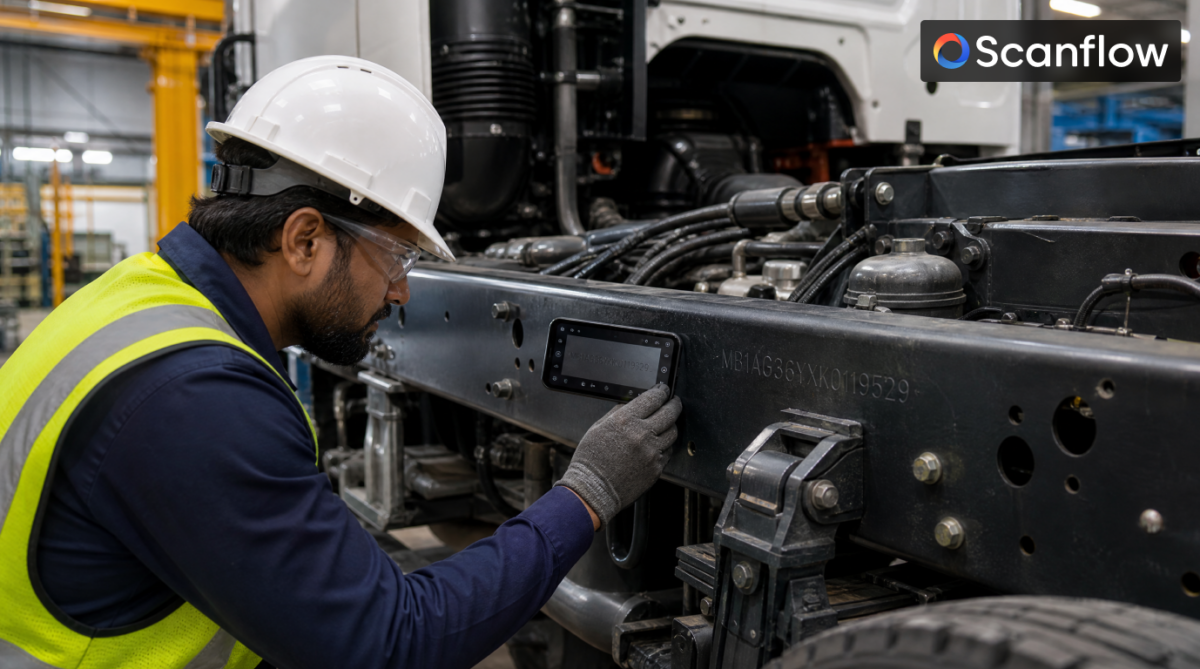
How Scanflow VIN number scanning enhances Quality Check in manufacturing?
3 Mins read
Posted on Oct 4, 2023