How AI VIN Scanning Cuts Gate Check-In Time And Reduces Condition Dispute Liability
The $165 Billion Industry With a 90-Minute Return Problem Every returned rental vehicle is a li...
 8 Mins read
Posted on Jun 24, 2026
September 11, 2026
4 Mins read



Every vehicle manufactured for road use carries a 17-character Vehicle Identification Number, a unique code that encodes far more than most drivers realize: manufacturer, model year, assembly plant, body style, engine type, and critically, the manufacturer’s original equipment specifications, including tire size. Unlike reading a worn sidewall or relying on memory, decoding a VIN pulls this information directly from manufacturer data, which means it’s accurate regardless of what’s currently mounted on the vehicle.
Reading tire size directly off a mounted tire seems like the obvious approach, and often it is. But it has real limitations. A previous owner may have installed a non-standard size, intentionally or by mistake. The current tires might be aftermarket replacements that don’t match the vehicle’s original specification. Sidewall text on an older, worn tire can be difficult to read accurately, especially in poor lighting or on a curved, dirty surface. And if someone is evaluating a vehicle they don’t yet own, checking specs before a purchase, or ordering replacement tires without the vehicle physically present, reading a sidewall isn’t even an option.
The VIN sidesteps every one of these problems. It doesn’t describe what’s currently mounted on the car. It describes what the manufacturer built and specified, which is the baseline most drivers actually want when they’re trying to confirm the correct tire size for their specific vehicle.
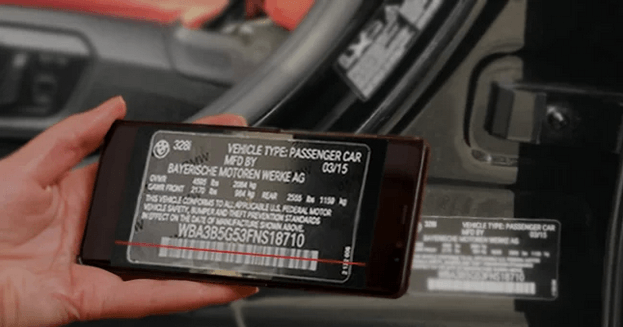
The VIN appears in a few standard locations on virtually every vehicle. The most common is a small metal or plastic plate visible through the windshield on the driver’s side dashboard, readable from outside the car without opening a door. It also appears on the driver’s side door jamb, usually on a sticker alongside other vehicle specification data, and on official documents including the vehicle’s registration, title, and insurance card. Any of these sources will provide the same 17-character code.
Once the VIN is in hand, the process of extracting tire size information is essentially a lookup problem, matching the encoded vehicle data against a manufacturer specification database. Modern VIN scanning tools decode the 17-digit VIN and return structured vehicle identity data, including make, model, year, trim, and original equipment specifications, ready to reference or push into another system entirely. Rather than manually typing a VIN into a search field and hoping for accurate results, camera-based VIN scanning captures and decodes the code directly from an image, reducing the transcription errors that come from misreading a small, sometimes worn character on a metal plate.
This matters more than it might seem. A VIN is long, alphanumeric, and easy to mistype, particularly when characters like the letter O and the number 0, or the letter I and the number 1, look nearly identical depending on the font and condition of the plate. A single mistyped character returns entirely wrong vehicle data, which means a manually entered VIN lookup carries real risk of confidently returning the wrong tire size for a completely different vehicle configuration.
This same principle applies to reading a tire’s own sidewall data once it’s actually mounted on the vehicle. Sidewall scanning technology built to read DOT codes, size, and brand information directly from a camera image, even on worn or damaged tires, closes the same gap from the other direction, verifying what’s physically on the vehicle against what the VIN says should be there, rather than relying on either source alone.
One detail that trips up a lot of manual tire-size lookups is that the same model year and make can have multiple original tire sizes depending on trim level, engine configuration, or optional wheel packages. A base trim and a sport trim of the same vehicle, same year, same model, can legitimately call for different tire dimensions. A generic search for “2021 Model X tire size” often returns the wrong answer for a specific vehicle, because it doesn’t account for which exact configuration that VIN represents.
This is precisely where VIN-based lookup earns its advantage over a generic web search. Because the VIN encodes the specific configuration, not just the general model, decoding it returns the tire size that was actually specified for that exact vehicle, not just a plausible-sounding answer for the model line in general.
This isn’t just a technical curiosity. It solves real, common situations. Someone buying a used car can verify before purchase whether the tires currently mounted match the manufacturer’s original specification, which can be a useful negotiating point or a flag for prior modifications. A shop processing a vehicle without direct access to walk out and read a sidewall, during a phone consultation or an online quote request, can pull accurate specifications immediately from the VIN alone. Fleet operators managing vehicles across multiple locations can confirm correct tire specifications for each vehicle without a physical inspection, useful for ordering replacement sets in bulk without guesswork.
In each of these cases, the alternative to VIN-based lookup is either a physical inspection that isn’t always possible, or a generic search that risks returning the wrong configuration’s data. Neither is as reliable as pulling the answer directly from the vehicle’s own encoded specification.
There’s also a compliance angle worth mentioning for shops and dealerships specifically. When a customer’s tire size is confirmed and recorded against their VIN at the time of service, that record becomes useful well beyond the single visit, supporting warranty documentation, future service recommendations, and accurate quoting for repeat customers without needing to re-verify specifications from scratch every time the vehicle comes in.
For most drivers, checking a sidewall will remain the quickest option when the vehicle is right there and the current tires are trusted to be correct. But for anyone who needs certainty, confirming original equipment specs, evaluating a vehicle before purchase, or ordering replacements without the car physically present, VIN-based lookup is the more reliable source, precisely because it comes from manufacturer data rather than whatever happens to be currently mounted.
Tire size isn’t just printed on the tire. It’s encoded into the vehicle itself, in a code most drivers walk past every day without a second thought. Learning to use the VIN for this purpose isn’t just a convenience, it’s often the more accurate answer, especially in any situation where the sidewall in front of you might not tell the whole story. The next time tire size needs confirming, the dashboard plate is worth checking before the tire itself.

How AI VIN Scanning Cuts Gate Check-In Time And Reduces Condition Dispute Liability
8 Mins read
Posted on Jun 24, 2026

How Scanflow VIN number scanning enhances Quality Check in manufacturing?
3 Mins read
Posted on Oct 4, 2023