Where Is the VIN Number on a Car? Every Location for Cars, Trucks, Motorcycles and Trailers
What Is a VIN Number? A VIN (Vehicle Identification Number) is a unique 17-character code that iden...
 2 Mins read
Posted on Nov 18, 2026
November 18, 2026
5 Mins read


A VIN has 17 characters and every one of them has to be right. Typed by hand, a long code like that goes wrong more often than people expect. A digit gets swapped, a letter is mistaken for a number or two characters change places. The good news is that the VIN has a safeguard built into it for exactly this problem: the check digit. This blog explains what it is, what it catches, where it falls short and why a good VIN scanner should use it on every scan.
The check digit is the ninth character of a VIN. Unlike the other characters, it does not describe the vehicle. Its only job is to confirm that the other 16 characters are consistent with each other. In North America, vehicle makers are required to include it. Many other markets do not use the same rule, so a VIN from outside North America may not follow it.
The calculation is simple enough to describe without any maths. Every letter in the VIN is converted to a number using a fixed table. Each position in the VIN has its own fixed weight. The number in each position is multiplied by that position’s weight and the results are added together. The total is divided by 11 and the remainder becomes the check digit. If the remainder is 10, the check digit is shown as the letter X.
The point is that the ninth character is not chosen freely. It is worked out from the other 16. If someone changes one of those 16 characters, the sum changes, the remainder changes and the ninth character no longer matches. Software can repeat the calculation in a fraction of a second and see that the VIN does not add up.
The design is clever because of the weights. Since each position has a different weight, a wrong character in almost any position will push the total to a different result. In practice the check digit catches nearly every case where one character has been replaced by another, with one exception: two characters that share the same number value in the conversion table. It also catches most cases where two neighbouring characters have been swapped, which is a very common typing slip.
These two mistakes, a wrong character and a swapped pair, are exactly the ones that people make when copying a long code.
It helps to be honest about the limits. Because the remainder can only take 11 values, a random wrong VIN has roughly a one-in-eleven chance of passing the check by accident. So a pass does not prove the VIN is correct. It only means the VIN is internally consistent.
It also cannot tell you whether the VIN is real, whether it belongs to the vehicle in front of you or whether the plate has been tampered with. A cloned VIN, copied from a genuine vehicle, passes the check because the number itself is valid. And a real VIN from a market that does not use the North American rule may fail the check without being wrong at all.
Most errors come from a short list of causes. Look-alike characters are the biggest. A zero and the letter O, or a one and the letter I, are easy to confuse. The VIN standard avoids this by never using the letters I, O, and Q, but a tired person still has to decide what they are looking at. Worn, dirty or curved plates add to the problem and once a number has been copied from a plate to a sheet and then into a system, it has had several chances to change.
Manual VIN entry is where compliance risk starts, because the check digit only helps if someone actually runs it and a person typing quickly rarely stops to calculate a remainder.
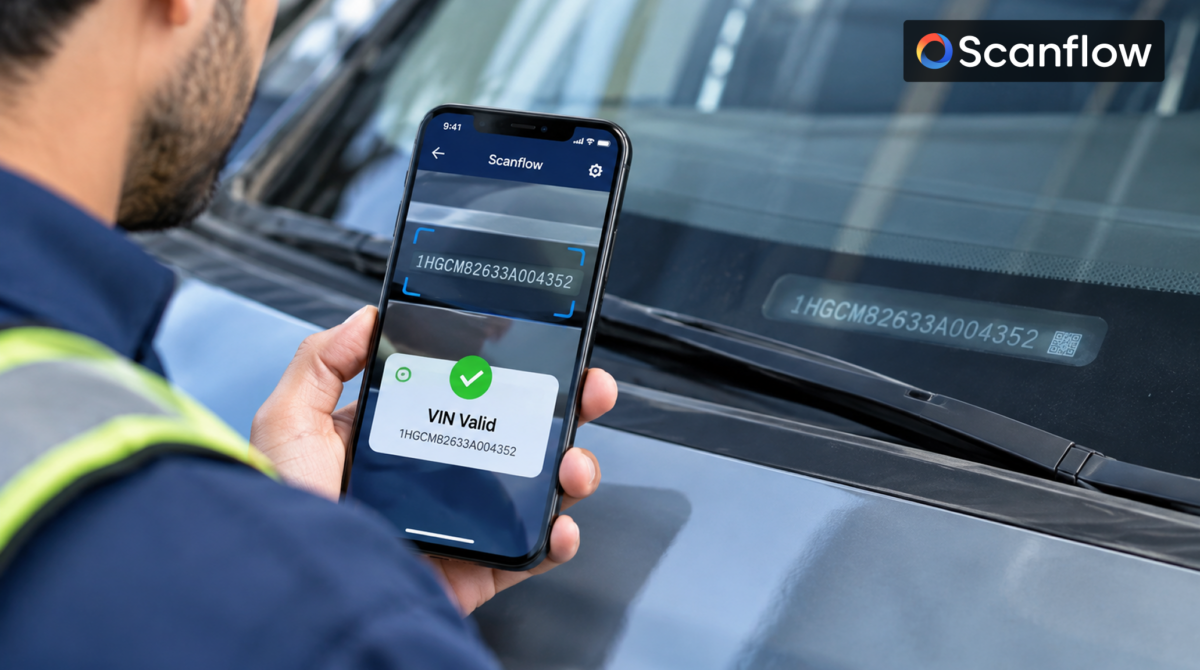
Replacing typing with a camera removes one source of error, but a camera can also misread. Text recognition software can confuse the same look-alike characters that people do, especially on scuffed or glare-covered surfaces. That is where the check digit becomes useful in a new way. A smart scanner can treat it as a built-in test on its own output.
There are several sensible ways to use the check digit on every scan. The first is simple validation. After reading the 17 characters, the software runs the calculation. If the result does not match the ninth character, the scan is flagged as suspect and the user is asked to try again or capture the number from another location on the vehicle.
The second is resolving doubt. If the software is unsure whether a character is an 8 or a B, or a 5 or an S, it can test each candidate and keep the one that makes the check digit work. The character rules help too, since a letter I, O or Q can never be correct.
The third is trust. When a scan passes both the character rules and the check, the team has far more reason to rely on the result than they would for a number typed from a plate. It turns a plain reading into a validated one.
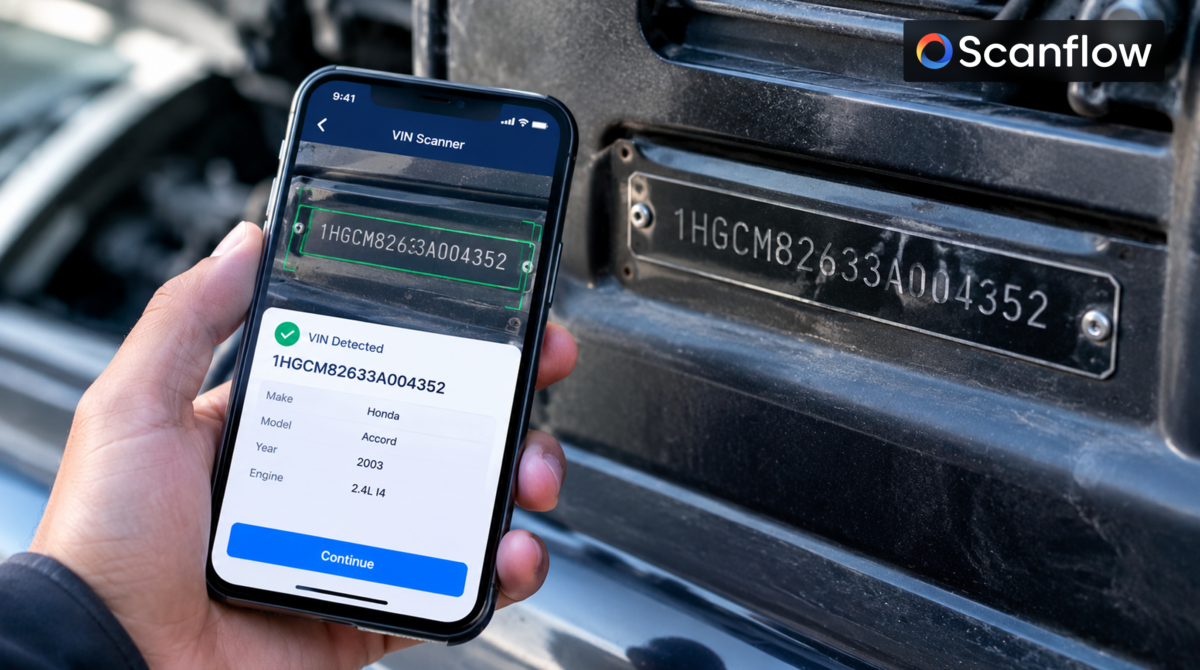
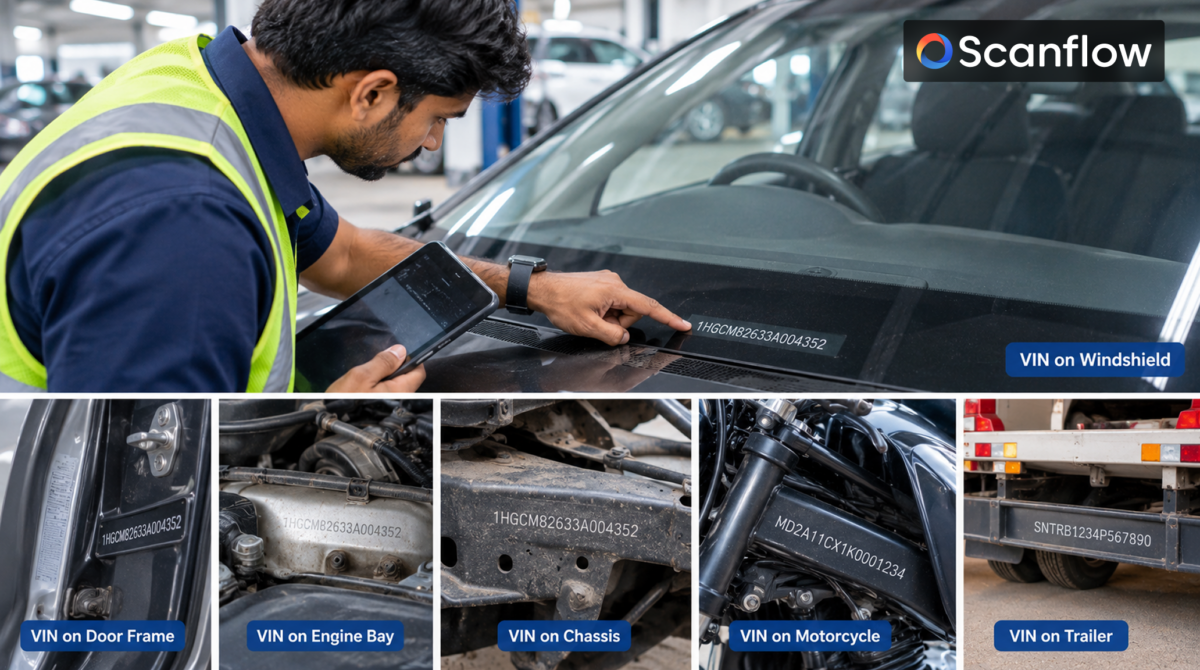
Scanflow’s VIN scanning works from a smartphone camera and reads VIN barcodes, etched chassis numbers, dashboard stickers, and door jamb labels, even in glare, low light or on curved surfaces. It is built to handle damaged labels, poor lighting and non-standard printing, and it does not need dedicated hardware.
After a scan, the software decodes the 17-digit VIN serial code and returns structured vehicle identity data. Scanflow’s page also says the app reads and verifies the vehicle’s identity and it lists instant VIN decode to vehicle specs. One point should be made clearly. The page does not describe how that verification is done, and it does not mention the check digit by name. If check-digit validation matters to your process, ask the product team to confirm how it is handled before you rely on it.
Scanflow’s page states 99 percent or better VIN scan accuracy, which is a vendor claim worth testing on your own vehicles and plates.
The check digit works best as one layer. A valid VIN should still be decoded, and the decoded make, model, and year should be compared with the vehicle itself. Capturing the number from more than one location on the car adds another test and for anything involving ownership, history or authenticity, the right records still need to be checked. Each layer catches something the others miss.
A practical routine does not need to be complicated. Scan the VIN instead of typing it. Make sure the tool tells you when a scan fails validation. If it does, scan again from another location. Compare the decoded specs with the vehicle. And keep a record of every scan so that errors can be traced later.
The check digit is a small piece of arithmetic that catches most of the slips people make when handling a VIN. It cannot prove a vehicle is genuine, but it can stop a mistyped or misread number from travelling through a system unnoticed. Scanning removes the typing, and validation removes much of the doubt, so the two work best together.

Where Is the VIN Number on a Car? Every Location for Cars, Trucks, Motorcycles and Trailers
2 Mins read
Posted on Nov 18, 2026
Why One Wrong VIN Digit Can Cost You a Used Car Auction Deal and How Mobile VIN Scanning Fixes It
5 Mins read
Posted on Oct 28, 2026