How AI Barcode Scanning Improves Solar Panel Traceability & Compliance
If you manage quality or compliance for a solar manufacturer or EPC firm, understanding the specific...
 5 Mins read
Posted on Mar 6, 2026
December 2, 2025
5 Mins read



Introduction Electric vehicle production is reshaping automotive manufacturing in Michigan. Quality expectations are rising, and tires are among the most critical components requiring precise verification. Each tire must match exact specifications, carry correct regulatory codes, and be accurately tracked from warehousing through fitment. Manual checks are slow and error prone, which leads to SKU mismatches, […]
Electric vehicle production is reshaping automotive manufacturing in Michigan. Quality expectations are rising, and tires are among the most critical components requiring precise verification. Each tire must match exact specifications, carry correct regulatory codes, and be accurately tracked from warehousing through fitment. Manual checks are slow and error prone, which leads to SKU mismatches, inventory confusion, and assembly delays. This is where tire sidewall scanning powered by Scanflow elevates operations.
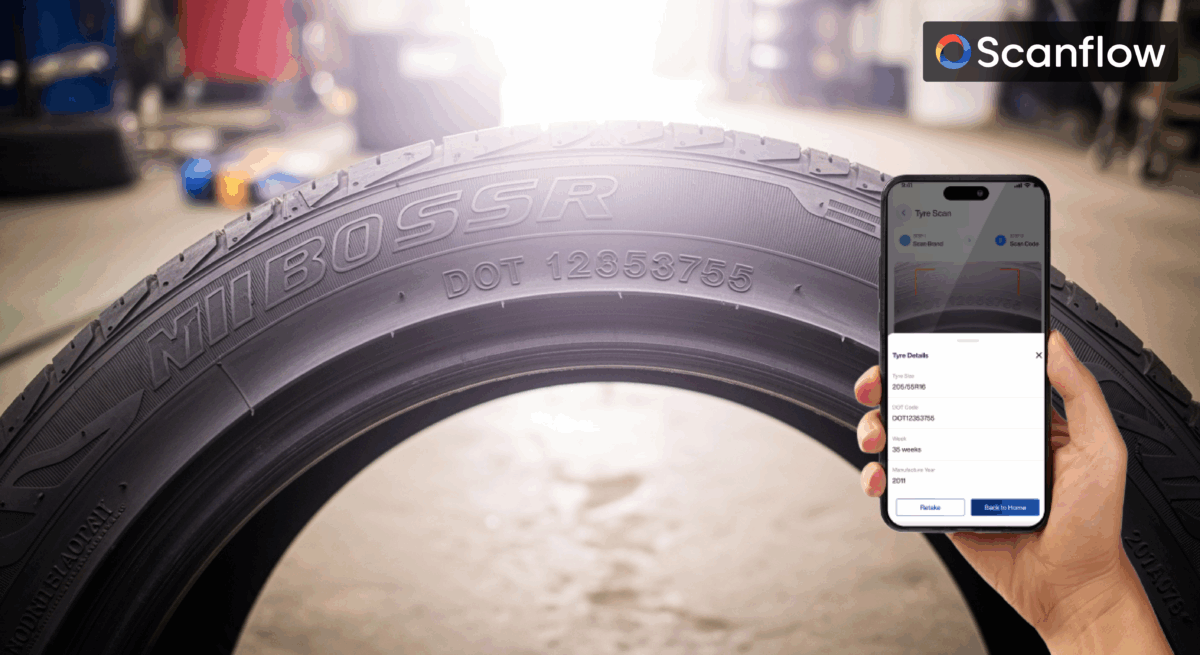
Tire sidewall scanning automates the capture of DOT, TIN, tire size, brand, model, and manufacture age codes. This replaces handwritten logs and manual data entry with clean, validated digital information. The result is stronger traceability, improved inventory accuracy, and reliable fitment verification. In this article, we explore how AI driven tire sidewall scanning supports next generation EV production across Michigan, and how Scanflow enables quality, speed, and data integrity for QA, warehousing, and tire fitment teams.
EV manufacturing introduces a higher variety of tire SKUs than conventional vehicles. EV tires must accommodate battery mass, torque delivery, and efficiency requirements. Michigan EV plants often manage dozens of tire sizes, load indexes, and model variants. Manual identification cannot scale reliably across such diversity. Tire sidewall scanning ensures that every tire entering production is verified against the correct attributes.
Manual reading of DOT or size markings often results in transcription errors. Operators may misread low contrast characters, overlook model variations, or enter the wrong SKU into the system. These mistakes cause mismatches during fitment and can lead to costly rework. Automating the capture of sidewall fields solves this persistent problem.
Accurate identification is a fundamental part of EV assembly quality. Validating size, load rating, brand, and manufacturing date ensures each tire meets build requirements. Automated capture from Scanflow provides immediate verification, reduces manual intervention, and strengthens the assembly line’s quality gate.
Scanflow’s tire sidewall scanning focuses on highly reliable identification and data accuracy. It does not attempt structural defect analysis. Instead, it ensures that every tire is correctly recognized and recorded at every step of production.
Scanflow reads and validates:
DOT codes
TIN codes
Tire size
Brand and model text
Manufacturing date or age code
Additional molded identifiers when present
This eliminates the inconsistencies of manual reading and supports fast, error free data entry.
Every captured field is validated against inventory and build data. When a tire is scanned, the system instantly confirms whether it matches the expected SKU or build. This prevents mounting errors, streamlines QA checks, and ensures production alignment.
From warehouse receiving to final assembly, Scanflow creates a complete, searchable data trail for each tire. Time stamps, captured fields, and evidence images support:
Warranty tracking
Recall readiness
Supplier quality evaluations
Evidence based audits
Traceability becomes effortless because data is collected automatically.
Scanflow integrates through APIs to update plant systems in real time. This creates synchronized digital records for warehouse management, production sequencing, and assembly line execution.
Scanflow’s AI solutions handle the variability of molded tire markings. Differences in depth, curvature, contrast, or wear do not prevent accurate reading.
The system captures and validates data quickly, allowing warehouse or assembly teams to maintain momentum without waiting for manual logging or double checking.
Captured fields are compared against production rules, ensuring:
Right size
Right load index
Right brand and model
Correct batch or age limitations
This ensures that tires delivered to the line match the vehicle’s exact requirements.
Scanflow provides clean datasets for QA teams to analyze patterns, identify process weaknesses, and strengthen quality control strategies.
Automated capture ensures that fitment teams always mount the correct tire on the correct vehicle. Human error is minimized, and quality assurance becomes more predictable.
Instead of visually checking codes, operators rely on automated validation from Scanflow. This shortens pre-fitment checks and allows lines to maintain speed.
When intake data is automated, warehouse systems immediately reflect the correct information. Inventory discrepancies decline, and stock becomes more predictable to manage.
Manufacture age codes and brand model identifiers captured during intake allow QA teams to trace issues back to specific shipments or suppliers. This eliminates guesswork and improves accountability.
Patterns in tire usage, batch age, mismatch frequency, and SKU rotation become visible. This supports continuous improvement, lean initiatives, and operational planning.
Electric vehicle production relies on consistent, verifiable data flows from receiving to assembly. Tire identity must remain accurate throughout, especially when multiple tire SKUs are used for different models. Scanflow ensures that tire data is never lost, misread, or manually corrupted.
At receiving, Scanflow confirms the identity of every tire. It creates clean, structured inventory records by capturing:
DOT
TIN
Size
Manufacturing date
Brand and model
This prevents mislabeled pallets or mixed batches from entering production. Warehouse teams benefit from reliable, searchable data and simplified rotation planning.
EV assembly requires perfect matching of tire specification and build requirements. Scanflow validates each tire before it reaches the mounting machine. Operators receive clear pass or mismatch indicators, which protects assembly quality while speeding up decision making.
Scanflow assigns digital records throughout receiving, storage, picking, and fitment. Each record includes captured fields, time stamps, and station identifiers. This creates a complete footprint of where each tire was, when it was handled, and how it was used in production.
With accurate sidewall data available, plants gain insight into:
SKU consumption
Batch aging
Procurement irregularities
Warehouse flow patterns
Fitment verification trends
These insights help QA and operations teams improve both process control and sourcing strategies.
Scanflow fits naturally into existing EV production workflows without requiring major process redesign. It strengthens key steps where manual data entry traditionally introduces errors.
At intake, operators roll each tire into view of the scanner. Scanflow captures all sidewall fields automatically and updates the inventory system. Incorrect or unexpected tires are flagged immediately, preventing them from entering storage.
With digital records available for each tire, WMS processes become more reliable. Staff can quickly locate tires by size, batch, or age. SKU mix ups drop dramatically because data is validated during intake rather than handwritten at the shelf.
As tires reach the assembly station, Scanflow re-verifies sidewall attributes. If the tire does not match the required specification, the system alerts the operator before mounting occurs. This is a strong final safeguard against misfit events.
Scanflow records support vehicle build documentation by linking the validated tire attributes to a vehicle ID or VIN in the MES. This improves warranty support, service analysis, and production recordkeeping.
The data collected supports audits, compliance reporting, supplier quality reviews, and investigations. Because every tire has a digital history, reviews become straightforward rather than paper driven.
Scanflow captures DOT, TIN, size, brand, model, and manufacture date with high accuracy.
Automated capture eliminates manual transcription errors.
Traceability is strengthened from warehouse intake to final assembly.
Fitment accuracy improves when tire verification is automatic.
Inventory systems become more reliable with validated real time updates.
Scanflow provides clean data for continuous improvement and supplier management.
Michigan’s expanding EV production ecosystem depends on precise, reliable, and efficient quality processes. Tires play a central role in both safety and performance, which makes accurate identification and data integrity essential. Scanflow enables plants to automate sidewall data capture, remove manual errors, improve inventory accuracy, and guarantee correct tire fitment.
By starting with warehouse intake and extending through assembly verification, Scanflow provides end to end traceability for every tire. The result is faster workflows, fewer mismatches, clearer supplier insights, and better production documentation. As EV output grows, tire sidewall scanning is becoming a fundamental step toward smarter, more dependable manufacturing operations.

How AI Barcode Scanning Improves Solar Panel Traceability & Compliance
5 Mins read
Posted on Mar 6, 2026

Managing Large-Scale IT Asset Refresh: A Guide for ITAD Providers
14 Mins read
Posted on Feb 27, 2026
Scanflow Tire Sidewall Capture: Deep Technical Insights
5 Mins read
Posted on Dec 9, 2025