How AI Barcode Scanning Improves Solar Panel Traceability & Compliance
If you manage quality or compliance for a solar manufacturer or EPC firm, understanding the specific...
 5 Mins read
Posted on Mar 6, 2026
December 9, 2025
5 Mins read


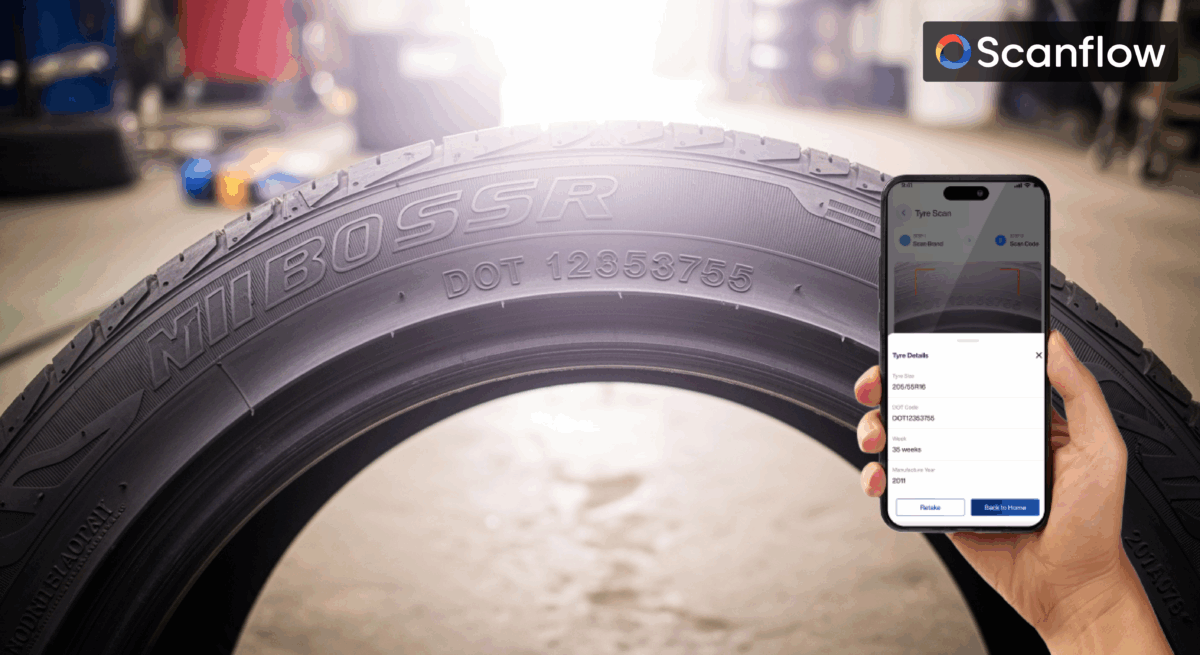
Scanflow’s tire sidewall scanning system harnesses mobile edge offline SDK that supports for both Android, iOS, Web and API which accurately and efficiently extract critical information such as DOT, size, model number, and brand from real-time images using smartphones and tablets. This article presents a technically robust account of each pipeline stage, relevant algorithms, and formulaic logic.
System Architecture: Edge-Driven Pipeline
Device & Data Capture Layer
Operators use a mobile app integrated with the Scanflow SDK. Images of the tire sidewall are captured using the built-in camera, under varying environmental conditions (light, dust, wear).
Real-time pre-processing ensures noise reduction and optimal imaging
Iproc = Enhance (Iraw), where Iraw is the input image and Iproc is the denoised, contrast-adjusted output.
Pre-processing workflow for tyre sidewall capture using the Scanflow Core SDK on mobile devices which has Scanflow Customized AI Camera. This step is critical, only high-quality frames make it to later stages, so scanning accuracy starts here.
The app uses Scanflow’s SDK (ScanFlowCameraSession, ScanTrustCameraManager)
Frame Filtering Algorithms:
Every frame is rapidly checked with a sequence of filters:
Sharpness Detection
Uses algorithms like Laplacian variance: computes edge sharpness. If variance is below a threshold, frame is too blurry and discarded.
S=Var(∇2I)
Where S is sharpnes, I frame image.
Motion Blur/Artifact Check
Simple frame-to-frame comparison assesses motion using optical flow or frame difference. If the tyre area shifts too much between frames, it’s rejected.
Exposure and White Balance:
Frames under- or over-exposed (too dark/bright) are detected with pixel intensity statistics:
Only frames passing ALL filters are sent to model inference (segmentation/OCR).
for (Frame frame : cameraBuffer) {
    if (!isSharp(frame)) continue;
    if (isMotionBlurred(frame)) continue;
    if (!hasGoodContrast(frame)) continue;
    if (!isProperlyExposed(frame)) continue;
    if (!isCentered(frame)) continue;
    processFrame(frame); // Pass to segmentation & OCR
}
Image Segmentation & Region of Interest (ROI) Detection
The SDK’s CV engine applies edge detection and region heuristics (Canny, Hough, and deep learning models) to localize key regions:
ROI = (Iproc) ROI = Detect (Iproc)
Segmentation leverages Custome model architectures for instance localization.
Optical Character Recognition (OCR)
P(ci) = Softmax(zi)
DOT = RegexSearch( S, DOT pattern )
Size= RegexSearch( S, Size pattern )
Manufacturer/brand is classified via context signals and dictionary lookups.
Semantic Parsing & Data Structuring
Extracted entities are tagged and validated:
Week/year codes from DOT (e.g., 4-digit decode: YYWW)
Size pattern (Width/Aspect Ratio R Diameter), matched by regex or neural text extraction
Model number filtered by fuzzy match to database records
The feature vector:
Vtire = [DOT, Size, Model_No, Brand]
Local Edge Validation & Timestamping
All critical data is validated on-device using checksum algorithms and cross-checks with reference datasets:
Valid = fcheck( Vtire, DBtire )
Timestamp and geotag are appended for traceability.
Edge Custome Model: Tuning for Tire Sidewall Capture
Model Training & Optimization
Training images are annotated for texture, contrast anomalies, and typical defect cases. Trained with 1 Million data sets
Loss functions combine categorical cross-entropy (for OCR) and segmentation IOU
Ltotal=αLocr+βLiou
Dataset diversity (thousands of brands, types, conditions) ensures generalizability and noise resilience.
The Mobile models are quantized using for real-time, low-latency inference (<300ms typical).
The mobile will completely run on edge with Offline capability for field/yard use.
Data Usage in Model Training
The foundation of Scanflow tire sidewall scanning model lies in meticulously collected, annotated, and curated datasets, incorporating diverse real-world edge cases. The dataset is used for training various AI models that perform segmentation, text detection, and recognition in a multi-stage pipeline:
Multi-stage Training
L=Lcls+Lbox+Lmask
Data Privacy and Security For Enterprise System Integration
Comparison statistics report of Scanflow and other Commercial SDKs available in Market.
Here is a comparative chart that illustrates the stability, accuracy, and performance (speed) of the Scanflow SDK versus three other commercial tire sidewall scanning SDKs. The values are on a 0-100 scale based on typical reported benchmarks and user feedback:
This visual comparison helps users quickly comprehend how Scanflow excels in delivering reliable, accurate, and fast tire sidewall scanning.

Users can visualize Scanflow outperforming competitors on all three parameters, indicating reliability and speed combined with superior detection accuracy.
Such a chart helps technical users quickly assess and compare SDK capabilities for integration or evaluation purposes. If needed, this can be presented as a grouped bar chart with distinct colors per metric for clarity.
Let’s take a comparison metrics with leading Competitor A SDK.
| Metric / Condition | Scanflow | Competitor A | Scanflow Advantage |
|---|---|---|---|
| Overall Accuracy | 96.6% | 85.1% | ✅ +11.5% higher accuracy |
| Old & Glared Tyres | 100% | Not specified | ✅ Proven capability on aged/glared surfaces |
| Blurred Images | 86% | 54% | ✅ Handles blurred captures (partial recovery possible) |
| Accuracy in Challenging Conditions | Very High | Low | ✅ Robust in difficult lighting/angles |
| Consistency Across Conditions | Very High | Moderate | ✅ Reliable across varying scenarios |
Scanflow Leading Metrics (Compared to Competitor A)
| Criteria | Scanflow | Competitor A | Scanflow Advantage |
|---|---|---|---|
| Tyre Compatibility | Works on any tyres | Car tyres only | ✅ Universal tyre support |
| Blurry Image Handling | Excellent | Poor | ✅ Handles low-quality images effectively |
| Challenging Conditions | Handles well | Struggles | ✅ Robust under real-world conditions |
| Offline Support | ✅ Fully Offline | ❌ Requires Internet | ✅ Works without connectivity |
| DOT Code ROI Handling | More flexible | Very narrow ROI box | ✅ Adapts better to varying code areas |
| Partial Value Return | ✅ Returns partial values | ❌ Not supported | ✅ Can decode incomplete DOT codes |
| Text Angle Handling | Tolerates a range of angles | Best when perpendicular | ✅ Works across multiple orientations |
| Default Camera Mode | Uses wide-angle (may need tuning) | Neutral | ✅ Broader field |
Summary
Scanflow’s tire sidewall scanning SDK combines cutting-edge AI models, mobile-optimized processing, comprehensive and accurate data extraction, and seamless integration, backed by industry-leading stability and performance. These technical strengths ensure developers and businesses gain a robust, future proof solution, minimizing operational friction while maximizing insight and efficiency making Scanflow an unmatched choice in the tire scanning ecosystem.
Scanflow delivers enterprise-grade reliability, accuracy, and resilience, positioning itself as the most advanced and deployable tire sidewall scanning SDK in today’s market.

How AI Barcode Scanning Improves Solar Panel Traceability & Compliance
5 Mins read
Posted on Mar 6, 2026

Managing Large-Scale IT Asset Refresh: A Guide for ITAD Providers
14 Mins read
Posted on Feb 27, 2026