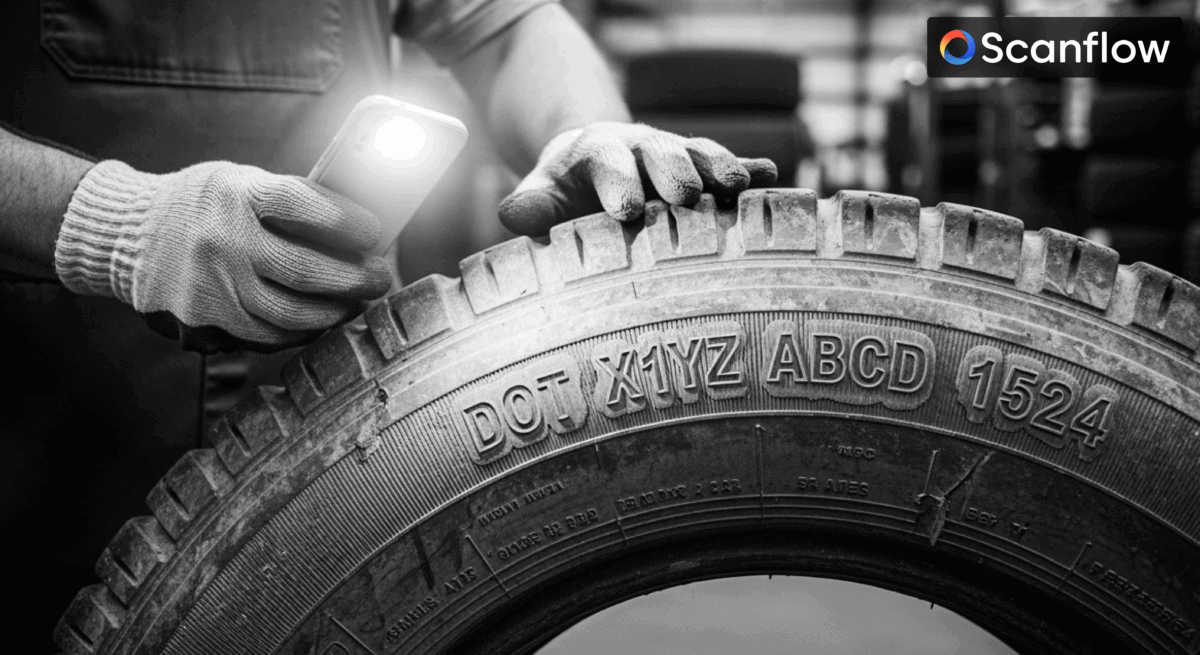
Discover why capturing tire sidewall data through advanced tire scanning technology is essential for improving accuracy, traceability, and compliance in tire assembly operations. Learn how Scanflow’s automated solutions empower modern manufacturing plants to optimize quality control and production efficiency.
Understanding Tire Scanning and Sidewall Data
In the tire manufacturing world, every component must be precisely identified and verified to ensure safe, reliable performance on the road. Each tire’s sidewall holds critical information including the DOT code, batch number, dimensions, serial identifiers, and manufacturer details that defines its unique identity. This sidewall data links the tire to its production history, materials, and quality inspections, forming a key part of traceability within manufacturing systems.Tire scanning technology automates the capture of this data by reading and recording these codes quickly and accurately. Instead of relying on manual inspection or handwritten notes, manufacturers can now use vision-based scanning systems to capture this information in seconds. This data then becomes part of a connected digital record, ensuring that every tire’s journey from production to assembly to final delivery is traceable and verifiable at any moment. For QC and assembly managers, this accuracy transforms daily operations. It eliminates uncertainty, reduces bottlenecks, and strengthens confidence that every tire assembled meets both internal quality benchmarks and OEM compliance requirements.
How Tire Scanning Works in Assembly Operations
Modern tire assembly operations rely on speed, precision, and data-driven decisions. Tire scanning fits perfectly into this environment. By placing scanners at strategic points along the line, the system automatically reads and extracts relevant information from each tire’s sidewall as it passes. These details are instantly linked to the manufacturing database, enabling plant teams to view the tire’s identity, production stage, and status in real time.The process is designed to be completely hands-free. Operators no longer need to stop, read, or record tire details manually. Instead, the scanning system ensures consistent, reliable data capture under various lighting and environmental conditions. This seamless automation minimizes errors and allows production lines to maintain flow without interruption.With tire scanning, assembly heads gain improved visibility and traceability across operations. The result is a faster, more reliable, and audit-ready workflow that supports lean manufacturing goals and continuous improvement initiatives.
Challenges in Manual Tire Identification and Tracking
Errors in Manual Data Entry
Despite rigorous training, manual data entry remains vulnerable to human error. In large manufacturing plants producing thousands of tires each day, even a small misread or misplaced entry can lead to costly complications. Tire sidewalls often include embossed text that’s difficult to read under production lighting or when dust and residue build up over time. A single incorrect digit in a DOT code can create confusion in tracking, product mismatches, or errors during tire fitment.These manual errors can cascade through the system from assembly alignment issues to quality hold-ups and even delays in dispatch. Over time, such inefficiencies reduce productivity and increase rework costs, directly affecting profitability and delivery timelines.
Loss of Traceability Across Production Stages
Maintaining continuous traceability across tire production and assembly stages is one of the biggest challenges for managers. Without automated scanning, it’s difficult to link each tire’s identity to its production data once it leaves the initial inspection stage. As a result, identifying which tire came from which mold or batch becomes nearly impossible in the event of quality concerns.This lack of traceability doesn’t just slow down problem-solving it can also complicate regulatory audits, warranty validation, and root-cause investigations. For manufacturers focused on global export or OEM partnerships, these traceability gaps can be major compliance risks.
Why Capturing Tire Sidewall Data Matters
Ensuring Product Quality and Consistency
Each tire must meet strict dimensional, material, and performance criteria before it reaches final assembly. Automated sidewall data capture ensures that only correctly identified tires move forward in the process. This maintains consistent quality standards and prevents mismatched or incorrectly labeled products from entering distribution. Tire scanning becomes a crucial quality checkpoint that reinforces brand reliability and customer trust.
Enabling Faster Quality Control Decisions
When tire data is available instantly, quality control becomes proactive rather than reactive. Managers can quickly identify production deviations, verify batch alignment, and confirm that each tire meets specification before reaching the next stage. This data transparency helps teams make faster, data-driven decisions that prevent potential defects from escalating. The result is fewer disruptions and a smoother overall workflow.
Meeting Regulatory and OEM Compliance Requirements
Today’s automotive OEMs and regulatory bodies require end-to-end traceability for every component. Capturing tire sidewall data is a vital part of demonstrating compliance with these expectations. Automated data capture ensures that each tire’s details are securely stored and retrievable at any point simplifying audits, warranty claims, and quality certifications. It’s a cornerstone of compliance-driven manufacturing excellence.
Tire Scanning in Smart Manufacturing Environments
Integration with MES and ERP Systems
As tire manufacturing evolves toward Industry 4.0, tire scanning is emerging as a critical enabler of digital integration. The captured data can seamlessly connect with Manufacturing Execution Systems (MES) and Enterprise Resource Planning (ERP) tools, creating a closed-loop production ecosystem. This integration ensures that every tire’s journey from raw materials to finished goods is digitally documented, traceable, and actionable in real time.
Data Analytics for Process Optimization
Once tire sidewall data is captured and stored digitally, it opens the door for advanced analytics. By examining patterns across production lines, managers can identify inefficiencies, predict maintenance needs, and optimize equipment scheduling. This data-driven decision-making enhances process stability, reduces waste, and improves overall yield. Over time, these insights can drive significant gains in productivity and cost efficiency.
Introducing Scanflow: Automating Tire Sidewall Data Capture
How Scanflow’s Tire Scanning Solutions Work
Scanflow delivers next-generation tire scanning solutions designed to make sidewall data capture effortless and precise. Its imaging and vision-based technology identifies every tire uniquely, regardless of lighting, surface texture, or environmental conditions. The system can be deployed in new assembly lines or easily retrofitted into existing ones, enabling manufacturers to upgrade without disruption.Once installed, Scanflow captures sidewall data automatically, uploads it to the central quality database, and links it to the corresponding production record. This closed-loop process creates a permanent digital footprint for every tire produced ensuring full visibility and control across the assembly operation.
Key Advantages of Using Scanflow in Tire Assembly Lines
- 100% traceability: Every tire’s journey is digitally documented, ensuring full visibility.
- Error elimination: Automated scanning removes human errors and mislabeling risks.
- Increased throughput: Real-time identification accelerates assembly flow and inspection cycles.
- Audit-ready data: Easy access to traceable records simplifies internal and regulatory audits.
- Fast ROI: Reduced downtime, enhanced accuracy, and improved operational efficiency yield measurable returns.
Real-World Impact: Transforming Tire Assembly Operations
Reducing Downtime and Improving Throughput
One of the most tangible benefits of Scanflow’s tire scanning technology is the reduction in assembly downtime. By automating data capture, operators no longer need to pause production for verification or labeling. This constant line flow improves throughput and supports lean production principles. In high-volume facilities, these time savings translate directly into higher daily output and improved equipment utilization.
Enhancing Data Accuracy and Traceability
Digitizing tire data with Scanflow strengthens operational transparency and accountability. Every tire can be traced back to its specific production parameters from mold data to curing conditions providing a complete record for analysis. This traceability not only enhances internal quality control but also simplifies external audits and OEM compliance checks. The result is a smarter, more connected, and more responsive manufacturing environment.
Choosing the Right Tire Scanning Solution for Your Facility
When selecting a tire scanning solution, manufacturers should focus on accuracy, scalability, and ease of integration. A system should seamlessly fit into existing production lines, minimize operator intervention, and provide reliable data outputs under real-world factory conditions. Scanflow stands out by combining proven industrial performance with flexibility supporting both large-scale production environments and specialized assembly setups.With Scanflow, manufacturers gain a partner committed to driving digital transformation in tire manufacturing. Its end-to-end scanning and data management capabilities not only improve operational control but also align with long-term Industry 4.0 and smart factory goals.
Conclusion: Driving Quality, Efficiency, and Compliance with Tire Scanning
Capturing tire sidewall data is no longer just a quality assurance measure it’s a strategic necessity for competitive manufacturing. Automated tire scanning ensures unmatched precision, traceability, and speed while reducing manual effort and compliance risks. It bridges the gap between human expertise and digital intelligence on the factory floor. With Scanflow’s advanced tire scanning solutions, manufacturers can modernize their assembly lines, strengthen quality assurance, and gain a powerful edge in efficiency and data-driven decision-making. Scanflow’s technology transforms routine inspection into an intelligent, automated process that scales effortlessly with production growth.
👉 To Book a demo to see how Scanflow can transform your tire assembly operations.