Categories
Tire Sidewall

How Tire Recycling Companies Can Avoid Costly Compliance Fines in 2025

Executive Summary


In 2025, U.S. tire recyclers face tightening state and federal compliance requirements for waste tire transportation, storage, and recycling documentation. Manual recordkeeping and paper manifests are no longer sufficient to meet evolving mandates from agencies such as CalRecycle (California), TCEQ (Texas), and the EPA.

To stay compliant and profitable, tire recyclers are turning to AI-powered scrap tire scanning that automates tire identification, helps with manifest preparation and reporting. These solutions deliver real-time data accuracy, audit-ready documentation, and end-to-end visibility reducing compliance costs and eliminating the risk of fines.

By leveraging AI, recycling facilities can digitize their compliance workflows, streamline manifests, and ensure consistent reporting accuracy, while maintaining data privacy and operational efficiency. Human oversight remains essential for interpreting context and validating data integrity, ensuring that automation supports not replaces regulatory accountability.

The 2025 Compliance Landscape for Tire Recyclers

State and Federal Oversight Intensifies

  • CalRecycle mandates hauler registration, manifests for loads of 10+ tires, and electronic trip logs for waste tracking.
  • TCEQ (Texas) enforces annual reporting and digital manifesting under its Scrap Tire Program.
  • Colorado’s 6 CCR 1007-2 regulation requires manifests and 3-year record retention for all generators and recyclers.
  • EPA sustainability frameworks are pushing for digital waste tracking systems across multiple industries by 2025.

Key Compliance Risks

  • Missing or incomplete tire manifests.
  • Incorrect or unreadable DOT codes on sidewalls.
  • Inconsistent reporting between transporters and processors.
  • Lost paper documentation during audits.

Fines can reach $25,000 per violation with additional penalties for repeat offenders.

AI-Powered Compliance: The New Standard

AI is transforming compliance from a reactive reporting task into a proactive, automated process.

Automated Tire Identification

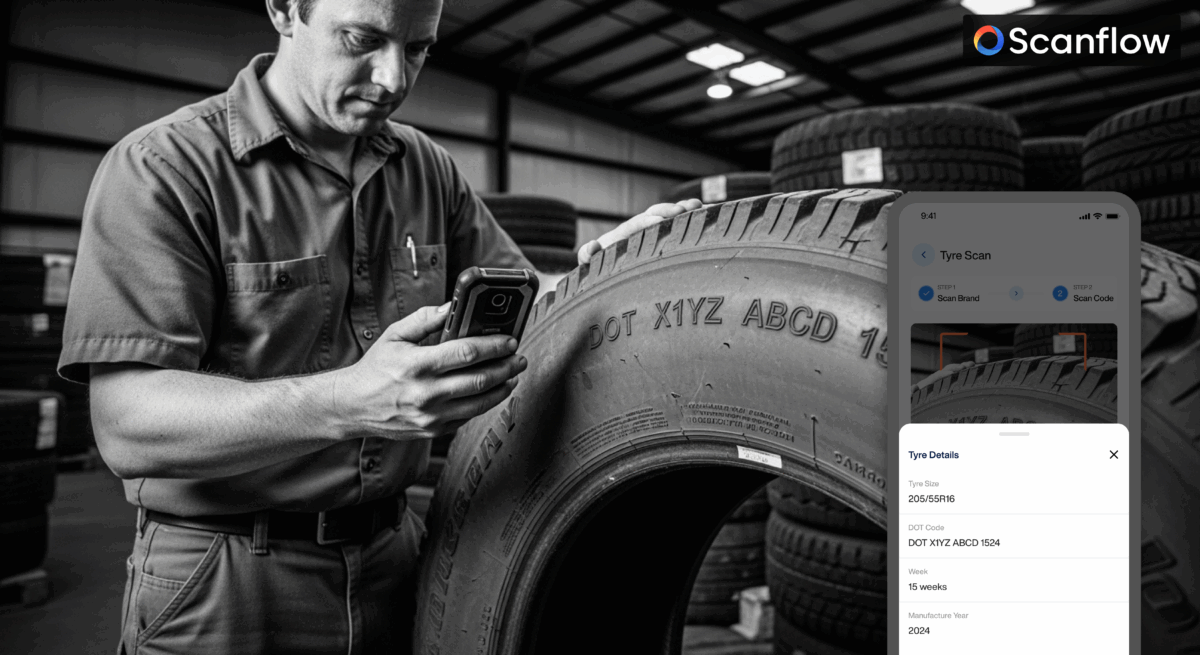
  • AI tire sidewall scanners capture DOT codes, brands, and serial details in real time.
  • Visual intelligence models identify sidewalls even under dirt, damage, or low light.
  • Each scan produces structured, tamper proof digital data ready for audit review.

Manifest Generation and Reporting

  • AI solutions like Scanflow compile captured data into complete digital manifests, automatically linking:
  • Source and destination facilities.
  • Transporter identification and load IDs.
  • Timestamped scan logs and batch summaries.
  • Helps create manifests that align with CalRecycle’s CTL and TCEQ reporting templates, minimizing administrative overhead.

Predictive Compliance Monitoring

  • AI flags missing tire counts, duplicate records, and data anomalies before audits.
  • Dashboards track real-time compliance performance, providing alerts for immediate correction.

Operational Transformation with AI Tire Scanning

Speed, Scale, and Precision

AI scanning enables tire processors to access huge volumes of tires, integrating seamlessly into existing systems.

  • Continuous scanning ensures uninterrupted workflow.
  • Batch-level reporting aggregates data for bulk shipments.
  • Local (on-device) processing ensures immediate feedback and no internet dependency.
  • All data is processed locally for full offline capability.
  • Meets EPA, GDPR, and state-level data privacy standards.

Business Impact: Turning Compliance into Competitive Advantage

AI tire scanning isn’t just about avoiding fines it’s a strategic investment in efficiency and growth.

Outcome AI-Driven Impact
Faster Operations 60–70% increase in throughput via automation.
Fewer Errors 80% reduction in data discrepancies and reporting mistakes.
Improved Audit Readiness Instant manifest retrieval and clean digital records.


By embedding AI into daily recycling operations, companies gain a long term edge in both compliance reliability and operational agility.

Optimizing Compliance Workflows with Scanflow

Scanflow’s Tire Sidewall Scanner helps recyclers implement digital compliance seamlessly through:

  • Hardware Integration: AI tire sidewall scanners retrofit easily into systems and inspection lines.
  • Data Dashboards: Real-time monitoring of tire inventory, shipment progress, and manifest status.
  • Reporting: Export-ready files compatible with CalRecycle, TCEQ, and EPA databases.
  • Predictive Insights: Early warnings for potential non-compliance issues.

This makes compliance visible, measurable, and verifiable turning regulatory obligations into process efficiency.

Practical Benefits for Tire Recyclers

  • Faster Audit Response: Generate digital manifests in seconds; auditors get clean, timestamped data instantly.
  • Lower Administrative Overhead: Reduce manual documentation and repetitive data entry, freeing staff for higher-value tasks.
  • Scalable and Flexible: Works across multi-site operations, from regional haulers to national recycling networks.
  • Real-Time Compliance Assurance: Get notified the moment a record goes missing or a data mismatch occurs.

Conclusion: The Future of Tire Recycling Compliance

AI is redefining how compliance is achieved, managed, and measured. By integrating tire sidewall scanning and automated manifest generation, recyclers can eliminate manual errors, reduce risk, and build transparency across their operations.

In 2025, compliance isn’t just about meeting regulations it’s about leading with precision, trust, and innovation. Scanflow enables recyclers to do exactly that.

Book a Demo with Scanflow

Regulatory compliance doesn’t have to slow your business down. With Scanflow, you can automate compliance tracking, manifest creation, and audit reporting all in real time.
👉 Book Your Demo at Scanflow

Categories
Tire Sidewall

How to Ensure Traceability of Scrap Tires from Intake to Processing Using AI Scanning

Introduction: The Growing Challenge of Tire Traceability 

Every year, billions of scrap tires reach the end of their useful life. Managing these tires responsibly is not just an environmental duty but a regulatory requirement in many regions. Yet, one of the biggest challenges facing recyclers and scrap tire handlers is ensuring traceability knowing exactly where each tire came from, its composition, and how it is processed. Traditional manual logging or barcode tagging falls short when handling large volumes or mixed sources.

This is where tire sidewall scanning solutions, like those from Scanflow, are transforming the recycling process. By automating identification through tire sidewall scanners and AI vision models, recyclers can establish a complete digital chain of custody from intake to final processing.

 Why Traceability Matters in Tire Recycling 

Traceability is critical for both regulatory compliance and operational efficiency. 

  • Regulatory compliance: Many regions require proof that scrap tires are processed or disposed of safely. Automated traceability reduces errors and ensures transparent reporting. 
  • Operational insight: Knowing tire types, brands, and conditions helps recyclers separate retreadable tires from shredding-grade ones, optimizing resource use. 
  • Sustainability and accountability: In a circular economy, data transparency ensures materials are reintroduced responsibly into the production cycle. 

Traditional methods manual data entry, stickers, or barcodes can be unreliable. Dirt, wear, or handling conditions often obscure identifiers. An AI-based tire scanner overcomes these challenges with machine vision that reads even worn-out markings. 

How AI Tire Scanning Works 

Modern tire scanners use high-resolution cameras combined with deep learning models trained to identify and extract text and structural patterns from tire sidewalls. 

At Scanflow, the tire sidewall scanner captures key data points such as:

  • DOT code / TIN (Tire Identification Number)
  • Brand and model
  • Size and load index
  • Date of manufacture and age
  • Stencil numbers and serial details

Once captured, the system automatically validates and stores these details in a digital database. Each scanned tire is assigned a unique digital profile, linking it to subsequent handling steps collection, sorting, shredding, or reuse. 

From Intake to Processing: End-to-End Traceability 

Let’s break down how AI scanning ensures full traceability across the tire recycling workflow.

1. Intake and Registration

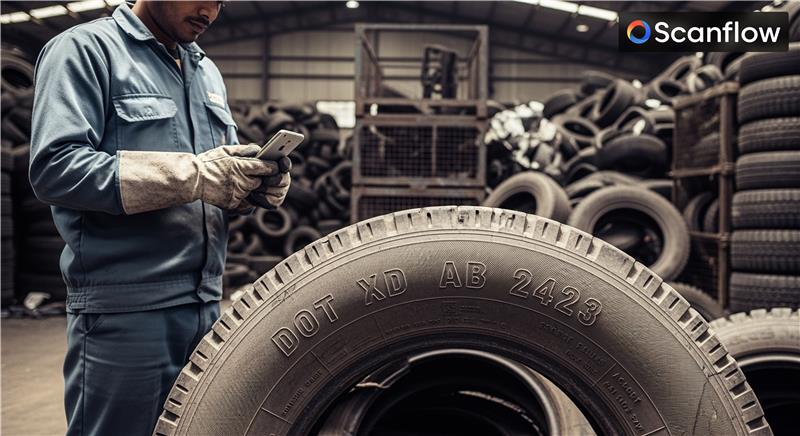
When scrap tires arrive at a facility, they are scanned using AI tire sidewall scanners at the intake point.
The system automatically reads DOT numbers, brand names, and sizes, registering each tire without manual input.
This step replaces paper-based logs and immediately creates a digital record that can be tracked throughout its lifecycle.

2. Sorting and Classification

Once identified, tires are automatically classified using AI algorithms. For example:

  • Retread candidates are directed to recovery lines.
  • Scrap tires are queued for shredding or pyrolysis.
    The scrap tire scanning data helps optimize sorting efficiency while maintaining a verifiable audit trail.

3. Integration with Backend Systems

Scanflow integrates seamlessly with ERP, waste management, or recycling plant software. This allows tire data to sync automatically with operational workflows inventory, logistics, or compliance modules ensuring that the traceability data remains consistent across all systems.

4. Processing and Final Reporting

At each processing stage cutting, shredding, or pyrolysis the tire’s unique ID is maintained. The system logs which tires have been recycled, repurposed, or destroyed.
With a few clicks, facility managers can generate comprehensive traceability reports showing each tire’s journey, satisfying both internal audits and external regulatory requirements.  

Key Advantages of Using AI-Based Tire Scanning 

Implementing AI-driven tire scanning technology delivers tangible benefits:

  • Accuracy and speed
    Automated tire sidewall scanners eliminate human error, processing thousands of tires daily with unmatched precision. 
  • Regulatory compliance
    Ensures that every tire processed has a verifiable origin and documented disposal method. 
  • Operational transparency
    Digital traceability enhances accountability between collection partners, transporters, and recyclers. 
  • Data-driven optimization
    Real-time analytics from Scanflow dashboards enable better forecasting, inventory management, and process improvement. 
  • Sustainability alignment
    AI-enabled traceability supports circular economy goals by ensuring tires are reused or recycled responsibly. 

How Scanflow Leads the Way 

Scanflow specializes in intelligent scanning and vision solutions for industrial automation. Its AI tire scanner platform is built specifically for the tire recycling sector, combining advanced image recognition with cloud-based data management. 

Some standout features include: 

  • Edge AI processing for real-time scanning even in rugged environments 
  • Automatic OCR for DOT/TIN recognition 
  • Brand and size classification using deep learning models 
  • Seamless integration with recycling ERP and waste management systems 
  • Analytics dashboards to track throughput and performance metrics 

By automating the entire identification and traceability chain, scanflow helps recyclers reduce manual work, improve accuracy, and ensure full compliance with local and international recycling standards.  

Future Outlook: AI-Powered Circular Tire Management 

The future of tire recycling will rely heavily on connected data ecosystems. As more facilities adopt scrap tire scanning technologies, it will become possible to share traceability data across regional or global recycling networks. 

Imagine a world where every tire has a digital twin accessible through an AI-driven database allowing producers, regulators, and recyclers to collaborate seamlessly toward sustainability goals. 

AI-driven tire scanning is not just an efficiency tool. It’s a foundation for transparent, circular, and data-driven waste management. 

 Conclusion 

Traceability is no longer optional in tire recycling it’s essential. AI scanning bridges the gap between manual inefficiency and automated intelligence, making it possible to track every tire from intake to final processing with speed and accuracy. 

With its specialized tire sidewall scanner and AI tire recognition system, Scanflow empowers recyclers and scrap tire handlers worldwide to achieve full visibility, regulatory compliance, and sustainability alignment. 

As the global circular economy evolves, technologies like scrap tire scanning will play a central role in ensuring that no tire goes untracked and every resource is reused responsibly. 

QR Floating