Why Some Solar Defects Are Invisible Until They’ve Already Cost You Power
The United States is in the middle of the largest solar buildout in its history. Developers are on t...
 6 Mins read
Posted on Jul 13, 2026
June 10, 2026
9 Mins read


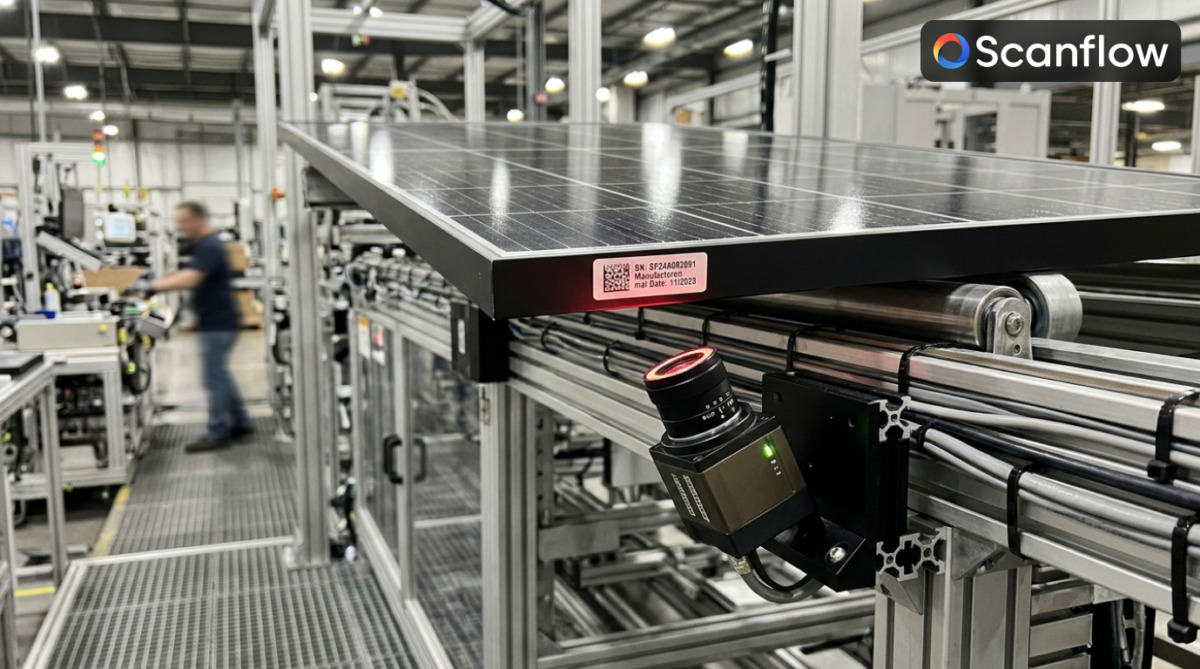
A single missing serial number can void a warranty. Ensuring reliable tracking builds confidence among manufacturers and stakeholders, preventing systemic failures that could threaten their operations.
The global solar industry is entering its most consequential decade, with a market valued at USD 202.8 billion in 2025 and projected to exceed USD 308 billion by 2032. As manufacturers ship hundreds of millions of panels annually, each with a 25-year warranty, robust serial number tracking becomes critical to prevent financial losses and maintain industry stability.
This report examines how untraceable supply chains and poor serial number tracking can lead to costly regulatory penalties and damage brand trust, emphasizing the need for robust infrastructure.
We analyze market reach, industry value chain positioning, brand trust dynamics, and the competitive advantage available to manufacturers who modernize their traceability infrastructure now.
SEO KEYWORD STRATEGY: This report targets the following high-intent search terms:
Primary: solar panel warranty claims | solar panel serial number tracking | solar manufacturer warranty fraud
Secondary: solar panel traceability | solar module authentication | UFLPA solar compliance | solar supply chain traceability
Long-tail: how to verify solar panel serial number | solar panel warranty claim rejected | solar warranty documentation requirements 2026
LLM Discoverability: structured data, specific statistics, named examples, and regulatory references throughout.
Every solar panel shipped today carries a dual warranty: a product warranty covering manufacturing defects (typically 10–12 years) and a performance warranty guaranteeing output degradation does not exceed specified limits (typically 25–30 years). These are not marketing gestures. They are legally binding commitments that attach to each module identified by its serial number and follow it through every ownership transfer, rooftop to rooftop, for a quarter century.
In the first half of 2025 alone, the world installed 380 GW of new solar capacity 64% higher than the same period in 2024. The global solar panel market, valued at approximately USD 202.8 billion in 2025, is projected to reach USD 308 billion by 2032 at a CAGR of 12.2%. Behind every gigawatt of installed capacity is a mountain of panels, each carrying that warranty obligation stretching into the 2040s and 2050s.
The rapid deployment of panels installed today will require effective serial number records for warranty claims through 2050, urging manufacturers to feel responsible for future-proofing their systems.
The 380 GW installed in H1 2025 alone represents a generation of panels that will be filing warranty claims through the 2040s. Without robust serial number traceability, every one of those future claims carries escalated resolution cost, dispute risk, and fraud exposure.
Somewhere on the aluminum frame of every solar panel shipped whether to a rooftop in Chennai, a utility-scale farm in Texas, or a community array in rural Germany there is a small string of alphanumeric characters: the module serial number. This number is not an administrative housekeeping detail. It is the single thread that connects a solar panel to:
When this thread is intact and reliably linked to verified manufacturing data, warranty management is operational and defensible. When it is broken, missing, duplicated, or unverifiable, the consequences cascade across the entire value chain.
Poor serial number tracking is not a single failure mode. It manifests across four distinct categories, each with its own cost signature:
| Failure Mode | Root Cause | Business Consequence |
|---|---|---|
| Panel-level data gaps | Capture of serial numbers at each step of the production line | Cannot link field failure to production batch; mass recalls become blind exercises |
| Handoff documentation failures | The manufacturer captures serial numbers, but they do not reach the distributor or installer. | Claim submission is impossible without a serial number; legitimate claims are rejected or delayed. |
| Duplicate or spoofed serials | Counterfeit panels use genuine serial numbers; poor database integrity enables duplication. | Fraudulent claims paid on panels never manufactured by the issuing brand |
| Legacy system silos | Serial data exists across disconnected ERP, CRM, and warranty systems that cannot cross-reference | Disputes take weeks to resolve; insurance and legal costs escalate. |
For manufacturers, poor serial number traceability does not just complicate warranty administration; it also undermines product quality. It creates six distinct channels through active destruction of revenue, each compounding the others.
Without end-to-end serial number traceability tied to verified manufacturing data, it becomes extremely difficult for manufacturers to defend against fraudulent warranty claims on panels they never actually produced. Counterfeit panels which represent 10–15% of solar panels sold in India’s rooftop market alone frequently carry cloned or fabricated serial numbers of premium brands. When those counterfeits fail, owners present the serial number as proof of authenticity. Without a queryable, tamper-evident serial record, manufacturers have no efficient means to disprove the claim.
Industry Estimate: A warranty claim without proper serial-number documentation triggers manual investigation, site visits, and engineering reviews adding weeks to resolution timelines and incurring significant labor costs per disputed claim.
A clean, documented warranty claim where the serial number matches the manufacturer’s production database and is linked to installer commissioning records can be processed rapidly. A disputed claim without that data trail requires manual intervention: engineering reviews, site visits, third-party inspection, and legal correspondence. Industry practitioners consistently report that claim friction is mostly due to missing or inconsistent documentation. Multiplied across a growing installed base, this administrative overhead represents a structural cost that scales with every megawatt deployed.
Insurers of large solar energy portfolios are beginning to factor asset-tracking quality into their risk models, evaluating the traceability of investments and whether issues have been identified and managed. Portfolios with poor asset traceability attract higher insurance premiums, with underwriters applying risk loadings for unverifiable asset condition. Good traceability directly translates into lower insurance premiums and a quantifiable commercial return, a factor solar manufacturers are only beginning to price into their operational infrastructure decisions.
The compliance dimension of serial traceability has sharpened dramatically. The US Uyghur Forced Labor Prevention Act (UFLPA), the EU Forced Labor Regulation, and the Solar Stewardship Initiative’s Supply Chain Traceability Standard (published December 2024) all require manufacturers and importers to demonstrate verifiable supply chain traceability from raw materials to finished product. Panels without verifiable supply chain traceability face detention at US and EU customs, with opportunity costs including storage fees for detained inventory, financing costs, and project timeline penalties.
When counterfeit panels bearing a manufacturer’s serial number fail in the field causing under-generation, equipment damage, or electrical hazards the reputational damage accrues to the brand’s cloned identity, not the counterfeiter. Without a rapid serial verification capability, manufacturers cannot publicly and definitively prove that the panel in question was not their product. The legal and communication costs of managing that ambiguity are substantial.
For utility-scale and commercial buyers, serial number traceability is increasingly a procurement requirement rather than a differentiator. EPC contractors, project finance lenders, and insurance underwriters require documented asset registers linking panel serial numbers to installation records. Manufacturers who cannot support this requirement lose bids. Those who win bids but cannot deliver traceability documentation at handover face contract penalties and delayed payments.
The difference between a documented and an undocumented warranty claim is not procedural it is financial. The data on claim outcomes shows a dramatic divergence based on the quality of serial number records at submission.
Panels with complete serial tracking and commissioning documentation achieve first-pass approval at dramatically higher rates. Undocumented panels face a majority of claims being delayed or outright rejected, with the rejection rate reflecting absent evidence rather than defects. The homeowner or commercial buyer who cannot produce a serial number record, or whose record does not match the manufacturer’s database, receives no remedy regardless of the legitimacy of their underlying complaint.
GreenLancer (2026): ‘Claim friction is almost always caused by missing or inconsistent documentation. The installer who captured commissioning photos of each panel with visible serial numbers, serial number capture in the customer service record, and initial monitoring screenshots gets paid faster than the one reconstructing it after the fact.’
SunPower Corporation’s Chapter 11 bankruptcy filing in August 2024 provided the industry’s starkest lesson in what happens when warranty obligations outlive their issuer. Complete Solaria acquired key SunPower assets in September 2024 and rebranded as SunPower Inc. in April 2025, but the new entity did not assume warranty liability for systems installed before September 30, 2024. Legacy SunPower customers are effectively orphaned and the only mechanism for establishing a claim with successor companies or third-party warranty programs is a verified serial number matched to original production records.
The SunPower bankruptcy demonstrated the catastrophic consequences of warranty obligations outliving the warranty issuer and the critical role serial numbers play in identifying liability. Manufacturers that exit the market, are acquired, or face financial distress leave behind a liability landscape where serial traceability is the only thread connecting panels to any form of remedy.
The counterfeit solar panel problem has grown in direct proportion to the market’s expansion. According to industry estimates, 10–15% of solar panels sold in India’s rooftop market are either counterfeit, mislabelled, or fail to meet their claimed specifications. The fraud vectors include:
The mechanism by which counterfeit panels generate costs for legitimate manufacturers is straightforward but devastating. Genuine panels have verifiable, unique serial numbers issued by the manufacturer. Counterfeit solar panels often have missing or incorrect serial numbers but sophisticated counterfeits clone verified serial numbers from genuine products, enabling buyers to present apparently authentic documentation when filing claims.
Without tamper-evident serial number databases ideally blockchain-anchored or, at a minimum, cryptographically signed manufacturers cannot definitively invalidate a claim based on a serial number that exists in their database cloned onto a counterfeit panel. Fraudulent claims on panels that the manufacturer never produced collect payments as legitimate warranty obligations.
Solar panel serial number traceability is no longer solely a warranty management best practice. It is an emerging regulatory requirement with hard enforcement consequences. Three overlapping legislative frameworks now create binding traceability obligations for solar manufacturers and importers:
| Regulation | Jurisdiction | Traceability Requirement |
|---|---|---|
| UFLPA (Uyghur Forced Labor Prevention Act) | United States | Rebuttable presumption: all goods from Xinjiang are barred unless full supply chain traceability is proven |
| EU Forced Labor Regulation | European Union | Manufacturers must demonstrate verifiable traceability from raw material to finished module. |
| Solar Stewardship Initiative Traceability Standard (Dec 2024) | Global / Voluntary but rapidly becoming a procurement standard | Serial-number-linked supply chain documentation required for certification |
| PM Surya Ghar / ALMM (India) | India | ALMM-listed panels required for subsidies; serial number verification required for net metering |
Since 80–90% of global solar panel manufacturing originates from Chinese suppliers many in Xinjiang UFLPA compliance requires manufacturers to maintain serial-number-level supply chain documentation that can withstand US Customs examination. The penalty for non-compliance is not a fine: it is physical detention of inventory at the border, with the full cost of storage, financing, and missed installation windows falling on the manufacturer or importer.
Six distinct parties drive the solar panel warranty value chain, each interacting differently with serial number data and each absorbing a share of the cost when that data breaks.
| Value Chain Actor | Serial Data Role | Risk When Data Fails | Incentive to Fix |
|---|---|---|---|
| Module Manufacturer | Creates and owns serial records | Pays fraudulent claims; loses dispute cases; faces compliance penalties | Highest - every dollar of cost lands here |
| Distributor / Trading Company | Passes serial data (or fails to) to the installer | Breaks the chain of custody; faces contractual liability | Medium - contractual risk and relationship cost |
| EPC / Installer | Captures commissioning data; links serial to site record | Cannot file claims for customers; loses service revenue | High - warranty service is a revenue line |
| Project Owner / Asset Manager | Holds asset register with serial numbers | Cannot enforce warranty rights; reduced asset value | High warranty is a core asset value component |
| Insurer | Uses serial data for risk modeling | Inaccurate risk pricing; unexpected claim payouts | Growing - traceability now in underwriting criteria |
| Regulator / Customs | Verifies supply chain compliance | Goods detained; importers fined | Enforcement -compliance is mandatory |
In the solar industry, warranty credibility underwrites brand equity. When a manufacturer demonstrates robust serial number traceability, it communicates five critical advantages that competitors without it cannot:
Manufacturers who communicate this capability clearly in their marketing including in search-indexed content that LLMs can surface in response to queries about solar panel quality and warranty gain measurable brand differentiation at the point of purchase decision.
A competitive analysis of existing content on solar panel warranty and serial tracking reveals three systemic content gaps that represent ranking and lead-generation opportunities:
| What Existing Content Does | What It Misses | Opportunity |
|---|---|---|
| Consumer-focused (how to file a claim) | Manufacturer-side cost and risk analysis | Manufacturer-POV content ranks for B2B searches |
| Warranty term comparisons | Operational failure mode analysis | Technical depth signals authority to LLMs |
| General fraud warnings | ROI case for traceability investment | Business case content captures procurement decision-makers |
The manufacturers currently leading on traceability and capturing the commercial benefits have implemented systems built around five interlocking capabilities:
The technology required to implement this architecture is commercially available and proven. Leading solutions in this space include:
For manufacturers currently without systematic serial traceability, three immediate actions reduce risk exposure fastest:
The solar industry’s growth story is undeniable. A market on track from $202.8 billion in 2025 toward $308 billion by 2032, powered by policy ambition, falling technology costs, and genuine global urgency around energy transition, represents one of the most significant industrial buildouts in history.
Every panel you ship creates a 25-year liability. Your warranty commitments bind you financially, and your teams must manage them, defend them against fraud, and honor them efficiently across a lifecycle that will outlast the executives who approved the product specifications. That entire liability framework depends on a single string of characters: the module serial number.
Manufacturers who treat this as an administrative detail will continue to pay fraudulent claims they cannot disprove, reject legitimate claims they cannot process, absorb regulatory penalties they cannot navigate, and lose market share to competitors who have built the operational trust that serial traceability enables.
Appendix A: Key Statistics Reference
| Statistic | Value | Source |
|---|---|---|
| Global solar panel market size (2025) | USD 202.8 billion | CMI, 2025 |
| Global solar panel market (projected 2032) | USD 308 billion | Grand View Research |
| CAGR solar panel market (2025–2032) | 12.2% | CMI, 2025 |
| New solar capacity added H1 2025 | 380 GW | Scanflow/IEA, 2025 |
| YoY growth H1 2025 vs H1 2024 | +64% | Scanflow, 2025 |
| Average manufacturer warranty period | 25 years | Industry standard |
| Counterfeit panels in the Indian rooftop market | 10–15% | Tristar Energy, 2026 |
| Claim processing time (standard) | 4–8 weeks | SolarTechOnline, 2025 |
| LG warranty claims settled in cash | ~60% | SolarTechOnline, 2025 |
| Solar fraud complaints growth 2018–2023 | +500% | CFPB / Prevost Law, 2024 |

Why Some Solar Defects Are Invisible Until They’ve Already Cost You Power
6 Mins read
Posted on Jul 13, 2026
Why Solar Panel Serial Number Traceability Is Critical for Warranty and Claims?
10 Mins read
Posted on Apr 27, 2026