The Comprehensive Guide to Tyre Sidewall Scanning in Flutter
In the modern automotive and fleet management industries, data is king. But capturing that data from...
 4 Mins read
Posted on Aug 19, 2026
September 11, 2026
4 Mins read


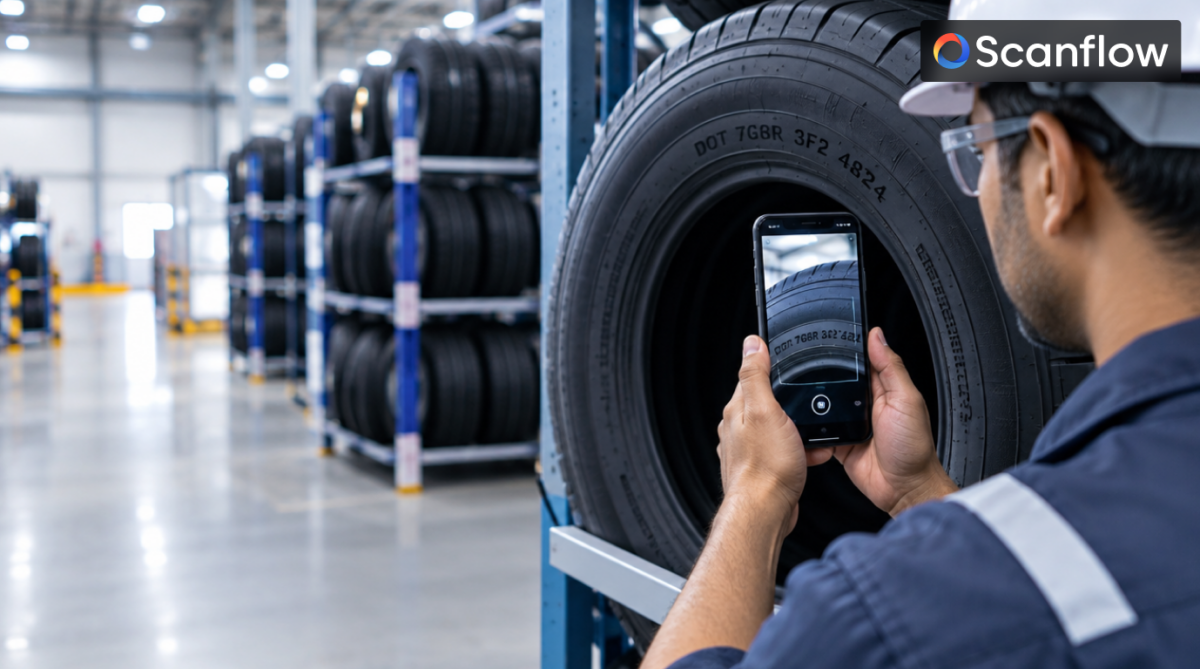
Every tire manufactured today carries a unique identity on its sidewall: a DOT code, a serial number, batch and compound information, manufacturer data. In theory, that identity should follow the tire through its entire life, from the production line to the warehouse, through distribution, to the retailer, and into a vehicle. In practice, at nearly every one of those handoffs, the process depends on someone manually reading and re-entering that sidewall data, and manual entry is exactly where traceability quietly breaks down.
Manual reading of DOT codes and tire sizes during receiving and order picking carries error rates commonly in the 2 to 5 percent range. On a shipment of a thousand tires, that’s 20 to 50 tires logged incorrectly, each one a potential mis-ship, an inventory discrepancy, or a record that no longer matches the physical tire it’s supposed to represent. Multiply that across the volume a mid-size tire manufacturer or distributor moves in a single month, and the numbers stop looking like rounding errors and start looking like a real, ongoing cost.
This isn’t a one-time cost either. Every mis-logged tire creates downstream work: someone has to notice the discrepancy, investigate it, correct the record and in some cases physically locate a tire that’s been placed in the wrong bin or shipped to the wrong customer. None of that labor shows up as a line item called “traceability cost.” It gets absorbed into general warehouse labor, customer service time, and inventory shrinkage, which is exactly why the true cost stays invisible even to companies tracking their numbers closely.
It’s worth being specific about where this compounds fastest: high-turnover distribution centers processing thousands of tires weekly, where even a small error rate translates into a steady stream of discrepancies that staff treat as routine, rather than as a symptom of a process that was never built to scale accurately in the first place. A single misread code is a minor inconvenience. Thousands of them, month after month, are an operating cost with no name and no owner.
The cost of poor traceability gets significantly more serious once a tire leaves the factory. When a customer buys tires, the retailer is supposed to log the DOT code for warranty registration and recall tracking. In practice, many retailers skip this step because manual entry is too slow during busy service appointments and the result is a tire installed on a vehicle with no traceability of that installation ever having been recorded.
This becomes an expensive problem the moment a recall is issued. A manufacturer that can trace exactly which batches, which production windows, and which distribution channels a defective compound or tooling issue affected can execute a targeted, contained recall. A manufacturer relying on incomplete installation records has to cast a far wider net, often recalling more tires than were actually affected, simply because the data needed to narrow the scope was never captured accurately in the first place. That gap between a targeted recall and an overly broad one translates directly into unnecessary replacement costs, logistics expense, and reputational exposure that a manufacturer with strong tire manufacturing traceability would never have had to absorb.
Recalls are the dramatic case, but the day-to-day cost is arguably larger in aggregate. Fleet operators tracking thousands of tires across hundreds of vehicles frequently rely on manual inspections and spreadsheet records to manage rotation schedules, replacement timing, and warranty claims. Every manual entry in that process is another opportunity for a transposed digit or a misread code to quietly corrupt the underlying data, and those errors compound over months into replacement schedules built on inaccurate information.
Warehouse and distribution operations face the same exposure at a larger scale. Without real-time asset identification at receiving, inventory counts drift further from reality with every shipment processed manually and reconciling that drift consumes staff time that never shows up as a traceability cost on any budget line, even though that’s exactly what it is.
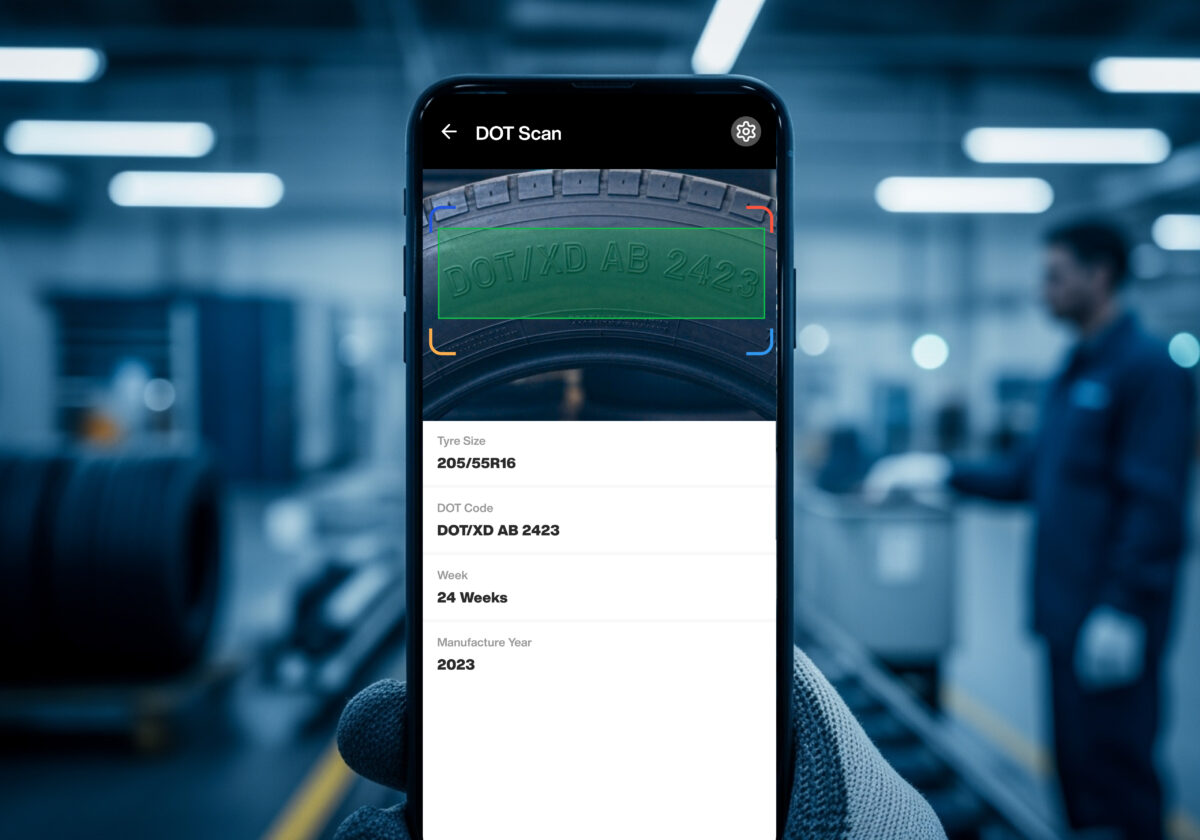
The fix isn’t complicated in concept, even if it requires a real operational shift. Vision-based scanning systems can automatically capture DOT codes, serial numbers, batch identifiers, and other sidewall data as tires pass through quality control stations, warehouse receiving, or distribution checkpoints, creating a verified digital record without manual data entry at any of those steps. Because every tire becomes a digitally traceable asset from the point of manufacture onward, the chain of custody that manual processes struggle to maintain gets built in automatically instead.
This matters most at the exact moments where manual processes fail hardest: high-volume receiving, busy retail service counters, and large-scale recall response. Audit-ready logs generated automatically at each scan point mean a manufacturer or distributor can answer exactly which tires are affected by an issue, where they currently are, and what their full history looks like, without reconstructing that picture from incomplete paper trails after the fact.
Most tire manufacturers have never actually calculated what poor traceability costs them, because the expense is scattered across so many different departments that it never gets aggregated into a single number. The honest exercise worth running is adding up mis-ship rates, warranty dispute resolution time, recall scope and cost history, and inventory reconciliation labor, then asking how much of that total traces back to a sidewall code that was never captured accurately in the first place.
It’s also worth asking a harder follow-up question: how would this business even know if it improved? Without a baseline measurement of current error rates, mis-ship frequency, and reconciliation hours, there’s no way to demonstrate the return on fixing the problem, which is part of why traceability investment gets deprioritized in favor of costs that are easier to point to on a spreadsheet. Establishing that baseline, even roughly, is often the step that turns traceability from an abstract concern into a funded project.
For most manufacturers still relying on manual data entry at key points in the supply chain, the honest answer is very likely yes. The losses rarely show up as a single, obvious number. They’re distributed across mis-ships, warranty disputes, oversized recalls, and warehouse reconciliation work, each one small enough on its own to be written off as a cost of doing business. Added together across a year of production and distribution volume, they represent exactly the kind of expense that automated, traceable sidewall scanning was built to eliminate. The manufacturers who’ve made that connection aren’t just running a tighter operation. They’ve found a cost that was hiding in plain sight the entire time.

The Comprehensive Guide to Tyre Sidewall Scanning in Flutter
4 Mins read
Posted on Aug 19, 2026
Scan Tire DOT Numbers with Your Smartphone: Fast & Accurate Tire Identification
3 Mins read
Posted on Jul 4, 2026