
Overview
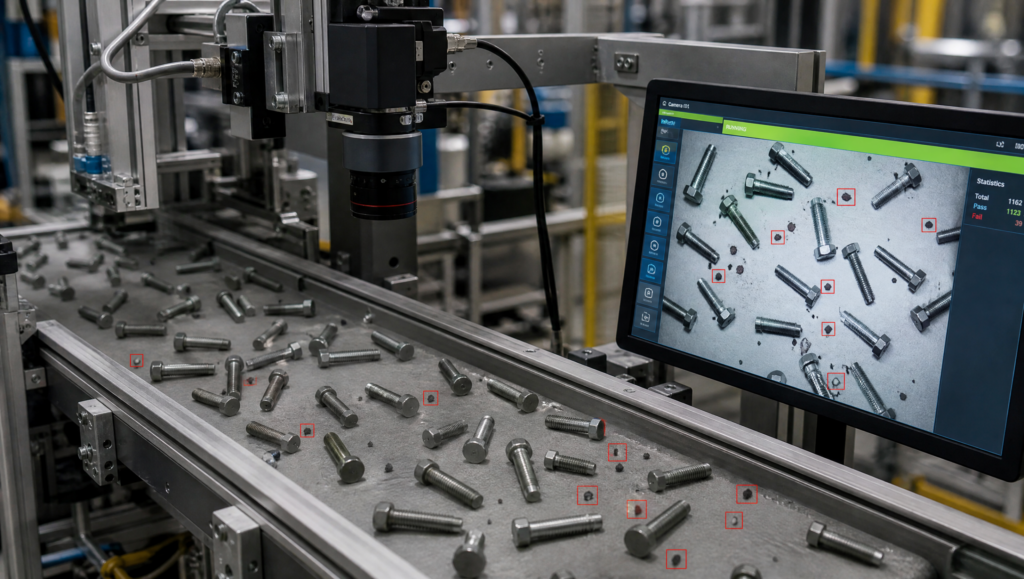
Sundram Fasteners (SFL), Madurai, was facing a carbon soot contamination problem in the furnace conveyor line during the heat-treatment process. Carbon soot can mix with the regular flow of bolts and nuts after oil quenching and act as foreign material. Since the soot occurrence is sporadic and can vary in size and shape, manual detection is difficult and unreliable. Undetected soot could therefore lead to quality issues, making continuous automated inspection necessary.
Scanflow/OptiSol proposed an AI-based vision system for real-time carbon soot detection across six furnaces at the SFL Madurai plant, rolled out in two phases to bring both sheds online.
Business Challenge
- Carbon Soot Could Enter Production as Foreign Material Carbon soot generated during heat-treatment could mix with bolts and nuts after oil quenching and act as foreign material if not caught.2. Sporadic, Variable Soot Made Manual Detection Unreliable Soot occurrence is sporadic and varies in size and shape, making manual detection difficult and unreliable.3. No Continuous Monitoring Across the Madurai Furnaces Without an automated system, there was no continuous way to monitor furnaces across both sheds for soot contamination.
4. Undetected Soot Risked Downstream Quality Issues Soot that went undetected could continue through the process, creating a direct risk to bolt and nut quality.
The Scanflow Solution
Scanflow/OptiSol proposed an AI-based vision system for real-time carbon soot detection across 6 furnaces at the SFL Madurai plant. The solution uses cameras positioned above the conveyor to continuously monitor the production flow and detect carbon soot. When soot is identified, the system provides the soot image, furnace name, and timestamp, and immediately triggers an alarm or light. An SMS notification is also sent to the manager and staff with the furnace unit, date, and time of occurrence. The implementation is planned in two phases: Phase 1 — 2 furnaces in Shed 2, and Phase 2 — 4 furnaces in Shed 1.
- Overhead Camera MonitoringCameras positioned above the conveyor continuously monitor the production flow for each furnace.
- Real-Time Soot DetectionThe AI vision model identifies carbon soot as it appears, despite its sporadic occurrence and variation in size and shape.
- Detection Record CaptureFor every detection event, the system captures the soot image along with the furnace name and timestamp.
- Alarm or Light AlertDetection immediately triggers an alarm or light, alerting staff at the point of occurrence.
- SMS Notification to StaffAn SMS notification is sent to the manager and staff with the furnace unit, date, and time of occurrence.
- Phased RolloutThe implementation is planned in two phases — Phase 1 covers 2 furnaces in Shed 2, and Phase 2 covers 4 furnaces in Shed 1.
Business Impact
By replacing unreliable manual inspection with continuous, real-time AI vision monitoring, SFL Madurai gains always-on coverage against carbon soot contamination, rolled out furnace by furnace across both sheds.
Key Outcomes
- Continuous coverage — cameras positioned above the conveyor monitor production flow in real time.
- Reliable detection despite variability — the AI model catches sporadic soot occurrences regardless of size or shape.
- Complete detection record — every event captures the soot image, furnace name, and timestamp.
- Immediate alerting — an alarm/light plus an SMS reaches manager and staff at the point of detection.
- Scalable, phased rollout — Shed 2’s 2 furnaces come online in Phase 1, with Shed 1’s 4 furnaces following in Phase 2.
Delivery Footprint
- Phase 1: cameras covering Shed 2’s 2 furnaces
- Phase 2: cameras covering Shed 1’s 4 furnaces
- Alarm/light plus SMS notification in both phases
SFL Madurai strengthens furnace-line quality control with Scanflow, catching carbon soot contamination the moment it appears, across both sheds as the rollout scales.
Conclusion
SFL is replacing unreliable manual soot detection with continuous AI-powered monitoring, rolled out furnace by furnace across both sheds. Cameras positioned above the conveyor catch sporadic soot occurrences regardless of size or shape, logging the image, furnace name, and timestamp for every event and alerting staff immediately. As Phase 2 brings Shed 1 online, SFL Madurai gains the same always-on protection already active in Shed 2 — scaling reliable detection across the full plant.