
Overview
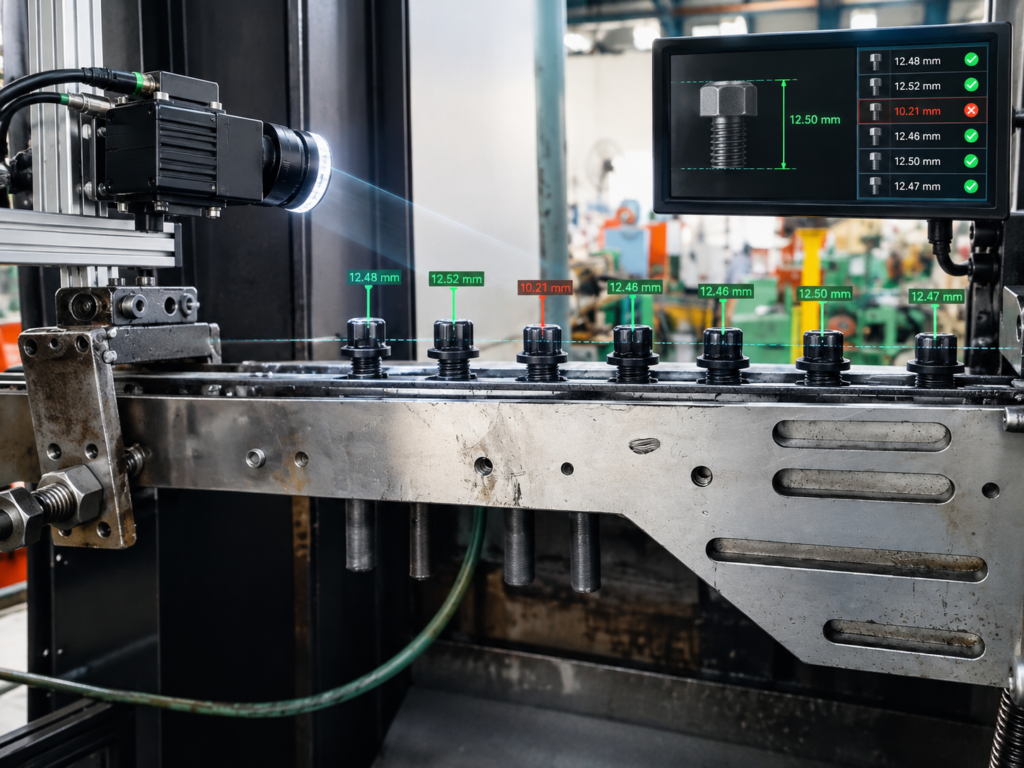
Sundram Fasteners (SFL), Padi, was facing a quality and production-risk issue in its automated bolt-feeding process. Defective bolts such as headless, bent, broken, cut, half-threaded, and mix-up bolts could enter the threading machine because there was no automated real-time inspection system. Such defects could potentially cause machine jamming, equipment damage, and production downtime. The existing process therefore required a reliable automated solution capable of continuously inspecting bolts while they move through the vibrating conveyor.
SFL engaged Scanflow to bring an AI-powered vision inspection system to the conveyor line, catching defective bolts before they reach the threading machine and alerting operators immediately.
Business Challenge
- No Automated Real-Time Inspection Existed Bolts moved through the vibrating conveyor toward the threading machine without any automated system checking for defects in real time.
- Multiple Defect Types Could Reach the Threading Machine Headless, bent, broken, cut, half-threaded, and mix-up bolts could all enter the threading machine undetected, each posing a different risk to the process.
- Defects Risked Machine Jamming and Equipment Damage A defective bolt reaching the threading machine could cause jamming and equipment damage, disrupting the production line.
- Undetected Defects Risked Production Downtime Without continuous inspection, defects that caused jamming or equipment damage translated directly into production downtime.
The Scanflow Solution
Scanflow proposed an AI-powered vision inspection system that continuously monitors bolts on the vibrating conveyor in real time. Cameras are deployed across two conveyor feeding lines to capture moving bolts, and a custom-trained AI object detection model identifies headless, bent, broken, cut, half-threaded, and mix-up bolts before they reach the threading machine. When a defective bolt is detected, the system triggers an alarm, allowing the operator to manually remove the defective bolt. The system is designed for continuous 24/7 operation.
- Dual-Line Conveyor MonitoringCameras are deployed across two conveyor feeding lines, each continuously capturing images of bolts as they move.
- Custom-Trained AI Defect DetectionA custom-trained AI object detection model identifies headless, bent, broken, cut, half-threaded, and mix-up bolts in real time, before they reach the threading machine.
- Real-Time AlertsWhen a defective bolt is detected, the system triggers an alarm, prompting the operator to manually remove the bolt.
- Continuous 24/7 OperationThe system is designed to run continuously, providing uninterrupted inspection coverage across both conveyor lines.
Business Impact
By replacing the absence of automated inspection with continuous, real-time AI vision monitoring, SFL Padi gains an early, always-on check against the defect types most likely to disrupt the threading process.
Key Outcomes
- Continuous inspection — real-time coverage across both conveyor lines, replacing a process with no automated check.
- Broad defect coverage — a single model detects headless, bent, broken, cut, half-threaded, and mix-up bolts.
- Faster intervention — an alarm lets the operator remove a defective bolt immediately.
- Reduced downstream risk — catching defects before threading lowers the risk of machine jamming, equipment damage, and downtime.
- Always-on coverage — the system is designed for continuous 24/7 operation.
Delivery Footprint
- On-premise vision system across two conveyor lines
- Automated alarm for immediate operator response
SFL Padi strengthens bolt-feeding quality control with Scanflow, catching defective bolts on the conveyor before they ever reach the threading machine.
Conclusion
SFL Padi’s bolt-feeding line is no longer exposed to undetected defects reaching the threading machine. Scanflow’s AI vision system continuously inspects both conveyor lines in real time, catching headless, bent, broken, cut, half-threaded, and mix-up bolts before they cause jamming or equipment damage — with an instant alarm giving operators the chance to intervene immediately. The result is a safer, more reliable threading process with meaningfully less downtime risk.