What Really Happens to Your Old Company Laptops After You Throw Them Away
"Throw them away" is rarely literal. Very few organizations actually send retired laptops to a l...
 4 Mins read
Posted on Sep 11, 2026
October 28, 2026
3 Mins read


Key takeaways
R2v3 certification shows that an electronics reuse, repair or recycling facility meets the R2 Standard, version 3, for environmental, health, safety and data security practices. The standard is owned by SERI and facilities are audited by accredited third-party certification bodies.
For ITAD (IT asset disposition) companies, R2v3 has become a baseline customers ask for. Enterprise buyers, especially in regulated sectors, often require it before they hand over retired laptops, servers and phones.
Every R2v3 facility must meet all 10 core requirements. Appendices are added on top, depending on the services the facility offers.
| Core requirement | What it covers |
|---|---|
| 1. Scope | Which facility, processes and equipment the certification covers |
| 2. Hierarchy of Responsible Management Strategies | Prioritising reuse and recovery over disposal |
| 3. EH&S Management System | Environment, health and safety controls |
| 4. Legal and Other Requirements | Compliance with applicable laws, including export rules |
| 5. Tracking Throughput | Tracking equipment and materials in, through and out of the facility |
| 6. Sorting, Categorization and Processing | Sorting incoming equipment into the right streams |
| 7. Data Security | A data sanitization plan with security controls for every data device |
| 8. Focus Materials | Safe handling of materials such as batteries, mercury and CRTs |
| 9. Facility Requirements | Physical site, security and closure planning |
| 10. Transport | Safe, secure transport of equipment and materials |
The appendices cover specific activities. They include Appendix A (Downstream Recycling Chain), Appendix B (Data Sanitization), Appendix C (Test and Repair) and Appendix D (Specialty Electronics Reuse), among others.
Core 7 applies to every R2v3 facility. Appendix B applies if your facility performs logical sanitization erasing data with software so the device can be reused.
Most ITAD operators that refurbish and resell devices therefore need Appendix B. That brings stricter requirements for sanitization records — which is where serial numbers become critical.
Auditors want proof, not policy. The core test is simple: pick any device, and show its full history.
In practice, that means an auditor can choose a serial number from a customer manifest, a sanitization log or a sales record, and expect you to show:
If the serial on the intake record doesn’t match the serial on the erasure certificate, the trail breaks. One mismatch can turn into a finding.
A data destruction certificate is the record that proves a specific device’s data was sanitized. SERI’s recommended record fields are modeled on NIST SP 800-88, the U.S. guideline for media sanitization. NIST published Revision 2 of SP 800-88 in September 2025.
A strong certificate, issued per device, records:
| Field | Why it matters |
|---|---|
| Device manufacturer and model | Identifies the device type |
| Serial number | Ties the record to one physical device the field auditors match on |
| Media type and serial (for drives) | Ties the record to the storage itself |
| Sanitization method and tool | Shows what was done (e.g. clear, purge, destroy) |
| Verification result | Proves the method worked |
| Date and time | Places it in the chain of custody |
| Technician or workstation | Shows who performed it |
Batch certificates that say “200 laptops destroyed” without a serial for each are a common audit gap.
Most erasure and destruction tools record serials automatically once the device is on the bench. The weak point is earlier: intake and receiving.
Every one of these happens before sanitization software ever touches the device. If intake is wrong, every later record inherits the error.
The fix is to capture the serial correctly at the first touchpoint, from the label, and use that same record at every step after.
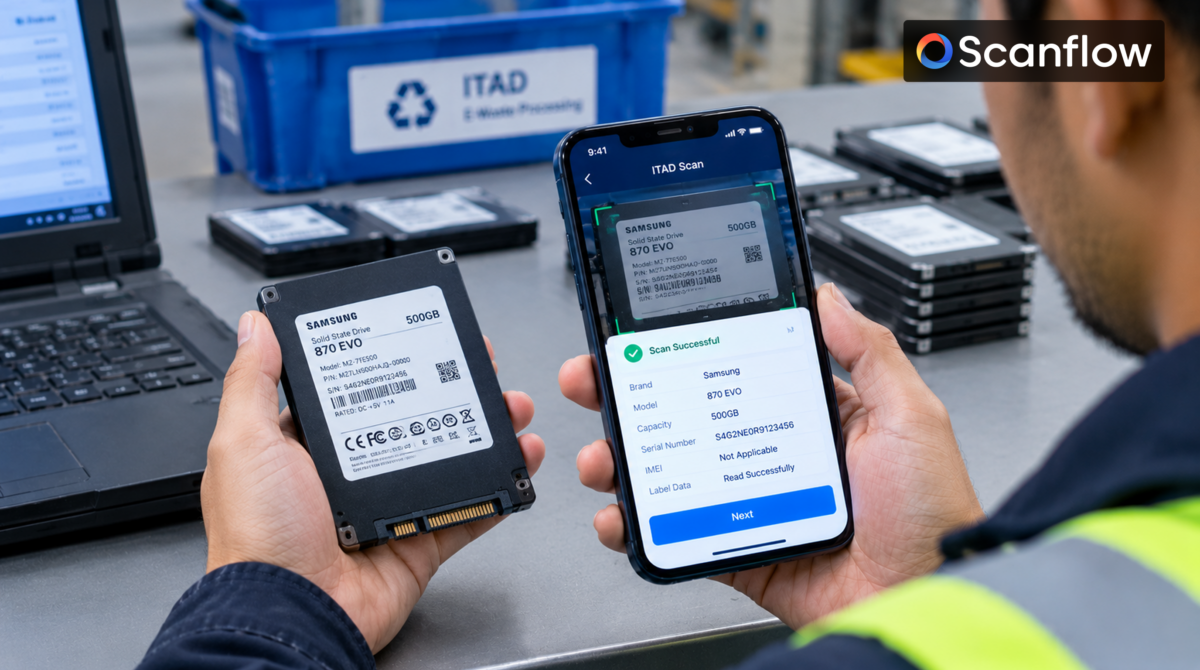
Scanflow ITAD serial number scanning is part of Scanflow Capture, an AI-enabled SDK for iOS and Android. It lets ITAD teams scan serial numbers, model numbers and barcodes from device and drive labels with a phone or tablet, inside the apps they already use.
For an ITAD operator, that means:
Scanflow does not certify facilities or replace erasure software. It makes the first record in the chain correct, so the rest of the chain can be proven.

What Really Happens to Your Old Company Laptops After You Throw Them Away
4 Mins read
Posted on Sep 11, 2026
Why Visual Grading Is the Bottleneck in IT Asset Resale
5 Mins read
Posted on Jul 15, 2026