Why Visual Grading Is the Bottleneck in IT Asset Resale
The U.S. IT Asset Disposition (ITAD) market is approaching a $5 billion valuation, growing alongsi...
 5 Mins read
Posted on Jul 15, 2026
May 12, 2026
8 Mins read



Every retired laptop, decommissioned server, and end-of-life storage device that leaves your organisation carries a risk most IT teams underestimate not just the data it holds, but the proof of what happened to it. In today’s regulatory environment, “we wiped it” is not an answer. Regulators want evidence. Auditors want timestamps. Cyber insurers want documentation. And increasingly, they want all of it in real time.
That is where AI-powered ITAD scanning software is changing the game. It transforms what was once a paper-heavy, error-prone compliance process into an automated, tamper-evident, continuously auditable system one that doesn’t just protect your data, but actively protects your business.
This ITAD guide breaks down exactly how that works, why the stakes have never been higher, and what to look for in a compliant ITAD program for 2026 and beyond.
IT Asset Disposition (ITAD) is the structured process of retiring, sanitising, and disposing of end-of-life IT equipment in a secure, compliant, and environmentally responsible way. It covers everything from laptops and mobile devices to data centre servers and storage arrays.
For years, ITAD was treated as an operational afterthought the “cleanup” phase after a hardware refresh. That era is over. The global ITAD market was valued at $19.70 billion in 2025 and is projected to reach $48.48 billion by 2034, growing at a CAGR of 10.53%. This explosive growth reflects a fundamental shift: enterprises now treat ITAD not as a logistics problem, but as a risk management, compliance, and ESG programme that demands the same rigour as any other data security function.
The trigger for this shift is straightforward: the financial and reputational consequences of getting ITAD wrong have become impossible to ignore.
According to IBM’s 2025 Cost of a Data Breach Report, the average data breach now costs organisations $4.44 million per incident and that figure climbs to $10.22 million in the United States specifically. Healthcare breaches average $7.42 million. A significant proportion of these incidents trace back to improperly decommissioned hardware: old drives, retired endpoints, and stale devices that left the building without verified data destruction.
The Morgan Stanley case is the most cited cautionary tale in the industry decommissioned servers resold without proper data destruction, resulting in regulatory action and reputational damage that far outweighed the cost of compliant disposal.
The compliance landscape governing ITAD has hardened considerably:
Industry research indicates that organisations with formal, documented data destruction programmes reduce breach-related losses by an average of $1.23 million compared to those relying on ad-hoc methods.
“Show Me the Audit Trail” Is the New Normal
The defining compliance shift of 2025 documented by multiple industry observers was cultural as much as regulatory. At the ITAD Summit 2025 in Las Vegas, a recurring theme was the increasing scrutiny from regulators and enterprise clients demanding proof: proof of sanitisation, proof of chain of custody, proof of downstream accountability. As one industry review put it, “Show me the audit trail” became a standard request even from mid-market procurement teams.
By 2030, over 70% of Fortune 500 companies are projected to outsource ITAD services, primarily for data security and the compliance documentation those partnerships provide.
An audit trail is not just a destruction certificate. A defensible, compliance-grade ITAD audit trail must document the complete lifecycle of every asset from the moment it is flagged for retirement:
Asset Identification Serial number, make, model, asset tag, and data classification for every device. Inventory systems at certified ITAD providers now achieve 99%+ accuracy in asset identification.
Chain of Custody Every transfer, storage location, and handling event from the client’s facility to final disposition, with timestamps and authorised personnel recorded at each handoff.
Data Sanitisation Method and Verification Which NIST 800-88 method was applied (Clear, Purge, or Destroy), by whom, with what tooling, and the independent verification result. For healthcare environments, this must explicitly reference ePHI handling protocols under the HIPAA Security Rule.
Certificate of Destruction A tamper-evident, serialised destruction certificate for every asset, exportable in formats regulators and auditors expect.
Downstream Disposition Where the asset went after sanitisation: redeployment, remarketing, recycling, or physical destruction. R2v3 certification requirements mean downstream vendors must also be accountable in the chain.
Without all of these elements, an audit trail has gaps and a single gap in documentation can expose a client to reputational and legal risks that dwarf the cost of the ITAD programme itself.
This is where modern ITAD platforms powered by AI and automation fundamentally change what is possible.
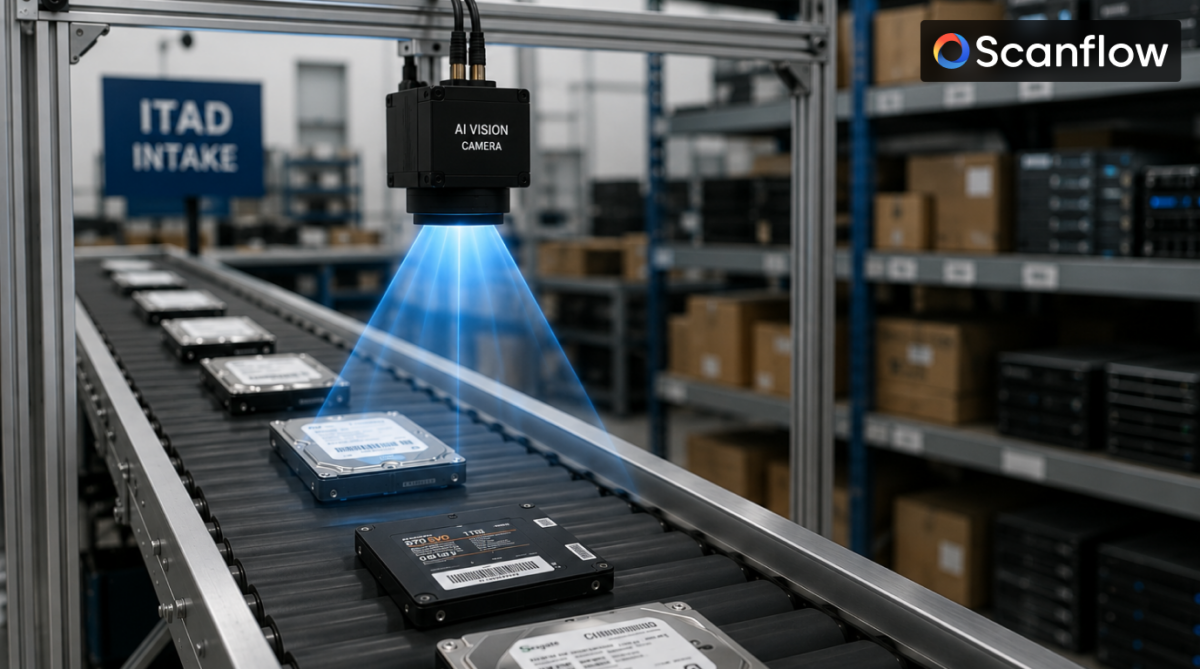
Manual asset tagging is slow, inconsistent, and error-prone. AI-powered scanning software can identify, classify, and log assets automatically using barcode scanning, RFID, computer vision, and serial number recognition. Every device entering the ITAD workflow is catalogued instantly, with data classification applied based on device type, storage media, and organisational policy no manual intervention required.
The result: complete, accurate inventory records from the first moment of intake, rather than retrospective documentation assembled from imperfect records.
Traditional chain-of-custody documentation relied on paper forms, spreadsheets, and manual sign-offs each one a potential point of failure. AI-enhanced ITAD platforms create a continuous, timestamped digital record of every custody event: pickup confirmation, in-transit tracking, facility intake, processing start, sanitisation completion, and final disposition.
Each event is logged automatically, with alerts triggered by any deviation from expected workflow. If a device leaves a designated processing area, misses a scheduled step, or fails to match its manifest, the system flags it in real time before it becomes a compliance incident.
Verifying that data destruction has been performed correctly is one of the most technically demanding aspects of ITAD compliance particularly for modern SSDs, NVMe drives, and encrypted storage that behave differently from traditional HDDs.
AI scanning software monitors and validates each sanitisation operation against the applicable NIST 800-88 method, generating pass/fail verification records automatically. For devices where cryptographic erasure is the appropriate Purge method, the system logs the verification of key destruction. For physical destruction, computer vision systems can confirm shredding output meets specification.
This removes the most significant single point of failure in traditional ITAD compliance: human verification of a process that requires technical precision.
One of the most powerful advantages of AI in ITAD audit trails is the ability to detect patterns that humans would miss. Machine learning algorithms can flag:
These anomalies are precisely the kind of compliance gaps that surface during regulatory audits and that are virtually impossible to catch with manual review processes operating at scale.
Generating audit-ready documentation manually is one of the most time-consuming aspects of ITAD compliance management. AI automation aggregates and formats audit data across all assets, producing destruction certificates, chain-of-custody reports, and regulatory compliance documentation automatically in the formats required by specific frameworks (HIPAA, GDPR, SOX, PCI-DSS) and in the timelines those regulations demand.
Real-time dashboards give compliance teams continuous visibility into key metrics: assets processed, sanitisation method distribution, pending items, exception rates, and downstream partner status without requiring manual data compilation.
Healthcare organisations are among the highest-risk ITAD environments. HIPAA mandates that every piece of ePHI on decommissioned equipment be destroyed using NIST-aligned methods, with documented proof that destruction was irrecoverable. Business Associate Agreements with ITAD providers must explicitly address data handling, breach notification, and liability. The healthcare sector is growing at the highest ITAD CAGR of 25.39% driven in large part by the need for defensible compliance documentation that stands up to HHS enforcement scrutiny.
The BFSI sector accounts for nearly 28% of the global ITAD market, valued at approximately $3.5 billion in 2024. Financial institutions operate under an overlapping set of frameworks PCI-DSS, SOX, GLBA, GDPR each requiring certified destruction of sensitive customer and transactional data. Around 72% of financial institutions in North America have adopted professional ITAD practices to comply with these regulatory frameworks.
Federal agencies retire more than 3 million IT assets annually. Government contractors face the most stringent ITAD requirements, with obligations extending to Controlled Unclassified Information (CUI) under NIST 800-171, classified system disposal under NISPOM 32 CFR Part 117, and NSA/CSS Policy Manual 9-12 for the highest sensitivity environments. AI-driven audit trail automation is increasingly critical in these contexts, where documentation must withstand inspector general review and GAO audit.
AI scanning software creates the evidence. The certifications validate the framework within which that evidence is generated. When evaluating an ITAD programme or provider, the following represent the compliance baseline:
NAID AAA The gold standard for data destruction service validation, requiring scheduled and unannounced audits of destruction processes, personnel, and security controls.
R2v3 (Responsible Recycling) Internationally recognised for both environmental responsibility and data security. By 2025, R2v3 had become a common procurement requirement for enterprise programmes, not merely a vendor differentiator.
ISO 14001 Environmental management system certification, increasingly required as ESG commitments are subjected to the same audit scrutiny as financial reporting.
ISO 27001 Information security management system certification, confirming that data handling within the ITAD process meets international security standards.
The combination of AI-generated audit trail evidence and third-party certification creates what compliance teams increasingly describe as a “defensible compliance posture” documentation that holds up not just in internal audits, but in regulatory investigations and legal proceedings.
Not all ITAD platforms are equal. For compliance officers and IT security leaders evaluating solutions, the critical capabilities to require include:
Tamper-evident logging Audit records must be immutable once created. Any platform that allows retroactive editing of processing records is not audit-ready.
100% asset coverage The system must account for every asset entering the workflow. Sampling-based approaches create exactly the documentation gaps regulators look for.
Framework-specific reporting Export capabilities must map directly to the reporting requirements of the regulations your organisation operates under not generic reports that require manual translation.
Downstream vendor integration Chain-of-custody does not end at your ITAD provider’s door. The platform must extend accountability to certified downstream partners and recyclers.
Real-time exception alerting Compliance failures caught in real time are manageable. Compliance failures discovered during an audit are catastrophic.
The compliance argument is compelling on its own. But forward-thinking organisations are recognising that a mature, AI-supported ITAD compliance programme also delivers tangible business value:
Risk reduction: Proper ITAD implementation with certified destruction methods and comprehensive chain of custody can reduce data breach risk by up to 89%.
Value recovery: Remarketing retired assets through certified ITAD programmes recovers 15–40% of residual asset value that would otherwise be written off.
ESG and sustainability reporting : Environmental reporting requirements are moving from voluntary disclosures to auditable obligations. ITAD programmes with documented recycling outcomes and e-waste diversion metrics are increasingly feeding directly into Scope 3 reporting frameworks.
Cyber insurance Insurers are increasingly requiring evidence of NIST-compliant data destruction practices as a condition of policy coverage and claim approval. An AI-generated audit trail provides exactly the documentation underwriters need.
In 2025 and beyond, the most valuable output of any ITAD programme is not the recovered hardware value, and not even the confirmed data destruction. It is the unbroken, tamper-evident, AI-generated audit trail that proves every step was executed correctly, to the right standard, by a certified process.
Regulators are asking harder questions. Cyber insurers are requiring documented evidence. Enterprise procurement teams are making “show me the audit trail” a standard vendor qualification requirement. The organisations that can answer these demands with automated, real-time, framework-specific compliance documentation are not just protected they are operating ITAD as a genuine strategic asset.
The technology exists. The regulatory pressure is here. The only question is whether your current ITAD programme is generating the audit trail your next audit will require.

Why Visual Grading Is the Bottleneck in IT Asset Resale
5 Mins read
Posted on Jul 15, 2026

How ITAD Companies Fail Compliance Audits — And How Asset Tracking Software Prevents It
7 Mins read
Posted on May 27, 2026