Are Tire Manufacturers Losing Millions Because of Poor Traceability Without Realizing It?
Every tire manufactured today carries a unique identity on its sidewall: a DOT code, a serial number...
 4 Mins read
Posted on Sep 11, 2026
March 11, 2026
5 Mins read


Whether you manage quality on a tire production line, oversee fleet maintenance compliance, or run a tire recycling facility, the demands on your documentation and inspection processes are growing fast.
Regulators are tightening. The EPA and state agencies such as CalRecycle and TCEQ are pushing for digital tracking of waste tires. The European Union’s product passport framework already applied to batteries is expected to extend to tires by 2027–2028, requiring end-to-end traceability from manufacturing through end-of-life recycling. At the same time, the global tire inspection system market is expanding rapidly, valued at USD 238.6 million in 2025 and projected to reach USD 336.6 million by 2035, driven largely by stricter regulatory requirements and Industry 4.0 adoption.
The compliance burden is real, and manual inspection processes aren’t keeping pace. AI-powered tire scanning reassures quality and compliance managers that defect detection and accuracy are significantly improved, providing confidence in meeting regulatory standards.
Traditional tire quality control has relied on a combination of manual visual inspection, physical testing, and paper-based or manually entered records. The limitations of this approach are well-documented and significant.
Each year, approximately 7% of tires produced are returned as defective, resulting in around $100 million in restitution costs for the tire industry. This figure represents the expenses associated with unidentified defects before the tires left the manufacturing facility. The primary issue stems from production capacity: as production volumes rise and the demand for rapid defect detection increases, human inspection becomes a bottleneck. This approach not only decreases production efficiency but also compromises product quality.
The problem compounds on the compliance side. For tire recyclers operating under state manifest requirements, missing or incomplete tire manifests, incorrect or unreadable DOT codes on sidewalls, and inconsistent reporting between transporters and processors are among the most common compliance failures. Fines under CalRecycle and TCEQ mandates can reach $25,000 per violation, with additionalpenalties for repeat offenders a cost that makes a strong business case for automation on its own.
The compliance gap isn’t about intent. It’s about the structural limits of manual processes applied at an industrial scale.

AI-powered tire scanning encompasses several distinct technologies, each addressing different parts of the quality and compliance workflow.
AI-powered vision systems on production lines use high-resolution cameras combined with machine learning algorithms to inspect every tire as it moves through the manufacturing process. While these systems significantly reduce human error, they may require initial calibration and ongoing maintenance to ensure optimal performance. These systems can detect anomalies such as sidewall imperfections, tread pattern inconsistencies, or internal structural issues in real time unlike manual inspections, which might miss subtle defects. AI evaluates every tire with the same level of scrutiny, 24/7, and without fatigue.
X-ray and laser-based AI inspection go deeper than surface-level scanning. By learning from thousands of images and historical data points, AI can spot defect patterns and predict failures that might otherwise go unnoticed. Internal defects foreign objects, structural anomalies, delamination are invisible to the naked eye but detectable through AI-enhanced X-ray analysis. Deep learning models now achieve accuracy above 94% in real-world tire defect detection, setting a new benchmark that manual inspection cannot match.
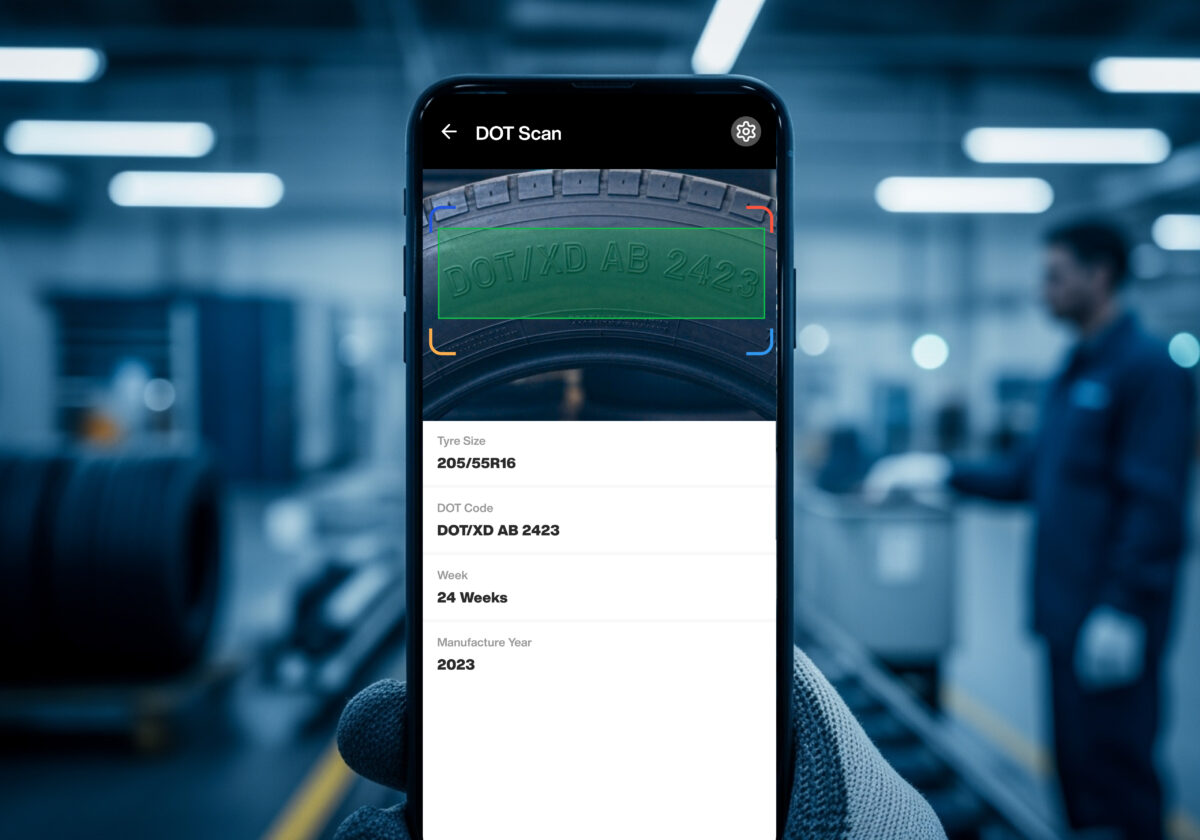
DOT code and sidewall scanning addresses one of the most persistent compliance pain points. Optical character recognition (OCR) and computer vision help automatically read tire sidewall markings, including Department of Transportation (DOT) codes, tire sizes, and manufacturing dates and modern AI systems can read these markings even under dirt, low light, or surface damage that would defeat a manual read. Each scan produces structured, tamper-proof digital data ready for audit review, eliminating the transcription errors that create compliance gaps in paper-based workflows.
Label and marking verification is another area where AI adds significant value for manufacturers. Vision AI systems use high-resolution cameras to capture detailed images of tire labels. They can instantly validate label information against pre-set standards and databases catching labeling errors before non-conforming tires reach the market.
For a compliance manager, the value of AI tire scanning isn’t just detection accuracy it’s the quality and structure of the data record it creates.
Manual scan or inspection processes create records that are only as good as the person entering the data at that moment. AI systems automatically generate consistent, structured records, supporting compliance managers by reducing manual effort and minimizing errors.
The same infrastructure that supports compliance reporting also powers proactive quality management. When a defect pattern emerges whether in a batch of tires from a specific production run or from a particular input supplier the AI system’s traceability data enables immediate isolation of affected units, rather than waiting for a recall. This process is root cause analysis at a speed that manual records cannot support.
Looking further ahead, the EU’s anticipated tire product passport requirement will demand exactly this kind of structured, lifecycle-spanning traceability. The European product passport, already introduced for batteries and expected to apply to tires by 2027–2028, will facilitate traceability, with the Global Data Service Organization for Tires (GDSO) playing a key role in uniquely identifying products and providing comprehensive information through a tire information system. Organizations that invest in AI scanning infrastructure now will be far better positioned to meet these upcoming regulatory requirements and avoid potential non-compliance penalties when they arrive.
AI tire scanning is not a one-size-fits-all deployment. The right architecture depends on the operational context.
Manufacturing plants benefit most from fixed industrial AI vision systems integrated directly into production lines. The priorities here are throughput, read reliability, and automatic integration with MES and ERP systems, so every scan creates a quality and compliance record without manual intervention. End-of-line inspection stations using AI-enhanced X-ray systems catch internal defects that surface cameras miss.
Fleet operations and automotive service centers are well-served by AI-enhanced handheld or camera-based scanning tools. Smartphone-based AI tire inspection achieves 99.5% accuracy in detecting surface defects, including cracks, bulges, foreign particles, and dimensional inconsistencies making it practical for field teams to conduct compliant, documented inspections without specialized hardware. Cloud sync ensures records are captured and stored centrally regardless of connectivity conditions at the inspection site.
Tire recycling facilities have specific needs around DOT code capture for manifest compliance. AI sidewall scanners that function reliably under dirty, damaged, or poorly lit conditions and that integrate with existing ERP or compliance platforms are the appropriate solution. Offline processing capability is important for facilities with intermittent connectivity.
Across all of these contexts, the data integration layer matters as much as the scanning hardware. An AI scanning system that generates accurate reads but stores data in an isolated silo doesn’t solve the compliance problem. The value comes from connecting scan data to the broader quality management and compliance reporting workflow.
AI tire scanning is increasingly a competitive and regulatory necessity, not an optional upgrade. Manual inspection processes introduce error rates, compliance gaps, and audit risks that carry real financial consequences from recalled products to regulatory fines to the $100 million-plus annual cost of defective tires reaching market.
The technology has matured significantly. Deep learning models trained on tens of thousands of real tire images now outperform human inspectors in terms of consistency and speed. Market adoption is accelerating, with self-learning AI systems for defect classification set to become the standard over the coming decade. And the regulatory environment driven by EPA digital tracking requirements, state agency mandates, and the upcoming EU tire product passport is moving firmly toward automated, auditable documentation.
For compliance and quality managers, the question is shifting from whether AI tire scanning is worth evaluating to how quickly it can integrate into existing operations.

Are Tire Manufacturers Losing Millions Because of Poor Traceability Without Realizing It?
4 Mins read
Posted on Sep 11, 2026
The Comprehensive Guide to Tyre Sidewall Scanning in Flutter
4 Mins read
Posted on Aug 19, 2026
Scan Tire DOT Numbers with Your Smartphone: Fast & Accurate Tire Identification
3 Mins read
Posted on Jul 4, 2026