Are Tire Manufacturers Losing Millions Because of Poor Traceability Without Realizing It?
Every tire manufactured today carries a unique identity on its sidewall: a DOT code, a serial number...
 4 Mins read
Posted on Sep 11, 2026
April 22, 2026
8 Mins read


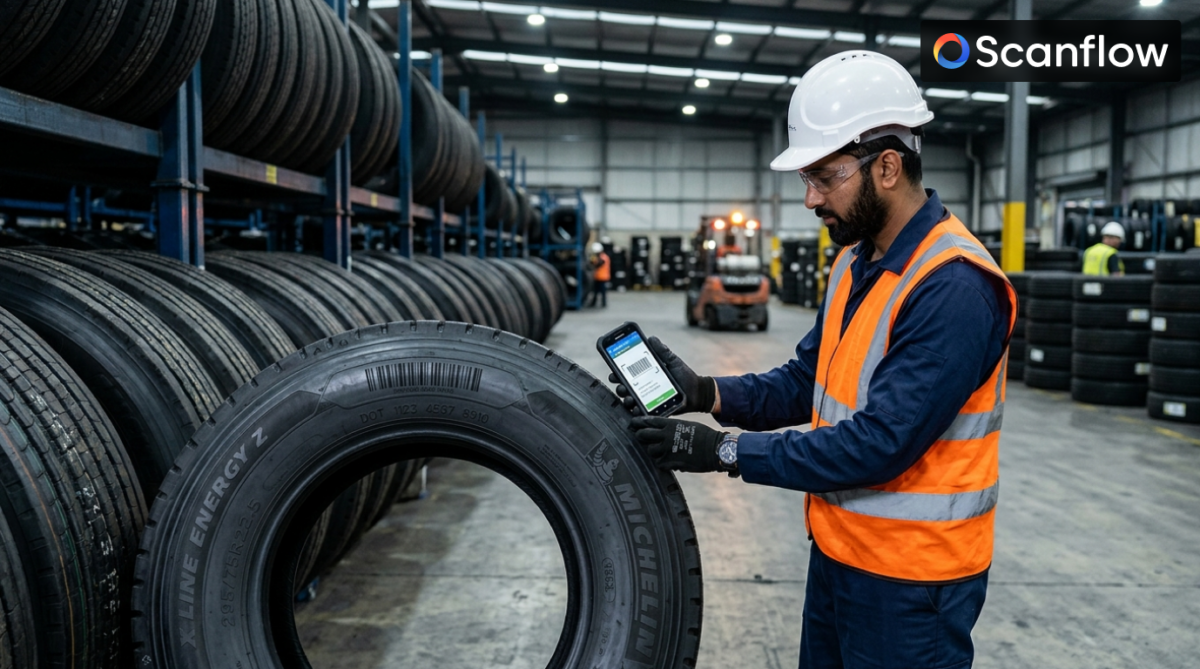
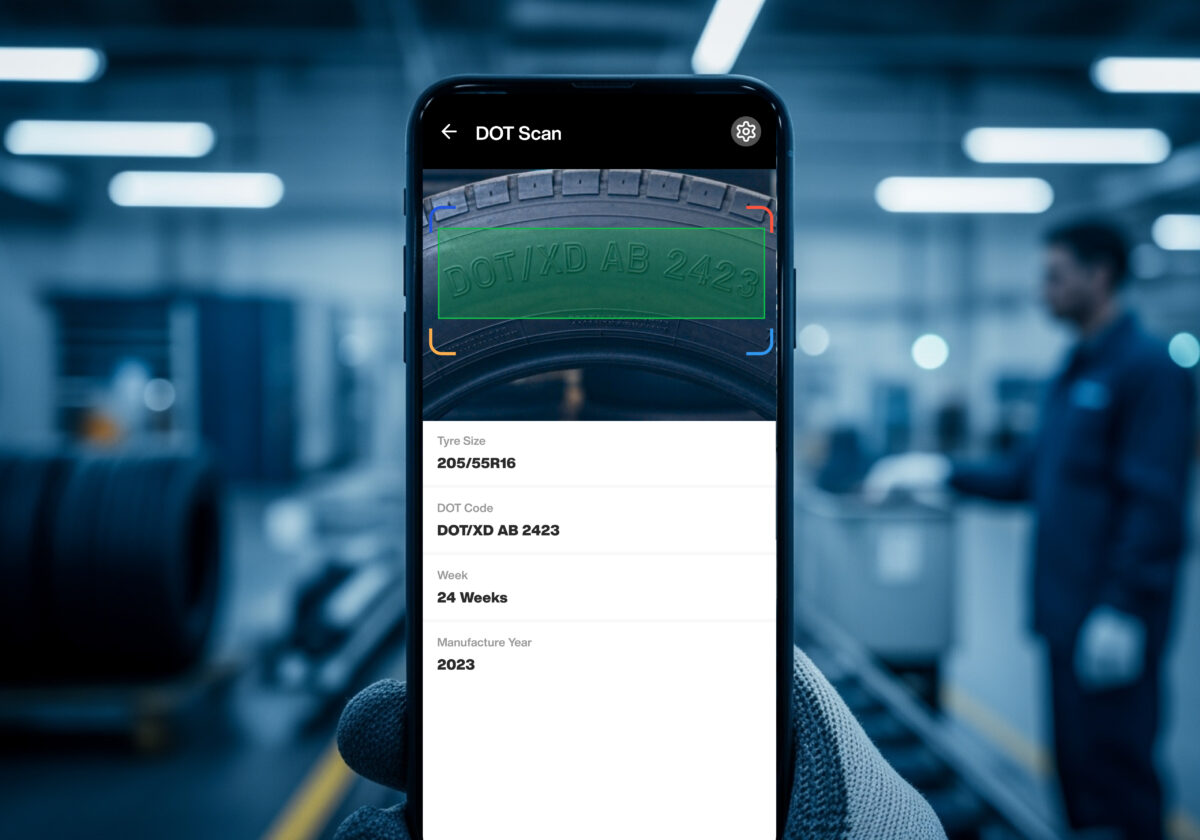
Every tire that rolls off a production line has a small but mighty string of alphanumeric characters molded into its sidewall the Tire Identification Number (TIN). Since 1971, 49 CFR Part 574 has mandated the TIN, which encodes the location of manufacture, the size specification, and the week and year of production. It is, in effect, a tire’s birth certificate. Yet for decades, capturing this data accurately and at scale has been one of manufacturing’s most persistent friction points.
The stakes are high. Tire recalls in the United States consistently return fewer than 20% of affected units, according to Safety Research & Strategies a staggering failure rate rooted largely in broken TIN traceability chains. When TIN data is missing, incomplete, or manually transcribed with errors, manufacturers lose the ability to surgically identify and remediate defective batches, putting consumers at risk and exposing companies to enormous regulatory and reputational liability.
The good news is that a new generation of TIN scanning technologies from AI-powered camera systems to embedded RFID chips is transforming how manufacturers capture, verify, and manage this critical identifier. This guide covers the best TIN scanning methods available today, their trade-offs, and how to choose the right approach for your operation.
The regulatory environment around tire identification is tightening. NHTSA’s 2015 final rule standardized the TIN to a fixed 13-character format and expanded plant codes from two to three symbols to accommodate the growing global manufacturing base. As of April 2025, all manufacturers need to comply with the new three-symbol plant code structure, ending a lengthy transition period. Non-compliance risks not just fines but recall complications.
Statistics: Around 82,964 Achilles ATR Sport 2 tires were recalled in late 2025 specifically because the TIN was too long preventing owners from receiving recall notices and increasing crash risk (NHTSA, 2025).
Beyond compliance, industry pressure to digitize and automate is accelerating. Zebra Technologies’ 2024 Manufacturing Vision Study found that 61% of manufacturers expect AI to drive growth by 2029 (up from 41% in 2024), while 92% of respondents cited digital transformation as a strategic priority. TIN scanning sits at the intersection of both trends: it is a quality control function ripe for AI-driven automation.
Add to this the growing complexity of global supply chains, counterfeit tires flooding markets, and EV manufacturers demanding tighter component traceability. It becomes clear why TIN scanning is no longer a back-office concern it is a frontline manufacturing imperative.
Before evaluating scanning methods, it helps to understand the structure. The modern TIN consists of three segments:
Plant Code (3 characters): Identifies the specific manufacturing facility, assigned by NHTSA.
Manufacturer’s Code (6 characters): A proprietary code describing tire characteristics such as size, type, and design unique to each manufacturer’s system.
Date Code (4 characters): The week (2 digits) and year (2 digits) of manufacture. For example, ‘1425’ means the 14th week of 2025.
The TIN must be molded permanently into at least one sidewall the full TIN on the outboard side, and either a full or partial TIN (without the date code) on the inboard side. This sidewall placement presents technological challenges because the characters are embossed into curved, textured rubber surfaces, which can hinder optical recognition accuracy and reliability.
Statistics: Manual TIN collection from a four-tire passenger vehicle takes an average of several minutes, is prone to transcription error, and becomes significantly harder on mounted tires with the TIN facing inward (NHTSA Electronic Tire Identification Study).
The most widely adopted modern approach, AI-powered machine vision, uses high-resolution industrial cameras and deep learning OCR (Optical Character Recognition) algorithms to read the embossed TIN on tire sidewalls in real time. Leading platforms including Anyline’s Tire DOT Scanner and Scanflow’s AI Tire Sidewall Capture SDK have been purpose-built to handle the specific challenges of curved rubber surfaces, variable lighting, dark sidewall colors, and embossed (rather than printed) characters.
Modern AI vision systems can process a tire sidewall scan in under one second and achieve character recognition accuracy rates exceeding 99%. The technology works on both stationary conveyor belt setups and handheld mobile devices, making it flexible for production floor and warehouse environments alike.
Statitics: Tire distributors using AI sidewall scanning have reported up to 96% reductions in inventory errors, according to Scanflow (2025).
Manufacturers can embed passive UHF RFID chips directly into the tire body typically in the inner liner or bead area during production. These chips require no battery and activate when a reader’s signal powers them. An RFID chip can store up to 2,000 bytes of data, far exceeding the 128 bytes the molded TIN can convey, enabling manufacturers to encode batch records, quality test results, and supply chain milestones.
NHTSA’s Electronic Tire Identification Study examined RFID as the leading candidate for mandated electronic tire identification, noting strong support from tire manufacturers, retailers, and automotive safety advocates. Michelin, Continental, and Pirelli have all trialed or deployed RFID-embedded tires for fleet and OEM markets.
Laser etching a 2D barcode (typically a Data Matrix or QR code) directly into the tire sidewall offers a middle ground between the simplicity of visual scanning and the data richness of RFID. The code can encode the complete TIN plus additional manufacturer data, and is readable by standard industrial barcode scanners or smartphone cameras with appropriate SDK software.
NHTSA’s study noted 2D barcodes as a viable electronic identification method, with several manufacturers already experimenting with laser-etched barcodes on tire beads. The technology is particularly attractive for retreaded tires, where RFID embedding is not possible, and AI-based sidewall OCR can be complicated by overwriting of the original TIN.
Purpose-built fixed camera stations positioned on conveyor lines represent the industrial workhorse of TIN scanning. These systems use line-scan or area-scan cameras with structured lighting (typically LED ring lights or coaxial illuminators) to photograph the tire sidewall as it moves past, feeding the image to an on-board processor running OCR or pattern recognition algorithms.
Companies like Cognex, SICK AG, and Teledyne DALSA supply high-end vision systems used across automotive manufacturing, including tire plants. SICK’s Inspector83x 2D vision sensor, introduced in 2024, processes up to 15 inspections per second using AI-enabled and rules-based algorithms well within the throughput demands of most tire production lines.
Market Statistics: The global machine vision market was valued at $20.4 billion in 2024 and may reach $41.7 billion by 2030 at a 13% CAGR with automotive manufacturing holding the largest end-user share (Grand View Research, 2025).
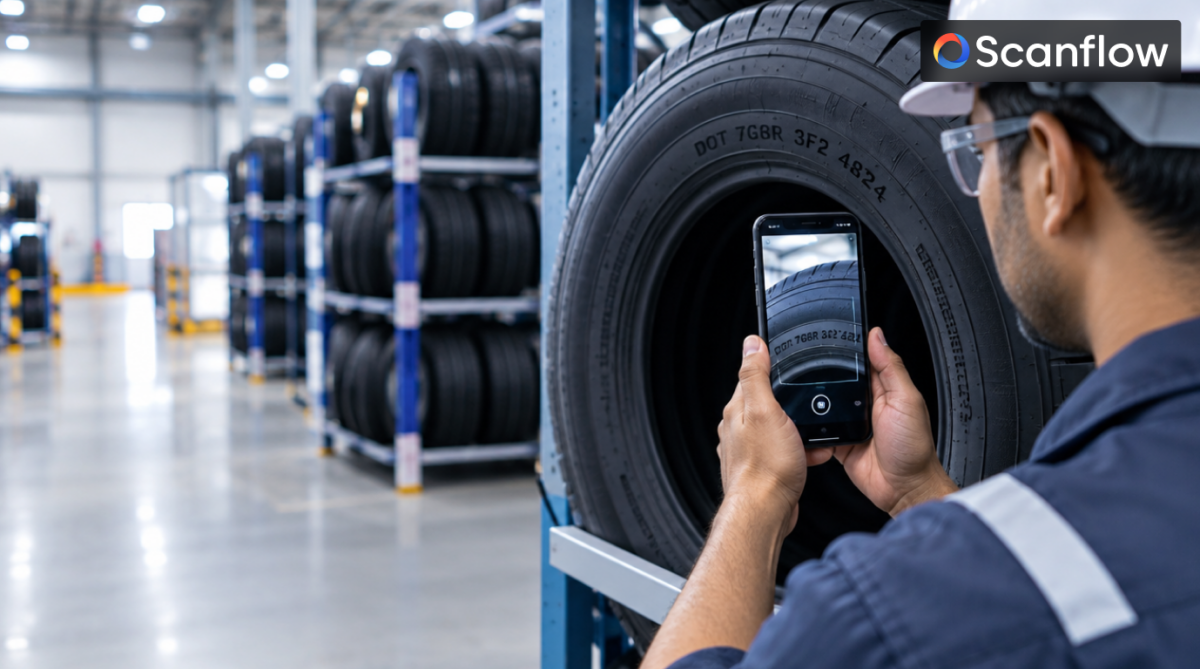
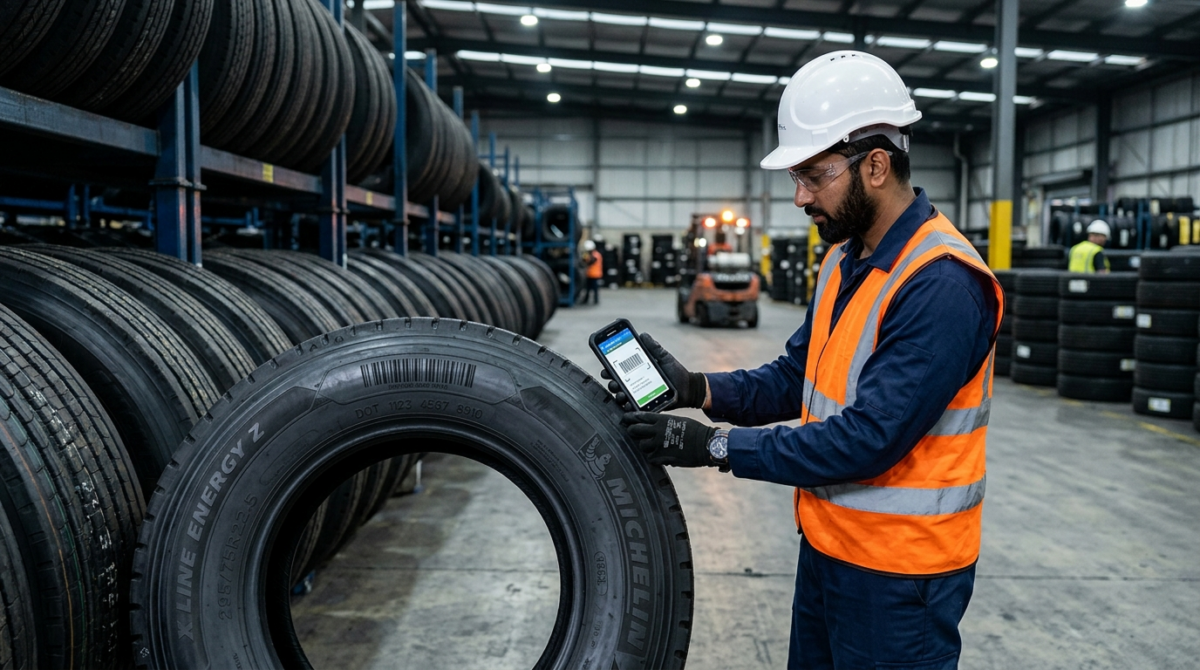
For operations that need flexibility over throughput warehouses, retail, service bays, or quality audits mobile handheld scanning using smartphone or rugged device cameras with dedicated TIN scanning SDKs has emerged as a practical and cost-effective option. Solutions from Anyline and Scanflow allow a technician to point a device camera at a tire sidewall and capture the TIN accurately in a single capture, with the result pushed directly to a cloud database or ERP system.
This approach is particularly valuable for independent tire dealers, who, under NHTSA regulations, must register tires at the point of sale but have historically had extremely low compliance rates.
Michelin’s own survey found fewer than 2% of tires purchased from independent dealers were registered. Mobile TIN scanning dramatically reduces the friction of this process.
Each method has its optimal application context. Here is how one compares across the dimensions that matter most to manufacturers:
The value of a scanned TIN multiplies when it flows in real time into an ERP, MES, or WMS system. Manufacturers increasingly demand that scanning hardware and software come with pre-built API connectors for SAP, Oracle, and Microsoft Dynamics. The shift from standalone scanners to connected scanning ecosystems is a defining trend of 2025.
Electric vehicle manufacturers hyper-sensitive to safety incidents and under intense public scrutiny are pushing tire suppliers for granular traceability data. Tesla’s December 2024 recall of 694,304 vehicles over a tire pressure monitoring software fault highlighted just how quickly a tire-related issue can balloon into a massive recall. EV OEMs are increasingly writing RFID readability requirements into their supplier specifications.
Statistics: Tesla’s 2024 tire-related recall covered 2,777,216 individual tire units demonstrating the catastrophic scale of the problem when tire identification and monitoring systems fall short.
Next-generation systems are moving beyond reading the TIN to analyzing the full sidewall image for surface defects, molding inconsistencies, and date code legibility scoring. This process fuses TIN capture with quality inspection in a single camera pass reducing line cycle time and capturing richer data. SICK AG’s 2024 Inspector83x and Cognex’s AI-enhanced In-Sight SnAPP sensor are early examples of this convergence.
NHTSA’s Electronic Tire Identification Study, released to Congress, reviewed the feasibility of requiring all new tires to carry electronic identifiers, such as RFID or 2D barcodes. While there is no mandate to date, stakeholder feedback including from major tire manufacturers was broadly supportive. Industry observers expect regulatory movement in this direction within the next five to seven years, particularly as recall return rates remain stubbornly low.
The optimal TIN scanning solution depends on your production environment, volume, budget, and compliance requirements. Use this decision framework:
If you are manufacturing more than 5,000 tires per day on automated conveyor lines, fixed industrial camera systems, or AI-integrated conveyor scanning are your baseline options. For lower-volume or mixed-production environments, AI-powered mobile or smart camera solutions offer better ROI.
If your customers particularly OEM automotive manufacturers require individual tire traceability (not just batch-level), RFID embedding is worth the additional unit cost. If batch-level TIN capture suffices, camera-based OCR is the most cost-efficient path.
TIN scanning that lives in isolation adds limited value. Prioritize solutions with robust API support for your ERP and quality management systems. Ask vendors for documented integrations with the specific platforms you use before committing.
Given the direction of NHTSA policy and the growing demands of EV OEM customers, building RFID readiness into your facility infrastructure now even if you are not yet mandated to embed chips positions you ahead of the compliance curve rather than behind it.
Tire Identification Number scanning is no longer a compliance checkbox. In the context of tightening NHTSA regulations, rising recall volumes, EV manufacturer demands, and the broader push toward Industry 4.0 manufacturing, TIN capture has become a strategic capability. The manufacturers who invest in accurate, integrated, and scalable TIN scanning systems today are building the foundation for faster recalls, cleaner supply chains, and stronger customer trust.
Whether you start with a mobile handheld SDK for dealer registration, deploy fixed AI camera systems on your production line, or take the long-term view and embed RFID chips into your tire body, the direction of travel is clear: manual, error-prone TIN transcription belongs to the past. The future is automated, digital, and connected, and it starts with getting the TIN right.

Are Tire Manufacturers Losing Millions Because of Poor Traceability Without Realizing It?
4 Mins read
Posted on Sep 11, 2026
The Comprehensive Guide to Tyre Sidewall Scanning in Flutter
4 Mins read
Posted on Aug 19, 2026
Scan Tire DOT Numbers with Your Smartphone: Fast & Accurate Tire Identification
3 Mins read
Posted on Jul 4, 2026