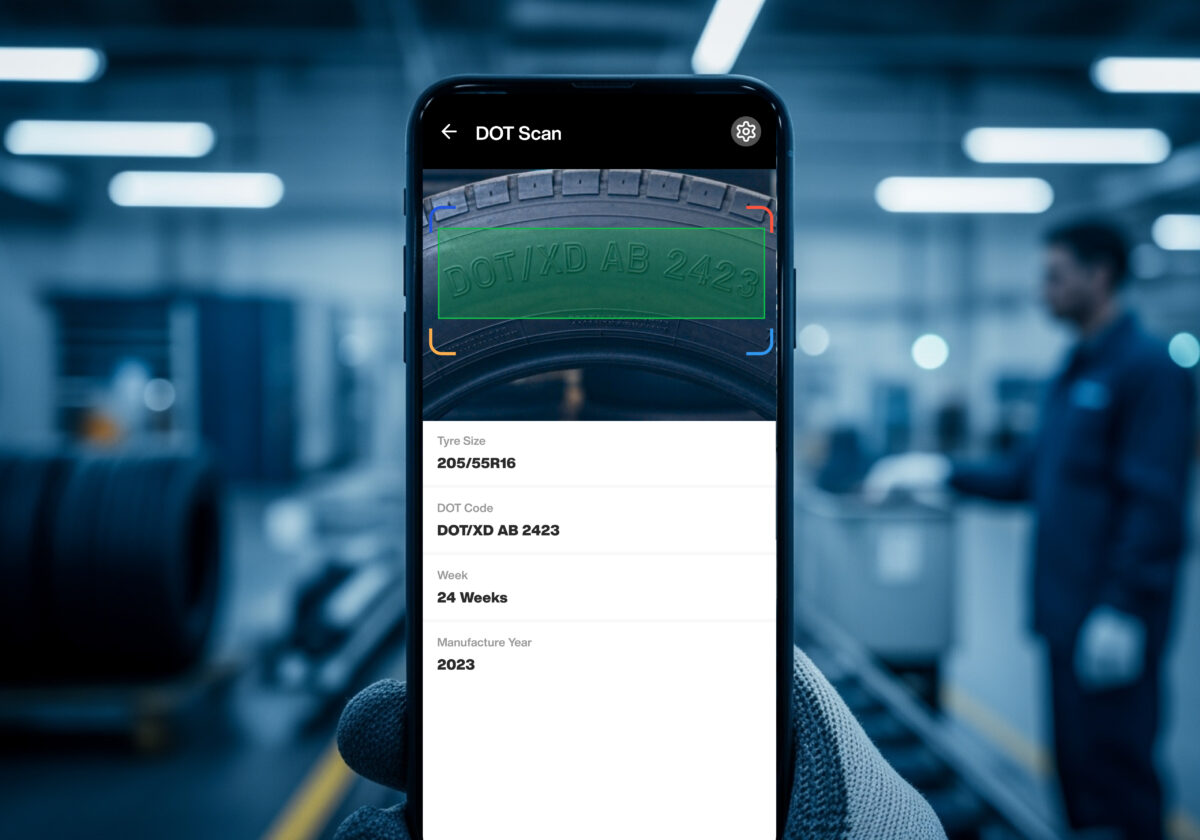
Are Tire Manufacturers Losing Millions Because of Poor Traceability Without Realizing It?
Every tire manufactured today carries a unique identity on its sidewall: a DOT code, a serial number...
 4 Mins read
Posted on Sep 11, 2026
May 19, 2026
9 Mins read


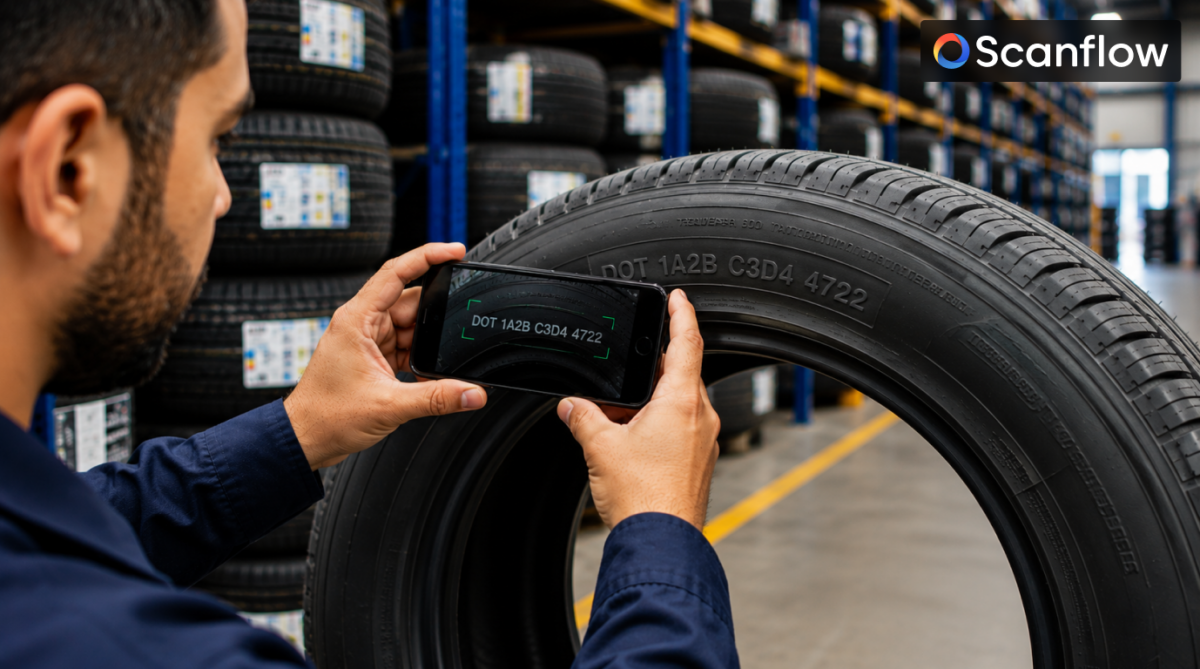
It happens every morning across thousands of fleet yards in the United States. A technician walks the vehicle line, crouches beside each tire, squints at embossed sidewall markings dulled by road grime, and transcribes an 11-digit DOT code onto a clipboard. That clipboard becomes the inspection log. That log becomes the only evidence of compliance when a DOT auditor comes calling.
For decades, this was the industry standard. In 2026, it is a documented liability and the enforcement data leaves no room for ambiguity.
| 56,178 commercial vehicles inspected in CVSA Roadcheck 2025 22.6% placed Out-of-Service vehicles pulled from operation 2,899 tire-specific OOS orders issued in a single 72-hour window |
|---|
These are not isolated incidents. The 2025 CVSA International Roadcheck a 72-hour enforcement blitz across North America reveals tire violations now account for 21.4% of all vehicle out-of-service orders, up from 18.6% the previous year. This upward trajectory highlights a persistent, systemic problem rooted in how fleets document, identify, and manage tires, underscoring the need for improved compliance solutions.
The technology to solve it has arrived. AI-powered tire sidewall scanning once a laboratory concept is now operational infrastructure deployed on standard smartphones, integrated with ERP and fleet management systems, and capable of producing a complete, audit-ready digital tire record in under two seconds per tire. This blog maps the compliance crisis, the industry forces accelerating the shift, and why 2026 is the inflection point.
Fleet managers often anchor their compliance calculus to the direct fine. The actual financial exposure is an order of magnitude higher and it compounds.
Federal penalties for tire violations under FMCSA regulations range from $1,000 to $16,000 per violation per occurrence. In more serious maintenance violation categories, penalties range from $13,300 to $53,203. A single recordkeeping failure a clipboard entry that is misread, illegible, or missing triggers fines of $1,584 per day, up to $15,846 total.
Each out-of-service order can cost a fleet $5,000–$100,000 per hour in operational downtime, underscoring the critical need for reliable tire management to protect profitability and reputation.
Only 7% of motor carriers pass DOT audits without a single violation. The remaining 93% average six violations per audit. These are not edge cases of negligent operators they are the predictable output of documentation processes that fail at scale. One company was fined $2.5 million for improper recordkeeping alone another paid $3.6 million for neglecting mandatory inspections.
Tire violations have not plateaued. The five-year CVSA trend shows a steady increase from 17.2% of all vehicle OOS orders in 2021 to 21.4% in 2025. Authorities have issued more than 456,000 tire-related DOT violations to commercial fleets across the United States during this period. The same root cause applies to every case: teams failed to properly identify, consistently document, and maintain traceability for tires when auditors requested proof.
The enforcement environment tightened further in 2026. FMCSA’s CSA scoring overhaul split the Vehicle Maintenance BASIC into two separate scoring categories, making DVIR quality directly visible in carrier safety ratings for the first time. Regulators have officially authorized electronic DVIRs, creating both an opportunity and an expectation for documentation to meet digital-grade standards. Fleets still operating on paper-based tire records are not just inefficient they are taking a documented regulatory risk in a newly tightened regulatory environment.
The problem is not that fleet technicians fail to inspect tires. Surveys consistently show inspections happen. The problem is that inspectors do not document results with the consistency, accuracy, or traceability required for DOT audits. Understanding why requires examining the actual task.
Every commercial tire carries a DOT/TIN (Tire Identification Number) embossed directly into the sidewall rubber. This code encodes the manufacturer, production plant, tire size, and manufacturing week and year every piece of information needed to confirm compliance, flag a recall, or verify age for fleet rotation policies. Unlike a barcode on a flat label, a DOT code is raised rubber on a curved, often dirty, frequently worn surface. Manual reading of this code introduces multiple structural failure modes:
AI-powered tire sidewall scanning was not an obvious technology to build. The physical characteristics of tire sidewalls curved surfaces, low-contrast embossed characters, variable lighting, aging rubber created a combination of challenges that defeated general-purpose OCR tools for years. Modern AI systems overcome each of these through purpose-built deep learning architectures:
The operational workflow is simple the complexity is in the engine. A fleet technician opens a mobile application on a standard iOS or Android smartphone. They point the camera at the tire sidewall. The AI engine performs real-time frame quality assessment, identifies the DOT code region using computer vision, extracts and validates the character string, and pushes a structured data record DOT/TIN, tire size, manufacturing date, brand identifier, and GPS/timestamp metadata directly into the fleet management system via API.
The output of each scan is structurally different from any clipboard record:
Result: Under two seconds per tire. Under one minute for a complete 18-wheel commercial vehicle. 60–80% reduction in audit preparation time compared to paper-based systems. Zero transcription errors.
The commercial case for AI tire scanning sits within a rapidly expanding market. The global fleet tire management software market reached $1.42 billion in 2024 and will grow at a 10.8% CAGR to $3.57 billion by 2033. The broader fleet management software market is on a steeper trajectory estimated at $27 billion in 2025, with projections to exceed $122 billion by 2035.
Driving this growth: regulatory pressure, rising insurance costs, e-commerce volume demanding higher fleet utilization, and the measurable ROI of predictive maintenance tools. The automatic tire inflation system (ATIS) market a closely adjacent segment was valued at $875 million in 2025 and will grow nearly double to $2.08 billion by 2034 (CAGR: 10.09%). The smart tire market may grow from $5.3 billion in 2026 to $8.6 billion by 2033.
The data on AI adoption in commercial fleets reveals a striking paradox: overwhelming awareness of the technology’s value, with strikingly low deployment at scale. According to Penske’s 2025 Transportation Leaders Survey, 70% of fleet companies now report adopting some form of AI tools up 17 percentage points from 2024. Yet Fleetio’s 2026 State of Fleet Management survey, which draws on 600+ fleet professionals, shows that only 5.6% use AI broadly. 35.1% are researching or piloting. 38% remain in limited experimentation.
The hesitation is not about awareness 84% of fleet executives believe the industry lags behind other sectors in AI adoption. It focuses on validated, field-proven deployment in the specific operational conditions fleets face. Tire sidewall scanning addresses this directly: it operates on existing smartphones (no capital investment in hardware), integrates with existing FMS and ERP platforms via API, and produces accuracy benchmarks 92 stability, 95 accuracy, 90 performance on a 100-point scale from real yard deployments, not laboratory tests.
Tire sidewall scanning is the entry point of a broader capability that modern fleets require: full-lifecycle tire asset identification. A tire is a tracked asset it carries a manufacturing origin, a service history, position records across vehicles, a remaining life estimate, and a recall status. Managing that asset intelligently rather than reactively is the difference between a compliant fleet and an exposed one.
The full lifecycle workflow enabled by AI asset identification:
For large fleets managing thousands of tires across hundreds of vehicles, the operational leverage of asset identification is profound. Manual tracking at that scale does not merely slow down it becomes structurally impossible to perform reliably. Asset identification through AI scanning makes it systematic, auditable, and automated.
The compliance investment calculus is straightforward. A single avoided out-of-service violation combining the direct fine, CSA score impact, insurance implication, and operational downtime typically exceeds the annual cost of a digital compliance platform by a factor of 10 or more.
| Category | Manual (Clipboard) Approach | AI Scanning Approach |
|---|---|---|
| Inspection time (18-wheeler) | Several minutes/vehicle + manual entry | < 1 minute, digital record auto-synced |
| Transcription error rate | 1–4% per data entry session | 0% OCR-validated, no manual entry |
| Audit prep time | Hours to days of manual compilation | 60–80% reduction; export in minutes |
| OOS violation risk | High 93% of carriers receive violations | Significantly reduced with structured records |
| Fine exposure per violation | $1,000–$16,000 per occurrence | Avoided through documentation completeness |
| CSA score impact | Cumulative triggers premium increases of 10–30% | Prevented clean digital audit trail |
| Recall response time | Hours of manual sidewall inspection | Seconds fleet-wide DOT code query |
| Integration with FMS/ERP | None clipboard to manual entry | Real-time REST API push zero lag |
The regulatory landscape for fleet compliance in 2026 is measurably more demanding than it was two years ago. Fleets that have not digitized their documentation workflows are navigating a higher-stakes environment with lower-fidelity tools.
AI-powered tire sidewall scanning creates measurable value across four distinct industries and operational roles that often overlap within a single fleet operation:
▸ Commercial Trucking & Long-Haul Carriers: Primary beneficiaries direct exposure to FMCSA regulation, CVSA Roadchecks, and DOT audit risk. ROI is immediate: every avoided OOS violation and every clean audit result has a direct dollar value.
▸ Last-Mile & Urban Delivery Fleets: High tire turnover, frequent inspections, and dense vehicle counts make manual documentation untenable at scale. AI scanning enables the documentation density that urban fleet operations require without proportionally scaling labor.
▸ Fleet Maintenance & Tire Service Providers: Tire shops, maintenance depots, and MRO providers gain a premium service differentiator: digital DOT/TIN capture and lifecycle tracking as a value-added service to fleet clients, enabling data-driven maintenance contracts.
▸ Insurance & Risk Management: Carriers and underwriters increasingly use CSA score data and documented maintenance records as pricing inputs. Fleets with structured digital compliance records represent lower risk profiles with emerging premium advantages.
▸ OEMs and Tire Manufacturers: Full-lifecycle DOT/TIN tracking provides manufacturers with field data on tire performance, recall exposure, and wear patterns that paper records cannot deliver at scale.
Manual tire inspection processes were the best available option for a long time. The clipboard was standard practice because nothing better existed. That changed and the industry data confirms it has changed on a consequential scale.
The combination of tightening regulations, enforcement data that explicitly quantifies the cost of non-compliance, and AI scanning technology mature enough to operate reliably in real-world conditions has permanently shifted the calculus. Tire sidewall scanning that produces audit-ready, tamper-evident, integrated digital records in under two seconds per tire is not an incremental improvement on the clipboard model. It is a category replacement.
For fleet managers evaluating compliance investments in 2026, the question is not whether AI tire scanning delivers ROI. The five-year violation trend, the FMCSA enforcement data, and the emerging case law on maintenance record penalties have answered that question. The only question that remains is: how many OOS violations, CSA points, and audit findings are acceptable on transition delay?
Fleets that make the transition to AI-powered tire scanning report lower violation rates, faster inspections, better tire lifecycle data, lower scrap costs through earlier defect detection — and critically, the ability to demonstrate compliance proactively rather than scramble to prove it reactively.
Sources: CVSA International Roadcheck 2025 | FreightWaves Roadcheck Analysis 2025 | FMCSA Enforcement Data 2025–2026 | Penske 2025 Transportation Leaders Survey | Fleetio 2026 State of Fleet Management | DataIntelo Fleet Tire Management Software Market 2025 | Fortune Business Insights ATIS Market 2026 | Persistence Market Research Smart Tire Market 2026 | GMI Fleet Management Market Report 2025 | Embark Safety FMCSA 2026 Regulation Changes | Scanflow AI Tire Sidewall OCR

Are Tire Manufacturers Losing Millions Because of Poor Traceability Without Realizing It?
4 Mins read
Posted on Sep 11, 2026
The Comprehensive Guide to Tyre Sidewall Scanning in Flutter
4 Mins read
Posted on Aug 19, 2026
Scan Tire DOT Numbers with Your Smartphone: Fast & Accurate Tire Identification
3 Mins read
Posted on Jul 4, 2026