Types of Barcodes: Choosing the Right Barcode
Barcodes are integral for tracking items and providing identification in today's world. Barcodes...
 8 Mins read
Posted on Feb 5, 2026
May 7, 2026
10 Mins read


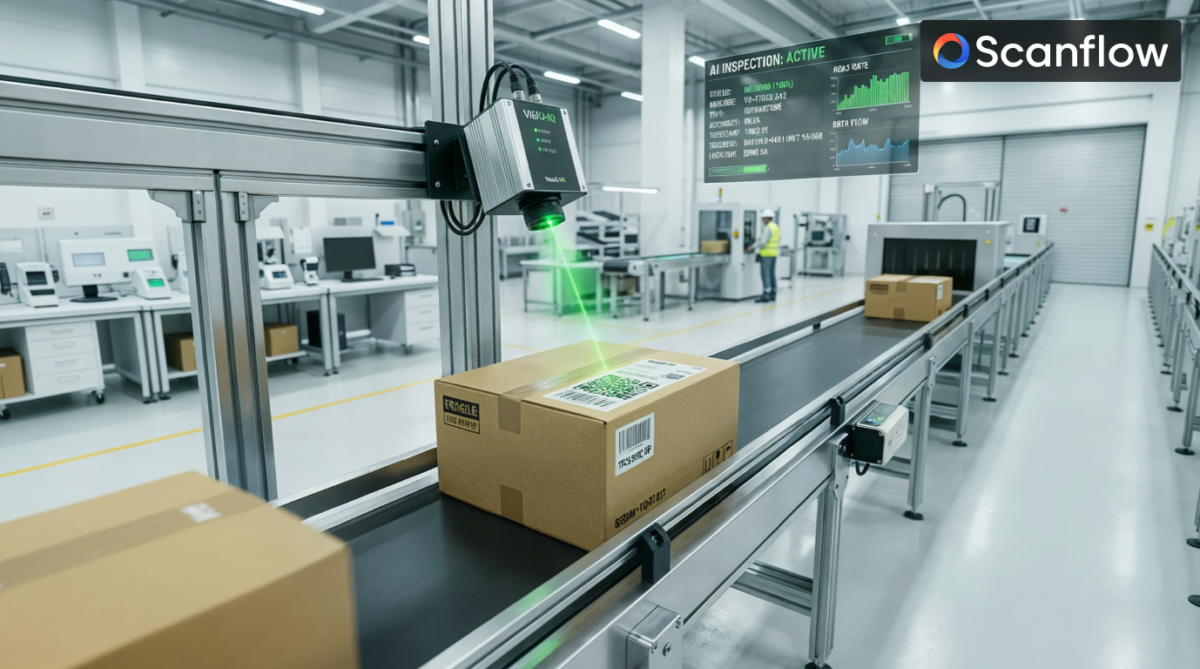
Over 10 billion barcodes are scanned every single day, twice as many as a decade ago. Behind every one of those scans is a simple question that has quietly become enormously consequential: did the scanner get it right? In a 200,000-unit-per-day fulfillment center, a 2% drop in scan accuracy results in 4,000 extra scans per day, consuming 50–70 wasted labor hours. In a pharmaceutical warehouse, a single misread could mean the wrong medication reaching the wrong patient. On a manufacturing line running at 120 parts per minute, a 95% read rate costs the equivalent of 6 unprocessed parts per minute.
For decades, the answer to barcode scanning challenges was hardware: bigger lasers, better optics, sturdier guns. Traditional scanners served the industry reliably in a simpler world: clean labels, flat surfaces, controlled lighting, and narrow barcode formats. Today’s operational reality looks nothing like that. Labels arrive dented, smudged, and curved. Workers scan at angles. Warehouses operate 24 hours a day under variable lighting. Formats multiply: 1D, 2D, QR, Data Matrix, DPM codes on metal parts. The traditional scanner increasingly struggles to keep pace.
Enter AI-enabled barcode scanning: a fundamentally different approach that uses computer vision and deep learning to understand images rather than reflect lasers off lines. This blog cuts through the marketing noise to answer the real question: what actually changes when you move from traditional to AI scanning, and when does the upgrade genuinely matter?
The barcode scanner market is growing steadily, but its composition is shifting fast. The global market was valued at approximately USD 7.4 billion in 2024 and may reach USD 13.0 billion by 2033, growing at a CAGR of around 6–10% across segments. The forecast for industrial barcode scanners alone may grow at a 11.3% CAGR through 2034, driven by Industry 4.0 adoption, e-commerce fulfillment pressure, and regulatory traceability requirements.
MARKET SIZE
Barcode scanner market valued at USD 7.4 billion in 2024
Projected to reach USD 13.0 billion by 2033 at 6.13% CAGR with AI-integrated scanning driving the fastest growth segment (IMARC Group, 2024)
The technology mix within that market is shifting dramatically. Imaging scanners, which capture full barcode images rather than sweeping a laser line, now account for the majority of new device shipments since 2022, while laser scanner demand is actively declining in retail and office settings. And on top of imaging, AI-powered decoding is being layered in at increasing speed: Cognex launched its AI-powered DataMan 290 and 390 barcode readers in January 2025; Datalogic introduced new AI-embedded solutions at NRF 2025 the same month; and in March 2025, DHL and Zebra Technologies announced a strategic partnership to deploy enterprise-grade AI scanning across DHL’s global network.
What is driving this shift is not marketing fashion. It is the real operational gap between what traditional scanners can and cannot do and what AI systems handle without breaking stride.
Traditional barcode scanning, whether laser-based or early-generation CCD/imager, operates on a fundamentally optical-mechanical principle. A laser scanner sweeps a laser beam across the barcode, measuring the reflection pattern of dark bars and white spaces to decode the encoded data. This approach is fast, reliable, and inexpensive for its purpose: reading clean, well-printed, properly oriented 1D barcodes in controlled conditions.
CCD (Charge-Coupled Device) scanners took a step forward by capturing ambient light patterns from the barcode surface rather than emitting a laser, offering better performance on some surface types. First-generation imaging scanners added camera sensors to capture full barcode images, enabling 2D code reading. But even these systems rely on rule-based decoding algorithms and fixed mathematical logic to interpret whatever the optics capture, without the ability to adapt, learn, or reason about ambiguous inputs.
Traditional scanning has a well-documented set of failure modes that become critically costly at scale:
THE HIDDEN THROUGHPUT COST
A manufacturing line at 120 parts/min with 95% read rate loses 6 parts per minute.
A 2% accuracy drop in a 200,000-unit fulfillment center = 4,000 extra scans daily and 50–70 wasted labor hours. Organizations rarely track the cost of scan failures, yet it is always present. (Visionify / OxMaint, 2025).
A scanner operating at 92% accuracy still works, but it forces pickers to re-scan items multiple times, slows throughput by 8–15%, and introduces mis-picks when frustrated workers override the system.” OxMaint, Barcode Scanner Maintenance for Fulfillment Accuracy, 2025
AI-enabled barcode scanning replaces rule-based optical decoding with deep learning models trained on vast datasets of real-world barcode images, including millions of examples of damaged, distorted, partially obscured, low-contrast, and awkwardly angled codes. The system does not simply measure reflected light patterns; it applies convolutional neural networks (CNNs) to analyze the full image, identify the barcode region, interpret ambiguous elements, and decode the data with contextual intelligence.
This approach runs directly on the scanning device, whether a smartphone, tablet, ruggedized handheld, or fixed industrial camera, without requiring cloud connectivity for each scan. The model’s intelligence is embedded in the software SDK, enabling it to operate at full speed in offline, low-connectivity, or security-sensitive environments.
The differences between AI and traditional scanning are not marginal improvements in the same dimensions; they represent a shift in what scanning can fundamentally handle:
| SPEED AND ACCURACY BENCHMARK
AI scanning engines process up to 500 barcodes per minute with 99%+ accuracy. On challenging out-of-focus images: AI leaders achieve 79–92% read rates vs. 10–14% for standard open-source engines (Anyline / Dynamsoft benchmark, 2025) |
The differences between the two approaches play out differently depending on the scanning environment and task. Here is a direct comparison across the dimensions that matter most operationally:
| Capability | Traditional Scanning | AI-Enabled Scanning |
|---|---|---|
| Damaged/degraded barcodes | Often fails or requires a re-scan | Reads using pattern inference and ML |
| Code formats supported | Usually 1D laser; limited 2D | All major 1D, 2D, QR, DPM simultaneously |
| Surface types | Flat, clean labels only | Curved, reflective, uneven, direct-part marks |
| Scanning angle tolerance | Narrow - requires alignment | Wide - any angle, any orientation |
| Hardware requirement | Dedicated scanner device | Existing smartphone, tablet, or fixed camera |
| Learning/adaptation | None - fixed algorithm | Continuous ML improvement from scan data |
| Multi-barcode capture | One at a time | Multiple codes in a single frame |
| Integration | Hardware drivers, middleware | Software SDK with direct API to WMS/ERP |
| Context awareness | None - reads what it sees | Intelligent intent detection and error filtering |
| Total cost of ownership | Hardware + maintenance cycle | Software license on existing devices |
| Offline capability | Full (laser optics) | Full (on-device model, no cloud needed) |
Scanflow: AI Barcode Scanning Built for Industrial Realities
Among the AI scanning solutions designed specifically for enterprise and industrial environments, Scanflow has built its platform around the operational challenges that traditional scanners handle poorly: complex manufacturing parts tracking, logistics traceability, multi-format code reading across unpredictable conditions, and seamless integration into existing enterprise workflows.
Scanflow is an AI-powered scanning SDK designed to run on standard smart devices, smartphones, tablets, ruggedized handhelds, and wearables, delivering what the company describes as enterprise-grade intelligent data capture without requiring specialized hardware investment. The system trains its AI models to scan barcodes, QR codes, serial numbers, and text even in difficult real-world conditions, such as low-light environments, long-range distances, damaged labels, and varying orientations and angles.
Rather than positioning itself as a generic barcode-scanning tool, Scanflow is purpose-built for industries where traceability is mission-critical: manufacturing, logistics and warehousing, automotive, and healthcare. Its capabilities include:
Scanflow is most relevant to organizations facing the limitations of traditional scanning in complex traceability scenarios. If a business is managing serial-number-level product tracking across a supply chain, running operations where labels arrive damaged or in varied formats, or building mobile applications that need to capture data from non-ideal barcode conditions, Scanflow’s SDK approach offers a practical path to AI-grade scanning without a hardware overhaul.
The key commercial proposition, deploying enterprise scanning capability on existing smart devices rather than maintaining a dedicated scanner estate, addresses one of the most common barriers to AI scanning adoption: upfront capital cost. Rather than replacing every traditional scanner on the floor with a new AI-capable device, organizations can extend AI scanning capability through software to the Android and iOS devices already in workers’ hands.
“Scanflow’s AI-powered barcode scanning solution ensures precise and rapid data capture, streamlining inventory management and supply chain processes deployed on smart devices your teams already carry.” Scanflow.ai
AI scanning is not universally superior for every use case. The investment calculus depends on the specific scanning environment and operational challenges. Here is a practical framework:
For high-volume, fixed-conveyor applications that read clean 1D barcodes in controlled environments, such as sortation lines in parcel hubs, laser scanners remain cost-effective and performant. The ROI of an AI upgrade depends on whether the failure modes described above are actually occurring in your operation. If first-pass read rates are consistently above 99.5% and formats are stable, the upgrade economics are less compelling.
| INDUSTRY ADOPTION SIGNAL
Imaging scanners account for the majority of new scanner shipments since 2022 Laser scanner demand is actively declining in retail and office settings as AI-enhanced imaging defines the new standard (Tera Digital / Market Analysis, 2025) |
Supply chain traceability requirements are tightening across the US, the EU, and the Asia-Pacific region simultaneously. The US Uyghur Forced Labor Prevention Act requires documented supply-chain provenance. EU Digital Product Passport regulations will require machine-readable lifecycle data for manufactured goods. Healthcare and pharmaceutical traceability mandates continue to expand. Each of these regulatory requirements creates a direct demand for scanning systems that can accurately capture serial numbers, product codes, and material identifiers at every point in the supply chain, exactly where AI scanning outperforms traditional approaches.
Global e-commerce projection may exceed USD 8 trillion by 2030. The fulfillment operations supporting that volume are under intense pressure to scan faster, with fewer errors, across an increasingly diverse product assortment. Traditional scanning is a bottleneck in this environment; AI scanning with batch capture, angle tolerance, and multi-format reading directly addresses the throughput demands of modern fulfillment.
The rise of BYOD (Bring Your Own Device) and enterprise mobility strategies has placed powerful camera systems in the hands of every warehouse worker, delivery driver, and field technician. AI scanning SDKs like Scanflow’s transform those cameras into enterprise-grade scanning tools, fundamentally changing the cost structure of deploying scanning capability. Instead of a capital expenditure cycle tied to dedicated hardware refresh, organizations deploy scanning as a software license update.
The gap between AI-enabled barcode scanning and traditional scanning is not a generational hardware upgrade; it is a categorical shift in what scanning can do. Traditional scanners ask: “Can I read this barcode under these conditions?” AI scanning asks: “What is the data here, and how do I get it reliably regardless of condition?” The difference matters every time a label is damaged, an angle is awkward, a format is unexpected, or a serial number capture is missing with legal-grade accuracy.
For manufacturers managing component traceability, logistics operators building intelligent supply chains, and field teams relying on mobile devices to capture data in the wild, AI scanning is not an optional upgrade; it is the infrastructure that enables accurate, scalable data capture. Solutions like Scanflow that deliver this capability as an SDK deployable on existing devices, integrable with existing systems, and purpose-built for industrial complexity offer a pragmatic entry point that avoids the traditional choice between capability and cost.
The 10 billion daily barcode scans of today will only grow. The question is not whether AI scanning will displace traditional methods in demanding environments; it is how quickly organizations will make the transition before the operational costs of legacy scanning accumulate beyond tolerance.
Key Takeaways

Types of Barcodes: Choosing the Right Barcode
8 Mins read
Posted on Feb 5, 2026
How to Eliminate Label Scanning Errors in High Volume Warehouses
2 Mins read
Posted on Jul 18, 2025