AI-Enabled Barcode Scanning vs Traditional Scanning
Over 10 billion barcodes are scanned every single day, twice as many as a decade ago. Behind every o...
 10 Mins read
Posted on May 7, 2026
February 5, 2026
8 Mins read


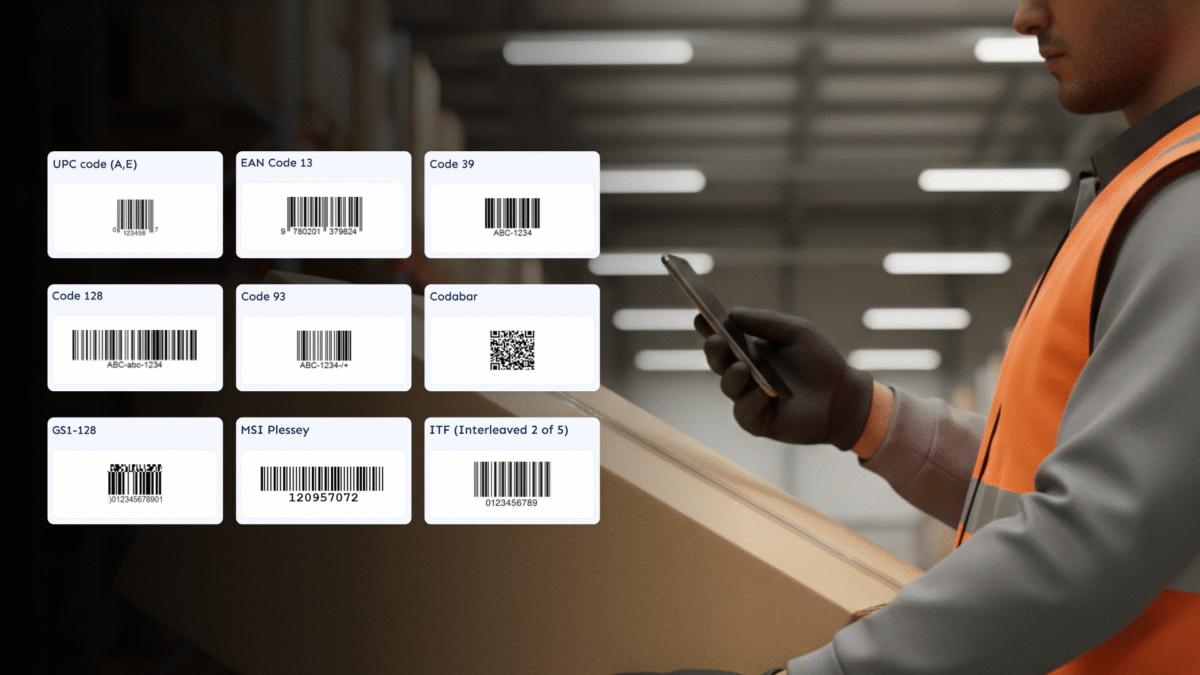
Barcodes are integral for tracking items and providing identification in today’s world.
Barcodes allow an organization to quickly, accurately, and automatically capture data at retail store checkout, warehouse shelves, hospitals, and manufacturing operations.
However, choosing the correct barcode can prevent scanning failures, regulatory issues, and operational delays, helping you feel confident in your decisions. This guide aims to support you in making informed, reliable choices for your company’s needs.
(Linear and Matrix Barcodes)
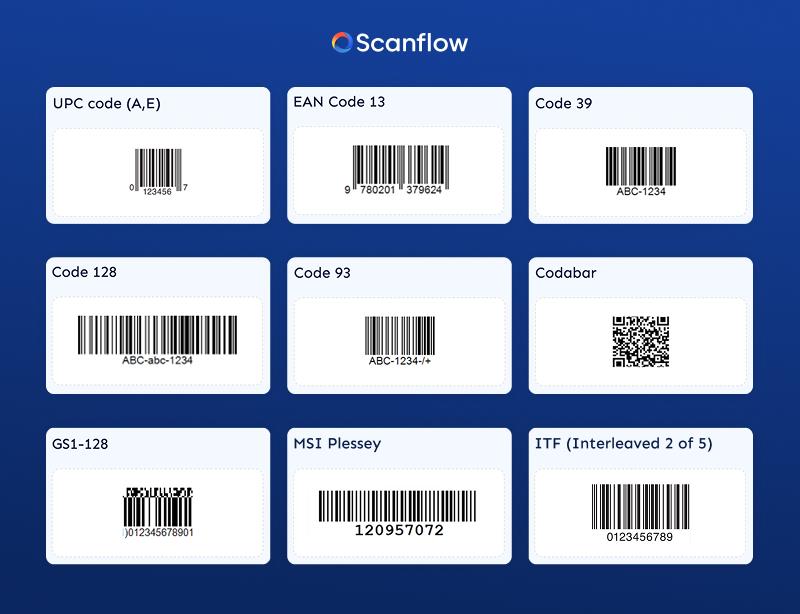
In most cases, we can classify barcodes into two types: one-dimensional (1D) and two-dimensional (2D).
1D BARCODES VS 2D BARCODES
| Feature | 1D Barcodes | 2D Barcodes |
|---|---|---|
| Data storage | Limited (numbers/characters) | High (text, URLs, IDs, metadata) |
| Structure | Horizontal lines | Square or rectangular patterns |
| Scan direction | Single direction | Multiple directions |
| Error correction | Minimal | Strong built-in error correction |
| Space efficiency | Requires more width | Stores more data in less space |
| Common use | Retail, logistics | Manufacturing, healthcare, mobile |
Different industries use specific barcode types, and choosing the right standard directly affects scan accuracy, system integration, and scalability.
One-dimensional (commonly referred to as 1D) barcodes (linear barcodes) have been the predominant barcode standard for many decades, typically found in retail, packaging, and logistics. 1D barcodes allow businesses to quickly and reliably identify products. The UPC is the most widely used 1D barcode in North America, while the EAN is the most commonly used standard internationally; both continue to serve as the underlying foundation of retail point-of-sale and inventory control systems.
Growing demand for rich data and flexible barcode scanners is pushing the market toward adopting 2D barcodes, which store more data in less space and are camera-readable.
This trend is occurring worldwide. Retail and manufacturing ecosystems are preparing to migrate from a world of 1D barcodes to hybrid 1D and 2D barcodes (i.e., QR Codes and Data Matrices) on packages. Instead of eliminating all 1D barcode usage, many organizations are pursuing hybrid strategies that will enable organizations to continue using existing infrastructure while moving towards future-proof capabilities.

Exploring this can inspire confidence in your ability to select the best options for your operations.
While there are approximately 30 barcode symbologies in use today, only a handful still exist. We focus on the 13 primary types of barcodes used in retail, logistics, manufacturing, healthcare, and transportation industries.
UPC Barcodes are primarily used in North America (the United States) to identify and scan consumer items via point of sale. They provide quick, easy checkouts while still allowing a unique identifier for each item within a given retail system.
The most common UPC format is UPC-A. This barcode type is a 12-digit number that uses the same encoding system as EAN-13, with the only major difference being that UPC-A omits the leading zero used in North America.
When packaged products are smaller than traditional packaging, retailers use the UPC-E type. UPC-E is a compressed format that contains 6 digits and interfaces well with standard UPC systems.
In addition to their use at the point of sale, UPC barcodes play an important role in retail inventory management by enabling accurate tracking from the manufacturer to the warehouse, from the warehouse to the distribution center, from the distribution center to the store, and finally from the store to the customer.
EAN barcodes (European Article Numbers) serve as an international standard for identifying retail products and function as a global counterpart to the American Universal Product Code (UPC). EAN barcodes originated in Europe; however, they have become the predominant form of product identification worldwide.
The EAN-13 is the most commonly used EAN barcode and encodes 13 numerical digits. The components of an EAN-13 barcode include a prefix (indicating the country/region), the manufacturer’s code, the product code, and a validation digit/checksum. The EAN-8 is an alternative to EAN-13 that is shorter and typically used for small retail items (to conserve space).
The EAN standard helps maintain consistency across a global supply chain, enabling seamless scanning during the order process across various manufacturers and suppliers worldwide.
Code 39 is one of the earliest alphanumeric barcode symbologies and is still widely used by various industrial and enterprise companies. While both UPC and EAN use only numerical digits for their identification systems, Code 39 supports both numbers and upper-case letters (which makes it a good choice for internal tracking systems).
Common uses of Code 39 include automotive manufacturing, defense, and logistics, where ensuring good readability and reliability take priority over using a small, compact design. Code 39 is often printed alongside human-readable text (underneath) to enable manual verification as needed.
Due to their lower data density, Code 39 Barcodes are longer than those of many other coding standards, which limits their use on smaller labels.
Code 128 is a linear barcode with a high data density. This bar code can encode more characters and/or more data in a compacted format.
Code 128 supports the full ASCII character set, and dynamically switches between character subsets to maximize the amount of data that Code 128 can encode.
These features make Code 128 an ideal barcode format for logistics operations, including shipping and receiving, as well as in warehouse settings where users need to encode both numeric and alphanumeric data efficiently.
In fact, even though the primary use of code 128 outside of retail is as an identifying and tracking method for couriers and freight systems.
Code 39 vs Code 128: Code 39 prioritizes simplicity and readability, while Code 128 prioritizes efficiency, compactness, and data capacity.
Interleaved 2 of 5 (ITF) is a Numeric-only Barcode extensively used throughout distribution to label cartons or packages. ITF is particularly well-suited for printing onto corrugated paper, where print quality may not be very controlled.
The Intelligent Technology Foundation (ITF) is a method of encoding numeric data using pairs of values. This process enables efficient numeric representation of products while being durable enough for industrial use. ITF is typically seen on packages or pallets, rather than on individual consumer products.
Code 93 provides a more compact and reliable alternative to Code 39. Code 93 uses a similar character set as Code 39, but with much more density and improved error detection and correction.
While the overall use of Code 93 is not high, it has found limited use in logistics and in internal enterprise applications, particularly when an organization wants to use less space to represent a barcode than a standard 2D code would require.
Code 39 Features:
Codabar is an older symbology still used in certain settings, such as libraries, blood donation facilities, and some legacy logistics systems. Codabar makes printing and decoding easy, with little to no computers required for either.
While most barcode types have replaced Codabar, it still has a place in systems where companies require backward compatibility.
Although updates to Codabar helped make it compatible with more contemporary barcode formats, it remains in use where backward compatibility with existing systems is necessary.
GS1 DataBar is a compact barcode designed for retail applications that require more product-related information than standard UPC or EAN codes. Examples of this type of barcode include vegetables or fruits, gift certificates, or items sold by weight.
Unlike traditional retail barcodes, the GS1 DataBar can encode product attributes, such as weight, selling price, and expiration status. Therefore, with the use of GS1 DataBars, retailers will be better able to maintain accurate inventory and improve checkout procedures.
The MSI Plessey is a numeric barcode designed primarily for warehouse inventory control and retail back-office systems. It is easy to implement and is a good choice in a closed-loop environment where global standards are not necessary.
A QR code is a 2-D barcode that can store large amounts of information in a compact square. QR codes are used in many ways across marketing, payments, authentication, and consumer interaction because of their compatibility with smartphone cameras.
The QR Code’s data-encoding capabilities enable businesses to encode URLs, text, identifiers, and structured data, making them ideal for both consumer and business applications.
Data Matrix code design can hold a high density of data in a small amount of space ideal for the manufacturing, electronics, and healthcare industries for Direct Part Marking (DPM).
Data Matrix codes facilitate accurate decoding even when they sustain partial damage, making them well-suited for the harsh working conditions common in the manufacturing industry.
PDF417 is both a stacked linear barcode and is capable of holding large volumes of information. The PDF417 code is popular on shipping materials, government-issued identification cards, and transportation documents.
PDF417 can hold a large amount of data and is often used to add detailed information directly to the barcode.
The Aztec Code is a compact 2D barcode that helps with easy decoding without a quiet zone. Its primary use is for ticketing and mobile boarding passes.
Its compact design makes it suitable for digital displays, and its durability ensures it remains effective even on low-quality printed materials.
Choosing the right barcode for your needs depends on many factors. There is no standardized “one-size-fits-all” barcode that you can use for every application.
Some of the factors to consider when making your decision are;
Are there any regulatory or industry requirements related to the use of barcodes? Important considerations when selecting a barcode include:
Compliance With Regulations Or Industry Standards – GS1, Industry mandates, or local, state, or federal regulations.
The types of barcodes used in different industries can vary. Here are the most common barcodes by industry:
Step 1: Identify Your Use Case
Determine the ideal barcode to track: products, parts, assets, documents, or shipments.
Step 2: What Type of Barcode Should You Use?
Once you identify the number of items to label, you can determine whether to use a 1D or 2D barcode based on the data volume per item, the available label space, and the scanning location.
Step 3: What Are the Printing and Labeling Conditions?
Choose printing and labeling methods with the appropriate quality and durability for real-world usage conditions.
Step 4: How Will You Verify the Scanner’s Compatibility with Your Barcode?
Test the barcode against every type of scanner to ensure it scans barcodes in your organization.
Step 5: How Will You Test, Monitor, and Scale the Barcode System?
Run a pilot program to test the accuracy of scans and revise the process before moving forward with the full implementation of the barcode system.
Barcodes may seem like a simple tool, but when you need to choose the right type of barcode for your organization, it can have a HUGE impact on your operational efficiency, compliance, scalability, and data-capture accuracy.
Understanding the various barcode types, their strengths/weaknesses, and how they work will help you create a barcode strategy that enables you to grow your organization rather than create a bottleneck.
Barcodes don’t just store data; if used correctly, they can provide your entire organization with improved visibility into its operations, faster inventory movement, and greater confidence in the integrity of your inventory.

AI-Enabled Barcode Scanning vs Traditional Scanning
10 Mins read
Posted on May 7, 2026
How 3PL Providers Use Mobile Serial Number Scanning to Enhance Traceability
4 Mins read
Posted on Oct 10, 2025