In 2025 a Newslaundry reporter, Shivnarayan Rajpurohit, spent a working day on the boundary wall of a registered e-waste recycling plant in Haryana. A man from the next field told him to leave or he’d be beaten. His series, published from 30 July 2025, traced 41 government-approved recycling plants across four states and reported that 31 of them either didn’t exist or appeared to be running ghost operations. By the outlet’s estimate, those 31 plants could generate EPR credits worth more than Rs 1,800 crore.
Those are one newsroom’s findings. They land in a market where the paperwork has a legal price: since September 2024, EPR certificates carry a minimum of Rs 22 a kilogram for consumer electronics and Rs 34 for smartphones. Each certificate rests on a claim about what came through a gate. For an ITAD operator, that claim starts with a serial number on a laptop, a server or a drive.
We think the ITAD operators who capture that serial at the gate, every time, will be the ones whose paperwork survives the next few years of Indian regulation. Three separate rulebooks now point that way.
Three Indian rulebooks now ask about the same device
The first is data protection. India notified its Digital Personal Data Protection Rules on 13 November 2025, and the obligations that matter most to ITAD clients start on 13 May 2027. From then, a company must erase personal data once its purpose is served and keep security safeguards and logs in place, with penalties of up to Rs 250 crore per breach. A bank retiring a floor of laptops will want proof, drive by drive, that each one was wiped or destroyed. A tonnage report can’t give it that.
The second is R2v3, the certification standard for electronics recyclers. It requires data-bearing devices to be secured from the moment they enter the facility and asks for device-level tracking and sanitisation records.
The third is the e-waste regime itself. EPR certificates are counted in tonnes by item code, which can make serial numbers look irrelevant. They aren’t. The tonnes on a recycler’s procurement entry have to come from somewhere, and for an ITAD stream the most defensible source is a count of identified devices, each tied to an item code and a weight. The 2022 rules also let producers defer their EPR obligation by the life a refurbisher adds to a product. A refurbished product is one device, with one serial number.
Four checks show whether your gate records would survive an audit
You can run these on last month’s work, with the systems you already have.
- Pick ten certificates of destruction issued last month. Trace every serial on them back to an intake record with a time, an operator and a photograph. Count how many you reach without asking anyone to remember.
- Pick ten refurbished units you sold. Check that each serial links to its intake record and the grade it was given.
- For one month, compare tonnes by item code across intake, production and sales invoices. The CPCB portal won’t accept production above procurement for an item code, so a gap you find now is one you’d otherwise meet at certificate time.
- Take one batch of shredded drives. Check that each serial was recorded before the shredder, and that the record names the lot the drive went into.
If the first check stalls, move capture to the front. Record the serial, item code and weight when the device arrives, carry lot numbers through processing, and close each batch on its sales invoice. The destruction certificate, the refurbishment record and the portal entry then become copies of one record.
Identity can only be captured before the shredder
Every e-waste stream has a point past which identity is gone. Before it, a laptop has a serial number, a model and a previous owner. After it, there’s copper, aluminium and a weight. Call that point the shredder horizon. Anything you’ll ever need to prove about a single device has to be captured on the near side of it, because nothing on the far side can be traced back to one item.
Past the horizon, the chain continues only as lot records. Each bin feeds a processing batch, each batch yields fractions, and each sale of those fractions closes on a GST invoice. None of those lot records can name a device that wasn’t recorded at the gate.
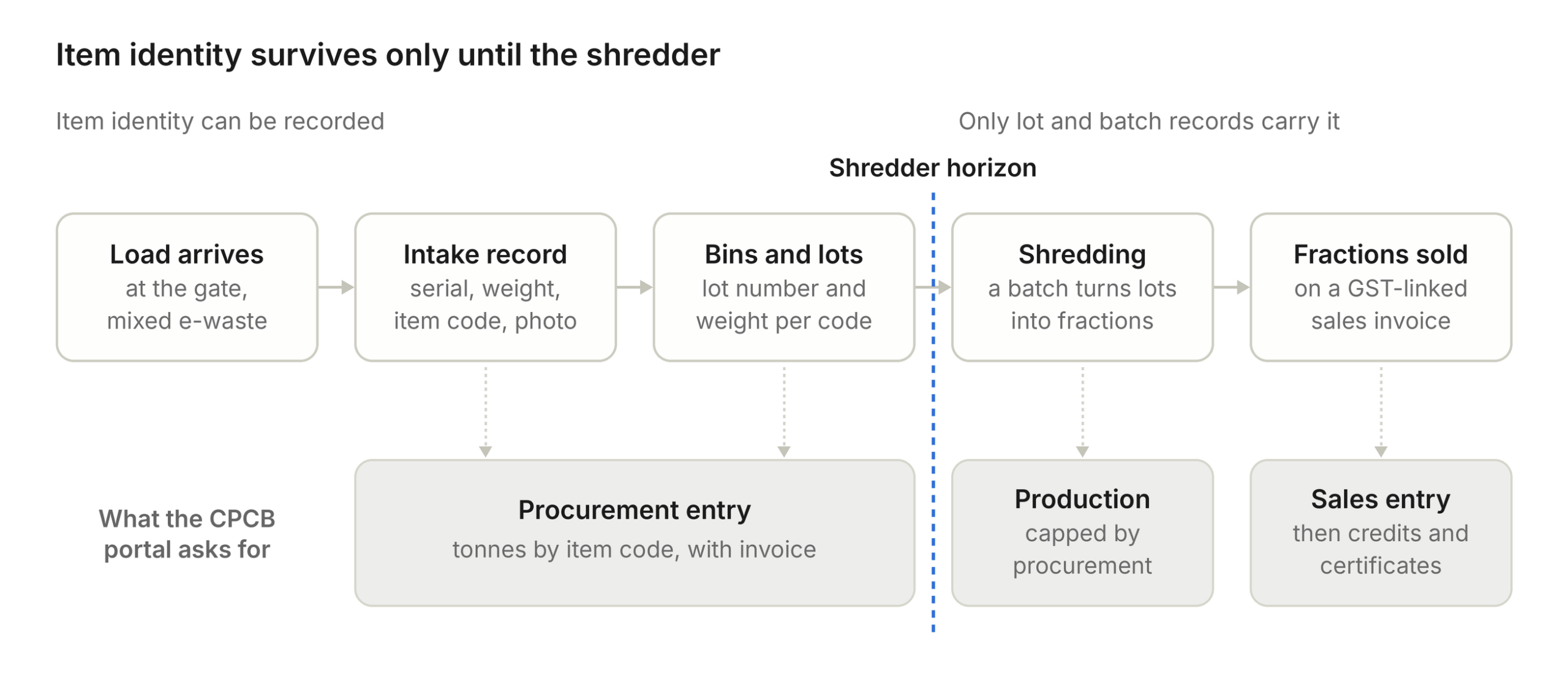
Load to certificate · 5 physical steps, 3 portal entries
Everything left of the dashed line can be recorded per device; everything right of it depends on lot and batch records reaching back across the line.
Serial capture has to work wherever the device happens to be
ITAD operators don’t meet devices in one place. Some are logged at a client’s office before pickup, by a technician holding a phone. Most arrive at an intake bench. In a busy plant, drives and laptops ride a conveyor towards destruction. A capture method that works in only one of those places leaves the other two unrecorded.
Scanflow Capture, our ITAD scanning product, reads serial numbers, labels and barcodes from cameras a site already has. A mobile SDK runs on iOS and Android phones for field collections and intake desks. A server SDK runs fixed cameras over conveyor lines and locks each serial before destruction. The mobile SDK keeps capturing offline at sites with weak connectivity and syncs when the network returns. Each scan is timestamped and tied to the device, operator, location and action. That’s the chain of custody the first check goes looking for.
Per-device capture stops paying at bulk scrap
Some streams don’t justify a serial per unit. Sacks of old phones or mixed consumer appliances are better handled as weighed lots with sampling. A camera weighs nothing, so scales and weighbridges still have to feed every record. We also found no public API or bulk upload on the CPCB e-waste portal, which means someone still keys the figures in. Gate capture changes where those figures come from. We’d serialise anything that carries data or could be resold, and handle the rest as weighed lots.
One question we can’t answer yet is how far India’s new environment auditors will go. The Environment Audit Rules, notified in 2025, let CPCB and state boards send registered auditors to inspect facilities. Whether they’ll accept lot records for ITAD streams, or start asking for the device behind each kilogram, is something the first audit reports will settle.
If an auditor picked one certificate your plant issued last quarter, how long would it take your team to walk it back to the device it came from?