In July, India’s Central Pollution Control Board told every state to start inspecting more than 2,000 recyclers, 309 of them handling electronic waste. The order was confidential. Reuters reported its contents in November.
The procedure that went with it is physical. Inspectors verify the machinery and ask for trial runs of the plant. They compare a plant’s electricity consumption with the tonnes it claims to have processed. A forged or manipulated document counts as a major violation, and the unit is blocked from generating certificates. In Uttar Pradesh the state board named its officers in September and put 33 e-waste recyclers on immediate audit.
Nothing in that procedure, as reported, asks for a serial number. It asks whether the plant is real, whether the machines run, and whether the power bill matches the tonnes. That tells you where the evidence has been thin. A recycler’s declared tonne is a claim entered on a portal, and the portal checks that the arithmetic and the order of entries hold together. It cannot check that the tonne physically arrived. I have come to think of the distance between a declared tonne and a proven one as the evidence gap, and these audits are the first large attempt to measure it.
A certificate is only as good as the entry behind it
Under the E-Waste (Management) Rules 2022, in force since 1 April 2023, producers of electronics must recycle a share of what they sell, and they can meet that obligation only through registered recyclers. The recycler earns an extended producer responsibility (EPR) certificate by proving, on CPCB’s portal, what it procured, what it produced and what it sold. Producers then buy those certificates to meet their annual targets.
The recycler’s side runs in order. Procurement goes in by tonnes and item code, with the purchase invoices. Production follows, as the end products obtained from that e-waste. Credit is generated for four metals: gold, iron, copper and aluminium. Sales go in with GST-linked invoices, and certificates follow. The portal enforces some discipline: entries must be made in sequence, production cannot exceed procurement for an item code, and procurement cannot exceed annual processing capacity.
The stakes are easy to size. At the Rs 22 per kg floor price that applies to general e-waste, 1,000 tonnes of certified recycling is worth about Rs 2.2 crore. Where money moves in proportion to the tonnes declared, the tonnes will be tested.
The portal checks arithmetic, and now the plant gets checked too
Three signals show where scrutiny has been heading. CPCB audits of four plastic recyclers found about 600,000 fake certificates, and the National Green Tribunal took notice in July 2024. That is a different waste stream, but it is the same certificate mechanism.
In July 2025 Newslaundry published an investigation of 41 authorised e-waste plants in four states. It found that 31 either did not exist or appeared to be running ghost operations, and reported that credits had nonetheless been generated for them. Those are the outlet’s findings about specific plants, not a measure of the whole sector.
Then came the audit campaign itself. An independent e-waste expert told Reuters it should weed out non-compliant operators and give genuine recyclers a level field. That matters, because a genuine recycler carries the cost of proving its own numbers while competing with any certificates produced without a working plant.
Where proof exists in a plant, and where it stops
Follow one load through a plant and you can see where proof exists. At the gate, a load of mixed e-waste arrives. At intake, each item can get a record: serial number, weight, item code and a photo. Items are then sorted into bins and lots, and each lot carries a number and a weight per item code. All of that can be recorded.
Then the shredder runs. A batch turns lots into fractions, and the fractions are sold on a GST-linked invoice. After that point only lot and batch records carry identity. The portal’s three entries sit on top of this chain: procurement by tonnes and item code, production capped by procurement, and sales followed by credits and certificates.
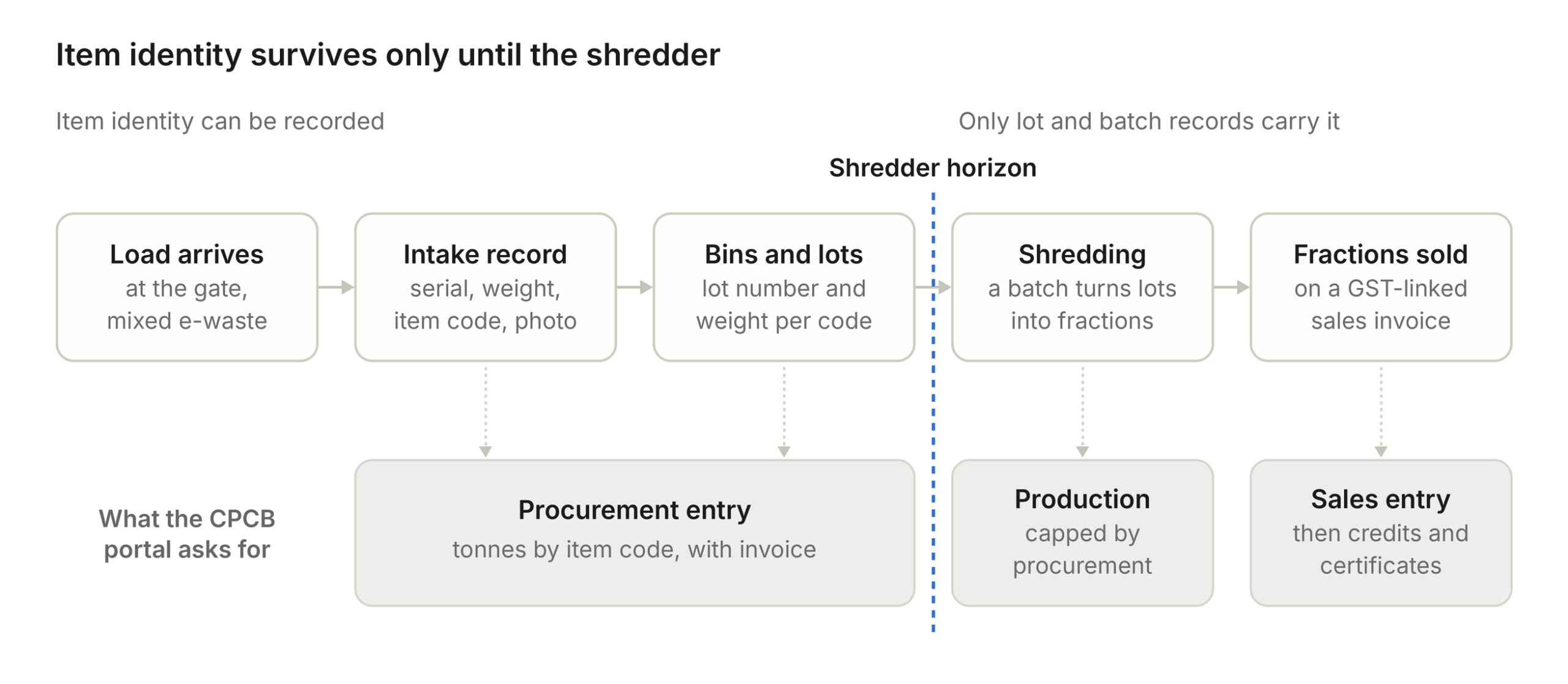
This is why capture has to come before destruction. There is no second chance once a device is shredded. It also means the right level of detail depends on the stream. Laptops, drives, servers and refurbishment candidates justify a full serial record each. Bulk consumer e-waste such as phones and appliances is better served by lot-level capture with statistical sampling, because reading every unit would cost more than it proves.
The audit question reduces to one chain. For every tonne declared: which load did it come from, which lot did it join, which batch consumed it, and which invoice closed it. A recycler who can answer that for any entry has done the part of the audit that paperwork can settle.
Four questions worth asking about your own plant this week
None of these need a vendor, a budget or a meeting. They take an afternoon and show the size of your own gap.
- Pick one procurement entry from last quarter and trace it back to a load, a weighbridge slip and a purchase invoice. Time how long it takes. That duration is your audit-day cost.
- Reconcile intake, production and sales tonnes by item code for one month. Any gap you cannot explain in a sentence is the one an inspector will find.
- Count how many times the same item code or weight is typed into a different system between the gate and the invoice. Each re-key is a chance for a mismatch that nobody notices until it matters.
- Ask what evidence exists for a unit once it has been shredded. If the answer is a shift log written afterwards, that is the reconstruction an inspector will test.
What changes when reading moves to the gate
Scanflow Capture is a set of software kits that embed into the application already running the workflow. At intake it reads serial numbers, labels and barcodes on laptops, drives, servers and loose media. It runs on standard smart devices and works offline, which matters at collection points where connectivity is weak. Each scan is tied to the device, the operator, the location and the time. Linking those scans to bins and lots is the layer the audits care about most, and I come back to it below.
The certificate stays with CPCB. What can be automated is the evidence behind each entry. Realistically that means pre-filling procurement and production entries from scan and weighbridge data, reconciling intake, production and sales as they happen instead of at audit time, and flagging exceptions early: output above input, entries out of sequence, volumes near the capacity limit. Capture does not weigh anything, so scales and plant systems have to feed it.
Three things we are still working out
Whether entries can be pushed to the portal. We have found no public documentation of an API or bulk upload, and CPCB’s guidance describes manual form entry. Until that changes, the most any system can do is prepare validated, reconciled entries and the supporting files for someone to key in.
What happens after the shredder. Capture records identity up to that point. Linking inputs to outputs through lot and batch records needs design work on a plant’s own data, and I would not claim it as solved.
How well reading works on mixed consumer e-waste. Serial numbers on IT assets are one problem. Phones, appliances and lamps have different surfaces and label quality, and we will not quote a figure for that stream until we have measured it.
Audits reward the recycler who can show their work
The audit campaign tests whether a plant is real and whether its claims fit its machines and its power use. Those are physical questions, and they sit on top of a paper chain that is still largely assembled after the fact. The recyclers best placed are the ones whose records exist before the shredder runs, and whose lots can be traced to an invoice.
ITAD firms are already ahead on one part of this. They track serialised, data-bearing assets from intake to disposition because their customers demand it. Extending that discipline to lots, weights and sales invoices is a smaller step than starting from a clipboard, and it is the step I expect the next round of inspections to reward.
Here is a question, if you run a recycling or ITAD operation. Pick last quarter’s largest procurement entry. If an inspector asked for the load, the lot and the invoice behind it today, how long would it take you to produce them? I would like to hear what you find.