Our team spent time in Médecins Sans Frontières warehouses and distribution centres in Kenya. The distribution centres receive large cartons. Staff open them, sort the contents, label them, and repackage them into distributable units sized to what each clinic has actually asked for.
Every one of those steps is a decision about what is inside a box, made by a person looking at it. What the field teams told us was straightforward. They wanted a scan that tells them what is genuinely in the carton. Done well, wastage falls and the right products get packed together. Done badly, a clinic receives something it cannot use, somewhere the next delivery is not soon.
There was a second constraint, and it rules out most software. Much of this work happens where connectivity is intermittent or absent, so anything that needs a live server is useless. The scanner has to run on the device, offline, and reconcile with the server later when a connection returns.
That distribution centre is the sharpest version of a problem that turns up in far more ordinary places: a tyre yard, an IT asset processing floor, a vehicle assembly line. I have come to think of it as the handoff gap. It appears wherever a physical object crosses from one organisation’s system into another’s, which is to say almost everywhere that matters.
The barcode was built for objects a system already owned
In October 1949 Bernard Silver and Norman Woodland filed a patent for a way of encoding product information as a machine-readable pattern. It was granted in 1952 and then sat largely unused for two decades while the scanning hardware and the industry agreements caught up. On 26 June 1974, at a Marsh supermarket in Troy, Ohio, a ten-pack of Wrigley’s Juicy Fruit became the first product scanned at a commercial checkout.
What made that work was the agreement rather than the optics. A barcode functions because a manufacturer decided in advance to apply a code, in a standard format, that trading partners had all agreed to read the same way. Inside that agreement, identification is a solved problem. Outside it, very little has changed in fifty years.
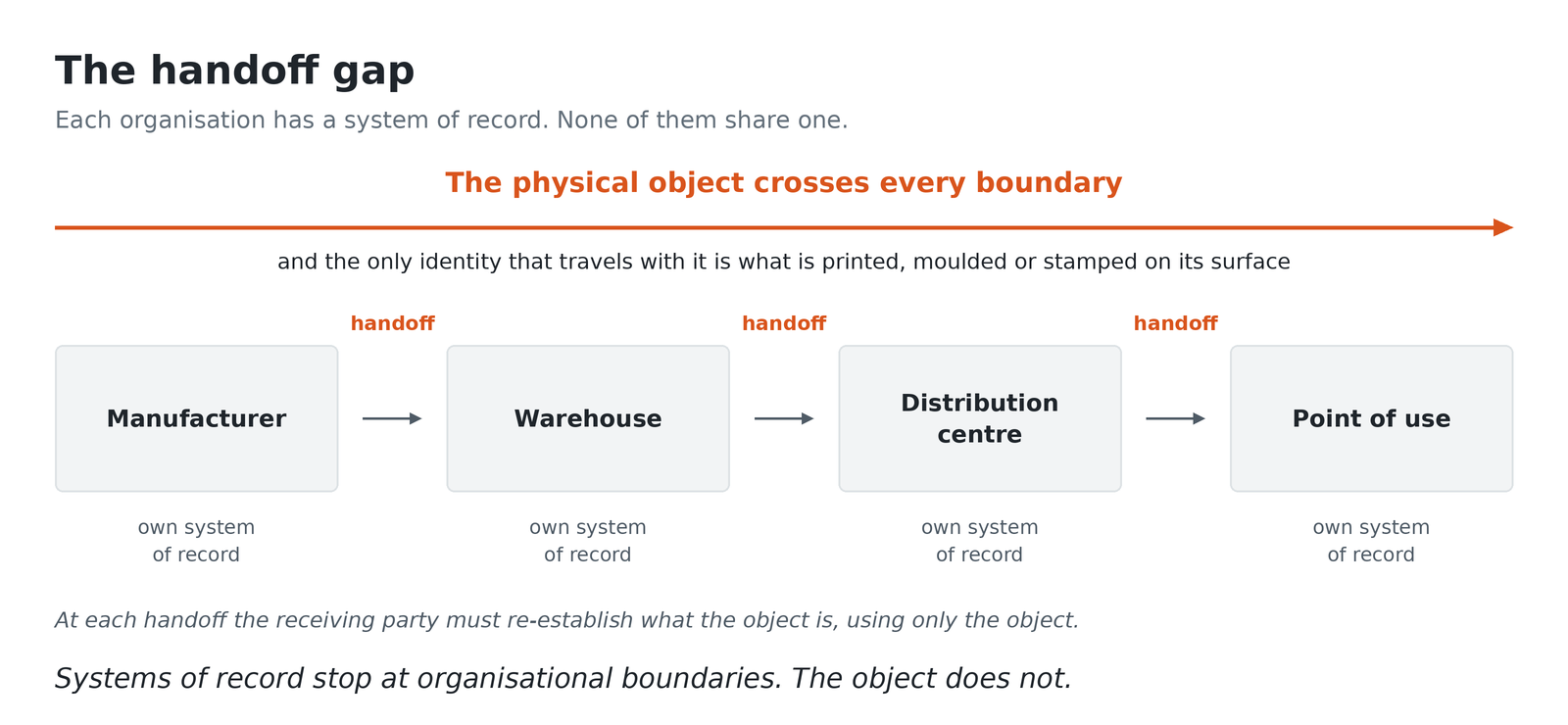
The barcode assumes somebody owned the object at manufacture, wanted it scanned later, and applied a code that survived intact. Now consider the identifiers that carry real consequence in the world. A DOT code moulded into a tyre sidewall, required by United States federal regulation and readable only as raised black-on-black lettering on a curved, dirty surface. A vehicle identification number stamped into steel in a poorly lit bay. An expiry date ink-jetted onto a carton in whatever font and language the market required. A serial number in six-point type under a laptop that has been in service for nine years.
Every one of those was designed for a human eye. They exist to satisfy a regulator, to support a recall, or to let a technician identify a part. Nobody designing them was thinking about a scanner. And they are precisely the identifiers on which safety, legal compliance and liability now depend.
Four industries living inside the same problem
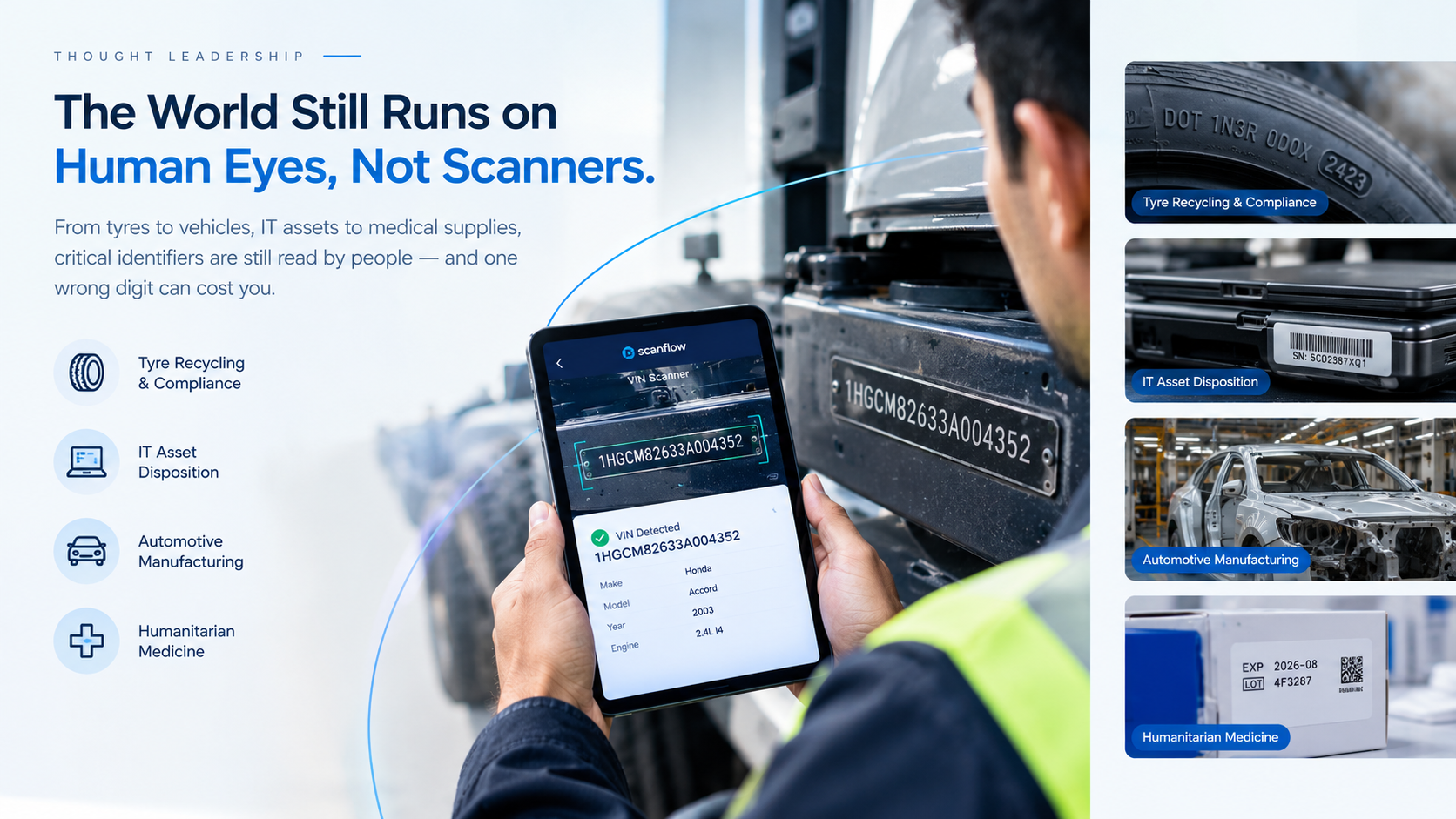
Scanflow Capture reads identifiers off physical objects using AI vision that runs on the device itself, whether that device is a phone, a tablet or a fixed station. The same problem shows up in four very different places.
Tyre recycling and compliance. A tyre at end of life is either a candidate for retreading and resale or a candidate for destruction, and the answer depends on the DOT code moulded into its sidewall, which carries the plant, the size and the week of manufacture. Recyclers processing thousands of units a day cannot have someone kneel and squint at each one, so sampling replaces reading and compliance becomes an assertion rather than a record.
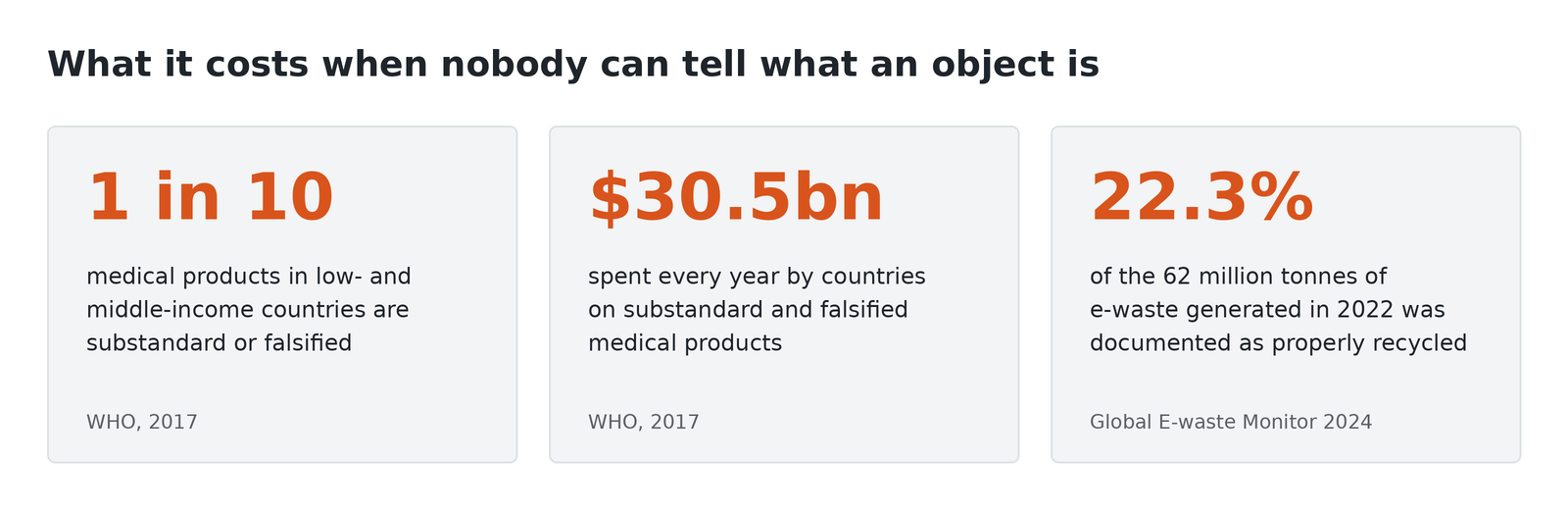
IT asset disposition. When an enterprise retires hardware, the processor must record what each asset was, by serial number, to certify data destruction and prove chain of custody. The Global E-waste Monitor found that of 62 million tonnes of electronic waste generated in 2022, only 22.3% was documented as properly collected and recycled. Material that cannot be identified cannot be counted.
Automotive manufacturing. VINs and component labels are captured through the build and fed into the manufacturing execution system, tying the physical vehicle to its digital build record at each station. Get this wrong and the traceability a recall depends on has a hole in it, discovered years later when it is most expensive.
Humanitarian medicine. Back to Kenya. Across MSF distribution, label data is captured at the warehouse, at the distribution centre and at the point of delivery, checking that product, strength and expiry match what the patient is meant to receive. The World Health Organization estimates that one in ten medical products in low- and middle-income countries is substandard or falsified, which is the reason a carton’s contents cannot simply be taken on trust.
Four questions worth asking about your own chain this week
These need no budget and no vendor. They will tell you the size of your own handoff gap.
- Pick one handoff in your chain and ask what carries identity across it. If the answer is a paper form, a photograph in a chat group, or somebody’s memory, you have found it.
- Count how many times the same physical object is typed into a different system between arrival and disposition. Each re-key is a chance for a transposed digit that nobody notices until it matters.
- Take ten of your most awkward objects, the worn ones, the curved ones, the badly lit ones, and try to read them with whatever your team uses today. Time it, and count the errors.
- Ask what happens today when a code cannot be read. If somebody types it in, ask whether anyone has ever measured the typo rate.
What changed is that reading moved onto the device
Optical character recognition is old technology. What was missing for most of its life was the ability to read text never presented cleanly: low contrast, curved surfaces, raised lettering with no colour difference, glare, wear, and a hundred typographic variations across markets. Trained models handle that variation in a way rule-based OCR never could. You show the system examples of the real thing in real conditions rather than describing what it should look like, so a DOT code half-obscured by road grime becomes one more training example rather than an edge case to program around.
The second change is the one the Kenyan distribution centres actually needed. Inference now runs on the device in someone’s hand. No round trip to a server, no dependency on a network that may not exist, no photograph of a drug carton leaving the country it was scanned in. The device records what it read and reconciles with the server whenever a connection comes back. For a field team that is the difference between a working tool and a demonstration.
Scanflow Capture is the reading layer for objects that arrive from outside
Capture is a set of software kits that embed into whatever application already runs the workflow: a warehouse app, an inspection app, a field distribution app. It reads barcodes and QR codes where they exist, and where they do not, it reads what is actually on the object. That includes tyre sidewalls and DOT codes, vehicle identification numbers, serial and part numbers, handwritten entries, labels and expiry dates, and batch capture of several codes in one frame.
It runs on standard smart devices rather than dedicated hardware, works offline, and feeds into the systems already holding the record. The gain is less about speed than about identity becoming a recorded fact at the moment of handoff, attached to an image, rather than an assumption carried forward from whoever handed the object over.
The handoff gap, in one line. Your system of record is authoritative right up to the moment the object leaves your building. After that, the only thing still carrying its identity is its surface.
One thing we are still working out
A scanner that fails to read is an inconvenience. A scanner that reads confidently and wrongly is something else, and in pharmaceutical distribution it is dangerous. The hard question in this field is not accuracy in the aggregate. It is knowing, in the moment, when to refuse to answer.
Set the confidence threshold too low and the system passes misreads a human would have caught. Set it too high and it rejects so much that field teams stop using it and go back to a pen. We tune this per deployment, with the customer, against their own tolerance for the two kinds of error, and I do not think there is a general answer to it yet. Anyone selling you a single accuracy number for a task like this is describing a laboratory rather than a distribution point.
Fifty years of scanning the easy things
The barcode is one of the most successful pieces of infrastructure ever built, and it succeeded by narrowing the problem. It works because everybody agreed in advance, and that agreement covers the objects a company makes and sells inside a supply chain it controls. It does not cover a tyre coming back at end of life, a laptop retired after nine years, or a carton that has crossed four organisations and two borders to reach a room with no network. Those are the objects where getting identity wrong carries a real cost, and they are exactly the ones nobody prepared for a scanner.
Reading what is already there, rather than requiring the world to label itself in advance, has only recently become possible. It is a quieter capability than robots on a production line. In a distribution centre in Kenya, with a carton open on the table and a clinic waiting, it decides whether the right medicine reaches the right person.
Here is a question, if you run operations. Think about the last time an object in your chain turned out not to be what your system said it was. Where did the two stories separate, and could anyone have caught it at the handoff? I would be interested to hear what you find.